 AI image
The Republic of Ireland is a member of the European Union, so goods from Poland travel there within the single market, with no clearance and no customs border. The key decision is the route: a direct ferry from the continent to Ireland, or the faster landbridge across Great Britain, which nonetheless introduces transit through a territory outside the EU. OTSL matches the option to the type of cargo and the deadline.
Two routes to Ireland
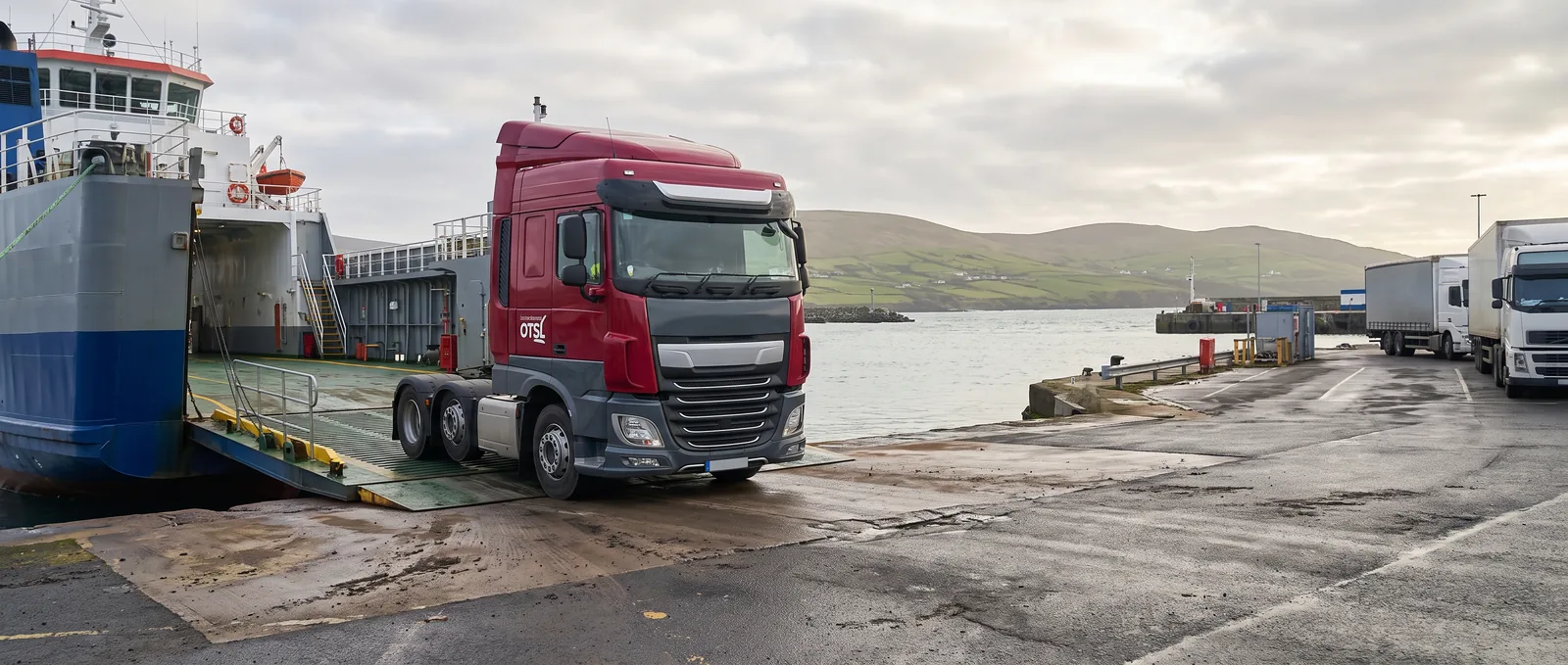
- A direct ferry: sailings from continental ports, for example in France, Belgium and the Netherlands, to Dublin, Rosslare or Cork. The goods stay within the EU throughout, with no customs formalities.
- The landbridge across the UK: a run through Great Britain with two crossings. It can be faster, but it requires transit through a territory outside the EU, and therefore a transit document and the planning of crossings.
When does each option fit?
The direct ferry simplifies the formalities and can be calmer for sensitive cargo, while the landbridge can shorten the time when the deadline counts. The difference between a full truck and a part load on these routes is explained in the text on FTL or LTL. If your delivery combines Ireland with the British market, it is worth setting in advance who is responsible for clearance on the UK side, which is put in order by the Incoterms rules.
Carrying goods to Ireland? Describe them in the contact form and we will propose the route and the crossing. The Irish destination in a wider context is covered by the guide to the islands of Britain and Ireland, and we discuss Northern Ireland separately.
How do transit times and load weight determine your route selection to Ireland?
When you plan to dispatch a standard trailer with a payload capacity of up to 24000 kg and 33 pallets, direct ferry crossings from French ports take between 20 and 24 hours at sea. During this voyage, the driver completes the mandatory rest period, allowing driving to resume immediately upon disembarkation in Dublin or Rosslare. Choosing the UK landbridge can reduce total transit time by roughly 15%, but it requires issuing a T2 transit accompanying document (TAD) and registering entries in Goods Vehicle Movement Service (GVMS).
Your operational planning must account for cargo height: trailers with an internal height exceeding 2.7 metres often require specific space booking on ferry decks. Furthermore, moving goods under the T2 procedure through the UK requires a valid transit guarantee to cover potential customs debt while crossing non-EU territory.
Note that the landbridge speed advantage does not apply when delays at Eurotunnel or Dover terminals exceed 6 hours, or when severe weather on the Irish Sea causes ferry sailings to be suspended for more than 12 hours. Under these operational or weather disruptions, total transit time via the UK exceeds that of the direct continental sea route.
Step by step
- Selecting the route. Decide whether to use a direct ferry from the continent or transit across Great Britain.
- Preparing the cargo. Secure the goods and issue standard commercial documents required within the EU.
- Arranging ferry bookings. Reserve a slot on a direct ferry or prepare transit paperwork for the landbridge route.
- Executing the transport. Monitor the shipment from the loading site in Poland to the destination in Ireland.
- Unloading the delivery. Hand over the goods to the recipient without customs clearance.
Definitions
- EU (European Union) single market: An area without internal borders and customs formalities between member states.
- Direct ferry: A sea connection linking continental Europe directly with Irish ports, bypassing third countries.
- Landbridge: A transport route involving transit across the territory of Great Britain.
- Customs transit: A procedure allowing goods to pass through a third country without paying duties or taxes.
The OTSL role
OTSL matches the transit option to your cargo requirements and delivery schedule, assisting with direct ferry passages or transit formalities. Explore our ferry booking services or read our guide on express vans and time-critical transport in Europe.