 AI image
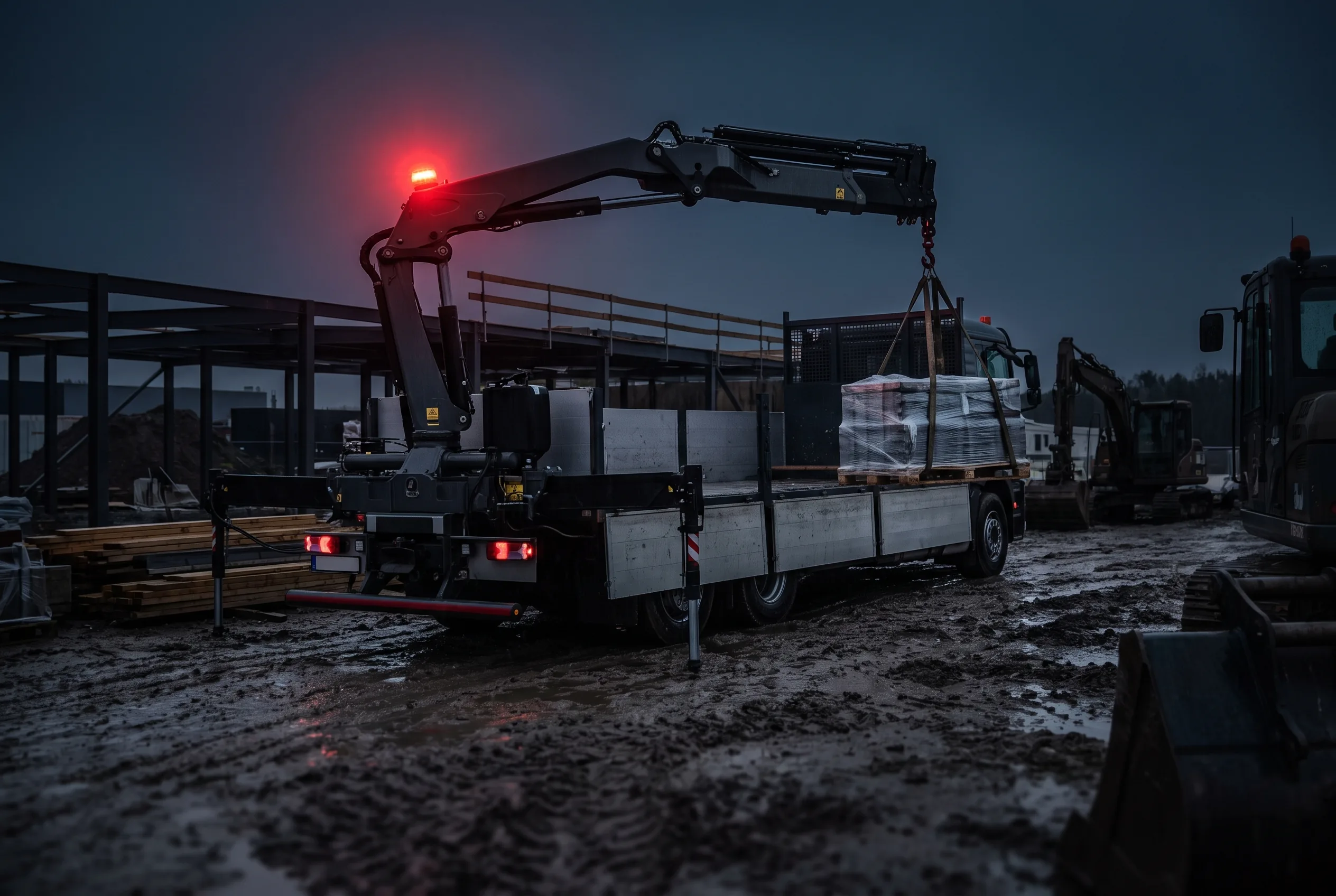
A construction site delivery with crane unloading is planned around the place, not the truck. Agree a time window and notification with the site manager, check the access road and the bearing capacity of the ground, mark a drop zone within the crane reach and make sure a decision-maker is on site. Then the truck unloads in tens of minutes instead of blocking the site and the crew.
The Polish-language version of this article is the reference one. This is an informational translation.
Notification and the time window on site
A construction site is not a warehouse: there is no fixed ramp and no all-day goods reception. Agree a specific unloading window with the site manager and confirm it the day before. Register the truck and the driver in advance if the site requires passes, and provide the phone number of the person who will point out the unloading spot. Without this the driver loses the first half hour looking for anyone with authority, and the window shrinks.
Access and ground: what to check before the truck arrives
- Whether the access road can take a loaded truck: entries, curves, the gate, tonnage limits
- Whether the ground at the unloading spot is hardened and will bear the crane outriggers
- Whether power lines or scaffolding elements hang over the working area
- Whether there are excavations nearby that rule out setting up the outriggers
- Whether the truck can turn around or drive out forwards after unloading
The drop zone and the crane reach
Mark the drop zone as close as possible to where the material will be built in, but within the crane reach. Give the carrier the weight of the heaviest package and the distance over which it must be placed: these two numbers decide the choice of vehicle. Material placed straight in the right spot saves double handling, which on a construction site is usually done by hand and costs more than the transport itself.
Coordination with the assembly crew
The most expensive scenario is fitters waiting for material or material lying around the site for weeks. For staged assembly, for example steel structures, it pays to split deliveries into batches following the works schedule and to set the unloading order so that the elements needed first lie on top. Report long and non-standard pieces in advance: they need a different vehicle and different securing, which we also cover under out-of-gauge loads.
How do we organise it?
At OTSL we run construction site deliveries: from notification and selecting a crane truck to deliveries in step with the crew schedule, including on the hour. Describe the material, the place and the deadline in the contact form and we will propose a delivery plan.
How do you calculate the working radius and actual capacity of a loader crane?
The nominal capacity stated in vehicle documents applies only when the crane boom is fully retracted. As the reach increases, the lifting capacity drops significantly. For example, a loader crane rated for 4000 kg at a 2-metre reach will only lift 800 kg at a distance of 10 metres, which is just 20% of its maximum capacity. If you need to position a pallet weighing 1200 kg at a reach of 12 metres, a standard loader crane mounted on a 26-tonne GVW rigid vehicle will not be able to set it down safely.
Before booking freight transport, analyse the weight of individual load units and plan their placement on site:
- Ensure pallets weighing over 1000 kg are offloaded close to the side of the vehicle (within 4 metres of the chassis axis).
- Allow sufficient offloading time: standard crane operation for 15 pallets takes roughly 2 hours, assuming stable ground conditions.
- Confirm site access and pre-booking notification at least 24 hours prior to the arrival of the vehicle.
These reach limits and payload capacity rules do not apply when heavy all-terrain mobile cranes or telehandlers are provided on site. In those cases, the lifting parameters of the external equipment determine the maximum payload weight and drop radius, rather than the delivery truck hydraulics.
Step by step
- Agree terms with the site manager. Confirm the unloading window and submit driver details for advance notification.
- Assess the access route. Check weight limits, ground bearing capacity, and entrance gate dimensions.
- Mark the drop zone. Prepare a stable area within crane outreach and secure the surroundings.
- Confirm decision-maker presence. Ensure an authorised representative is on site upon arrival to sign off the delivery.
- Execute unloading efficiently. Unload materials safely and clear the space for subsequent site deliveries.
Definitions
- HDS (Hydraulic Truck Crane): A crane fitted on a lorry, used for self-unloading and loading of goods.
- Notification: Advance registration of delivery details and arrival time with the site manager.
- Time window: A designated period within which the vehicle is permitted to enter the site and unload.
- Drop zone: A designated and secured area on the construction site within the crane's working reach.
- Crane outreach: The maximum operating distance of the crane boom, which directly dictates the lifting capacity.
When does this rule not apply?
This rule does not apply if the construction site is equipped with its own stationary crane or forklift with operators on site, where a truck-mounted crane is not required for unloading.
The OTSL role
OTSL organises freight transport and coordinates site deliveries across borders. Learn more about our road transport services and read our guide on project cargo site logistics.