 AI image
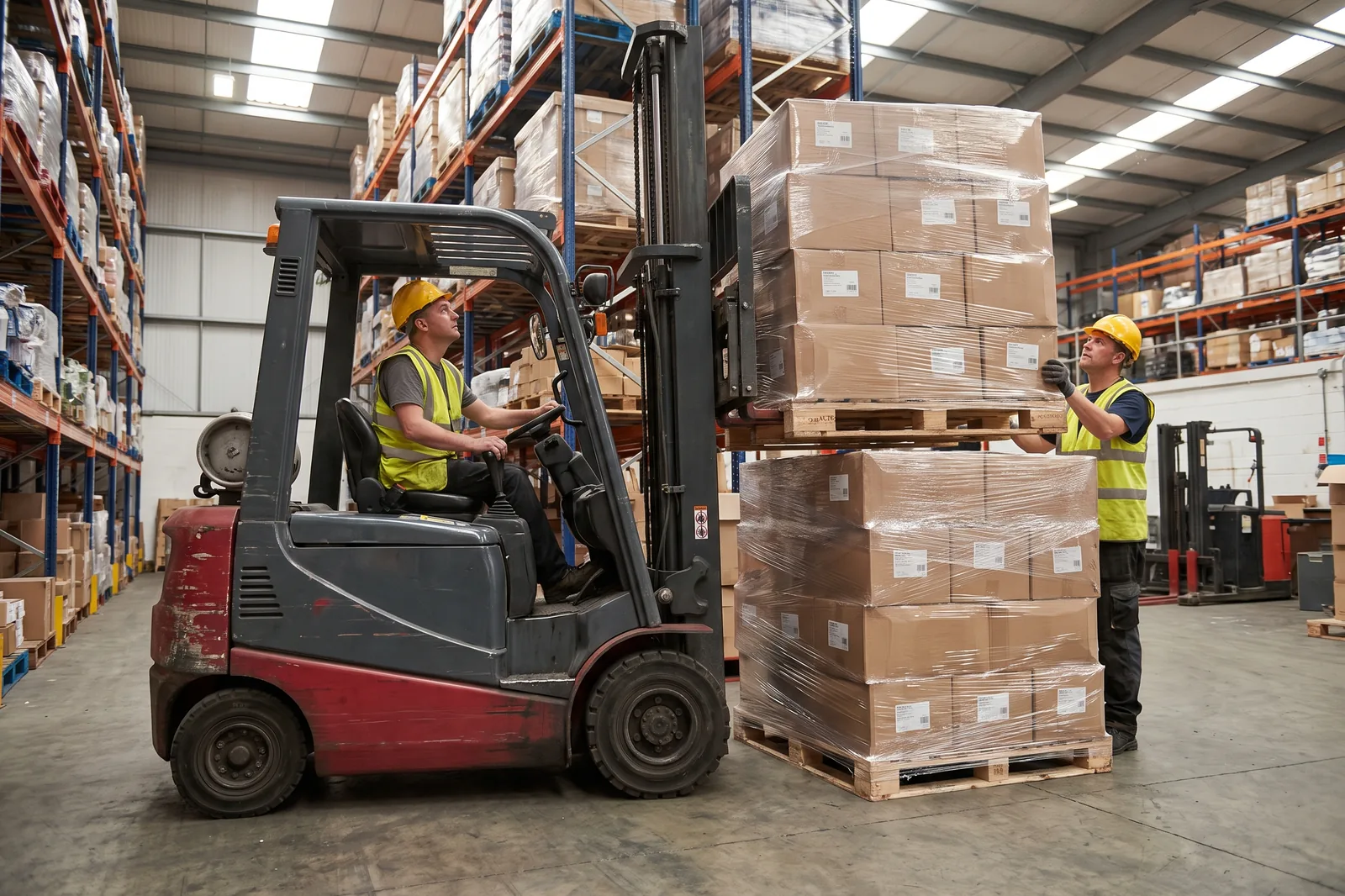
Pallet stacking (double-stacking) is placing one pallet on top of another to save warehouse floor space and room in a trailer. It is only safe when the lower load is stackable, meaning it will bear the weight of the top pallet without crushing. In our Milton Keynes warehouse we assess this before every stack and restack mixed loads.
The Polish-language version of this article is the reference one. This is an informational translation.
Why stack pallets at all
The reason is simple: space costs money. Doubling a layer of pallets can fit a load into one trailer instead of two, or onto half the warehouse floor. That is a real saving on freight and storage. The catch is that a badly stacked pallet turns the saving into a loss: crushed goods, a leaning column and a refused delivery at the consignee. So we stack with judgement, not by force.
What decides safe height and weight
| Factor | Why it matters |
|---|---|
| Strength of the lower load | the top pallet must not crush the lower layer of cartons or goods |
| Weight distribution | a heavier pallet on top overloads and destabilises the column |
| Quality and condition of the packaging | damp or damaged carton loses its load-bearing strength |
| Stability (wrapping, strapping) | a loose pallet spreads out under load |
| Trailer or rack height | a physical limit plus clearance for safe forklift handling |
Stackable or non-stackable: how we assess it
The rule is simple: we only stack when the lower load will clearly bear the upper one. We check the packaging type, the condition of the carton, how uniform the pallet is, and whether the top pallet is lighter than the bottom one. A load that is fragile, in soft packaging, with an uneven top or with protruding parts we treat as non-stackable and cover it with nothing. Where needed, we insert rigid layer boards that spread the pressure of the upper pallet across the whole surface of the lower one, rather than pressing on single cartons.
Restacking: more space without the risk
Trailers and pallets often arrive arranged sub-optimally: heavy on light, tall next to short, mixed heights. Restacking is reordering the layers so the load takes less room and travels stably: heavy at the bottom, uniform columns, rigid on rigid. We do it in the warehouse on receipt or during consolidation, often together with straightening and re-palletising, which we describe in the article on damaged pallet repair and rebuilding.
HSE rules: this is not only about space
Stacking loads is also about workplace safety. The British Health and Safety Executive (HSE) points out that badly stacked or unstable loads are a crushing risk for warehouse staff, and that racking and stacks must be stable and not overloaded. So the top layer must not exceed the load-bearing capacity of the lower one, and the stack height must leave a margin for safe forklift handling. We stack in line with these rules, because a collapsed column of pallets is a danger to people, not only to goods. It also connects to manual handling: awkward, heavy pallets moved by hand are a recognised source of injury, which is why we mechanise the handling where the weight demands it.
Where do we do it?
We carry out stacking, double-stacking and restacking in our Milton Keynes warehouse between London and Birmingham, within our warehousing and cargo handling services. It is one of the value-added services we describe around the value-added services of the Milton Keynes warehouse. Thanks to this the same trailer carries more, and the consignee receives the load intact.
Step by step
- Inspect the cargo. Check whether the top cartons of the lower pallet can support additional weight.
- Calculate weight and height. Verify the combined weight and total height of both pallets against trailer limits.
- Prepare the base. Ensure the surface of the bottom pallet is even and flat.
- Position the top pallet. Place the second pallet squarely on top of the lower load without overhang.
- Secure the stack. Wrap or strap the double-stacked unit to prevent any movement during transit.
Definitions
- Double-stacking: Placing one pallet directly on top of another to save warehouse space and vehicle room.
- Stackable load: Freight whose structure and packaging are strong enough to safely support a second pallet placed on top.
- Non-stackable load: Goods that cannot carry an upper pallet without risk of crushing or leaning.
- Restacking: The process of unloading and rebuilding pallet layers to ensure safety and stability.
When does this rule not apply?
This rule does not apply to irregularly shaped goods or damaged packaging that cannot form a flat, load-bearing surface for a second pallet.
The OTSL role
At our Milton Keynes facility, we inspect each load prior to dispatch and handle groupage (LTL) services. If a double-stacked load shifts or tilts in transit, our team steps in with practical solutions like rebuilding a collapsed double-stacked load of canned vegetables to restore safe transport conditions.
Sources
Want to fit more pallets into a trailer or onto the same warehouse floor without risking crushed goods? Describe the load in the contact form and we will assess what is stackable, stack it safely and restack the rest.