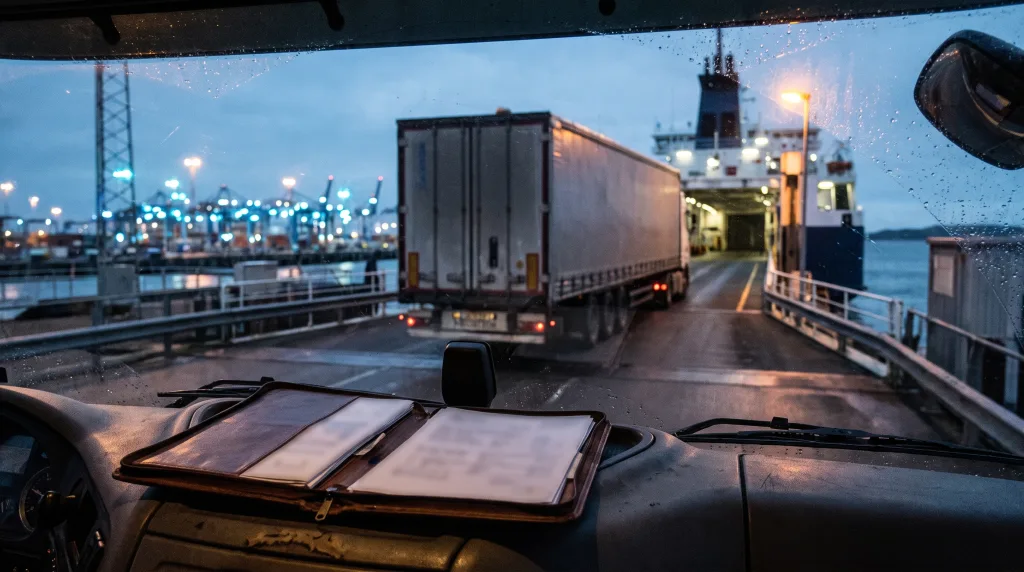
 AI image
Norway belongs to the EEA but not to the EU customs union, so every transport of goods crosses a customs border. The standard path: an export declaration in the EU, T1 transit to Norway, digital submission of data in Digitoll and an import declaration in the TVINN system. Businesses registered for VAT in Norway settle import VAT in their VAT return, not at the border.
The Polish-language version of this article is the reference one. This is an informational translation.
Step 1: commercial documents and proof of origin
The basis is the commercial invoice, a specification or packing list and the CMR consignment note. Then comes the origin of the goods: the EEA agreement removes duties on most industrial goods originating in the EU, but only on condition of a proof of preferential origin. According to Norwegian Customs (Tolletaten) the most common forms are the EUR.1 movement certificate, certified by the customs authority of the exporting country, or an origin declaration placed on the invoice by the exporter, available to authorised exporters or for consignments up to the value limit of the given agreement. Without a proof of origin, duty is charged at the general rates, and food and agricultural goods follow separate rules regardless of origin.
Step 2: the export declaration in the EU
Goods leaving the EU need an export declaration (EX) in the country of export. This produces the EAD with an MRN number that accompanies the consignment to the border. The exit of the goods from the EU must be confirmed in the system, because among other things the 0% VAT rate on export at the seller depends on it.
Step 3: T1 transit to Norway
Norway is a party to the Convention on a common transit procedure, so the goods travel across the borders under a T1 procedure opened in the NCTS system. The transit accompanying document (TAD) travels with the vehicle, and the procedure is closed in Norway. Thanks to this, duty and taxes are not payable along the way, only at the place of import clearance.
Step 4: Digitoll, data digitally before the border
Tolletaten is moving to digital border handling under the name Digitoll: data on the means of transport, the arrival time and the transported goods reach the system before the border crossing or at the latest at that moment. When the data is complete and no control is needed, the goods can be released automatically at the border crossing. Under the revised Tolletaten timetable the digital notification and information obligation becomes strictly binding from 15 September 2026, and from 1 March 2027 the customs declaration must be lodged at the latest at the border crossing, ending the previous practice of clearance after entry (direktekjoring). In practice it pays to work in the target model already: the import declaration can be sent to the TVINN system up to 5 days before the goods arrive.
Step 5: the import declaration and VAT
Import clearance takes place in the Norwegian TVINN system, usually through a Norwegian customs agent. VAT works differently than in classic imports: according to Skatteetaten (the Norwegian Tax Administration) businesses registered in the Norwegian VAT register do not pay the tax at the border, they calculate import VAT themselves and report it in the periodic VAT return, based on the value of the consignment plus duty and charges. Non-registered entities settle VAT at clearance. Distance sales to consumers are handled by the separate VOEC scheme, which we describe in the article on clearance and VOEC.
The most common stumbles
- No proof of origin: goods that could have entered duty free get the general rate
- An unclosed T1 transit: the risk of a demand to pay the customs debt despite delivered goods
- Data not submitted digitally before the border: the truck waits at the crossing until the paperwork catches up
- Confusing VOEC with B2B imports: these are two different VAT settlement modes
How is import VAT settled when entering Norway?
Businesses registered for VAT in Norway account for import VAT directly within their regular tax return rather than paying it at the border crossing point.
Step by step
- Document preparation. Gather the commercial invoice, packing list and CMR consignment note.
- EU export declaration. File the export declaration in the EU to generate the export accompanying document.
- T1 transit issue. Raise a T1 transit document to cover the movement of goods to Norway.
- Digitoll submission. Submit transport details digitally to the Norwegian border system prior to crossing.
- TVINN import clearance. Discharge the T1 document and complete the import declaration in the Norwegian TVINN system.
Definitions
- EEA (European Economic Area): A single market area covering EU member states alongside Norway, Iceland and Liechtenstein.
- T1 (T1 Transit Document): A customs procedure allowing non-union goods to move between customs offices without immediate payment of duties and taxes.
- Digitoll: The Norwegian digital system for submitting transport and customs data prior to border arrival.
- TVINN: The automated customs clearance system used for import and export declarations in Norway.
- CMR (International Consignment Note): A standardized document confirming the contract for international carriage of goods by road.
The OTSL role
Organising cargo movements requires strict compliance with customs workflows. You can rely on our Road transport (FTL) service, and read our guide on avoiding operational delays at Skopana odprawa, a ekipa stoi i czeka.
Sources
- Tolletaten (toll.no): Digitoll
- Tolletaten (toll.no): revised implementation plan for Digitoll
- Tolletaten (toll.no): two types of proof of origin
- Skatteetaten: calculating and reporting VAT on goods imports
We have organised transport and clearance on this lane for years. See transport to Norway, customs clearance and the article on deliveries to Norway outside the EU, or describe the consignment in the contact form.