 AI image
Transport to Norway requires customs clearance, because despite EEA membership Norway is outside the EU customs union. For sales of goods to consumers, VOEC registration concerning VAT on lower-value goods may matter. At OTSL we organise transport and customs to Norway as part of our European coverage.
What should you prepare before shipping?
- A commercial invoice with the description and value of the goods.
- The data for the EU export declaration.
- Whether the sale is to a business or a consumer.
- The consignee data and the import clearance method in Norway.
Why the sales model matters
A B2B delivery looks different from a sale to a consumer, where VOEC may come in. So we ask about it up front to pick the right clearance path and avoid surprises on import. Above the NOK 3,000 per-item threshold, and for some goods excluded from the scheme, the shipment is cleared under the standard rules. We confirm the exact VOEC requirements for your goods individually, because they depend on their value and type.
How do we work?
We run transport and customs to Norway as part of European coverage, with one responsible contact. We settle the documents in advance and say plainly what to prepare.
See transport to Norway, customs clearance and deliveries to Norway outside the EU.
How does border clearance work and what influences transit time?
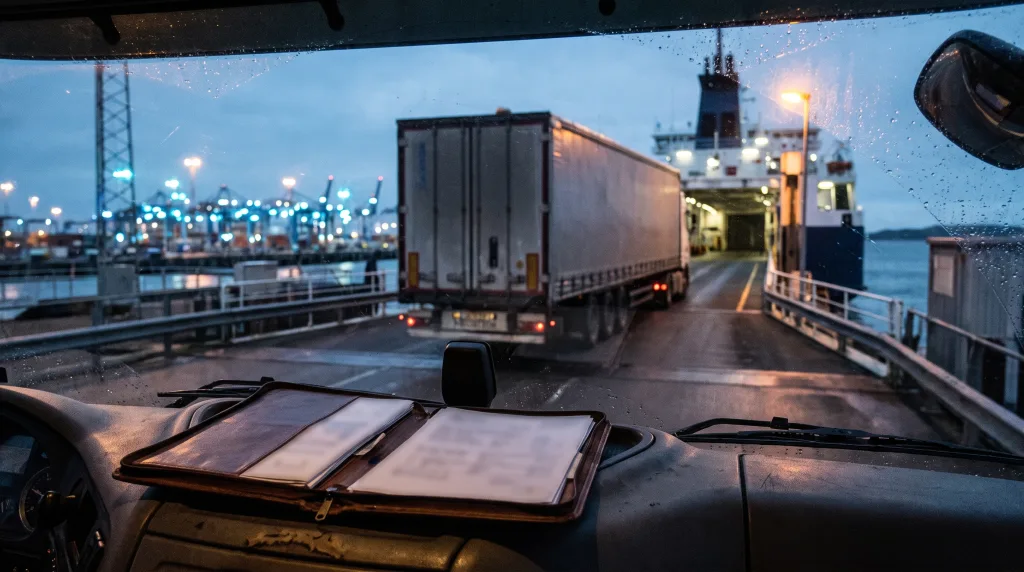
Before a 13.6 metre trailer with a maximum payload of 24000 kg boards a ferry or reaches the Svinesund border crossing, a customs broker must open a T1 transit procedure or submit a final import declaration. Standard border clearance takes between 2 and 4 hours, provided that the Movement Reference Number (MRN) for the export declaration is fully active in the NCTS system before the driver arrives. When a full load of 33 pallets contains consolidated goods from multiple shippers, this duration increases because customs officials verify the HS commodity codes for each consignment separately.
To qualify for a 0% customs duty rate when importing into Norway under the EEA Agreement, you must prove the preferential origin of the goods. For consignments valued over 6000 euros, an EUR.1 movement certificate or an authorised exporter declaration on the commercial invoice is mandatory. Without this documentation, Norwegian Customs will apply the full statutory duty rate, regardless of whether the goods were manufactured within the UK or EU.
- Vehicle holds at the border typically occur due to three main factors:
- Failure to release the IE599 export confirmation in the country of dispatch prior to border arrival.
- Gross weight discrepancies exceeding 5% compared to the declared T1 transit guarantee details.
- Missing Norwegian Organisation Number (Org.nr) of the importer on the CMR (the Convention on the contract for international carriage of goods by road) consignment note.
Please note that these simplified transit procedures and preferential zero-duty rules DO NOT apply to excise goods, alcohol, tobacco products, or agricultural commodities subject to Norwegian import quotas. Such shipments require full standard customs clearance at the primary customs post upon entry into Norway and valid import licences prior to dispatch.
Step by step
- Invoice preparation. Prepare a commercial invoice with a detailed description and value of the goods.
- Customer status check. Determine whether you are selling goods to a business or directly to a consumer.
- VOEC scheme verification. Check if the consumer sale requires registration and settlement under the Norwegian VOEC scheme.
- EU export declaration. Gather all required data for the export declaration when leaving the European Union.
- Norwegian import clearance. Confirm consignee details and select the appropriate import clearance method in Norway.
Definitions
- VOEC (VAT On E-Commerce): A Norwegian scheme for collecting VAT on lower-value goods sold directly to consumers.
- EEA (European Economic Area): An economic zone including Norway, which nevertheless remains outside the EU customs union.
- Skatteetaten: The Norwegian Tax Administration managing VOEC registrations and tax collection.
- VAT (Value Added Tax): A consumption tax applied to sales of goods or collected during import clearance.
When does this rule not apply?
The simplified VOEC scheme does not apply to business-to-business sales or to shipments containing goods excluded from this procedure.
The OTSL role
At OTSL, we arrange transport and help manage customs formalities for shipments moving to Norway. You can explore our road transport (FTL) services or read our article on express vans and time-critical transport to plan your logistics effectively.