 AI image
Reverse logistics from the UK is the handling of returned goods after they leave the customer: receiving, sorting, grading by condition, and deciding whether each item goes back into sale, into refurbishment or into disposal. In our Milton Keynes warehouse we receive and grade UK returns, put sellable stock back into circulation and consolidate the rest back to the EU, with the customs side handled.
Why UK returns need a base in the UK
An e-commerce or retail operation selling into the United Kingdom generates returns in the United Kingdom. Without a local base, every return either sits at a random address or crosses the Channel one parcel at a time, which is slow and expensive and delays any refund or resale. A UK receiving point lets returns land in one place, get graded fast, and either re-enter UK sale immediately or wait to travel back to the EU as a single consolidated load. The returns and VAT side of UK e-commerce is set out in our article on e-commerce transport to the UK, returns and the VAT threshold.
What we do with a return
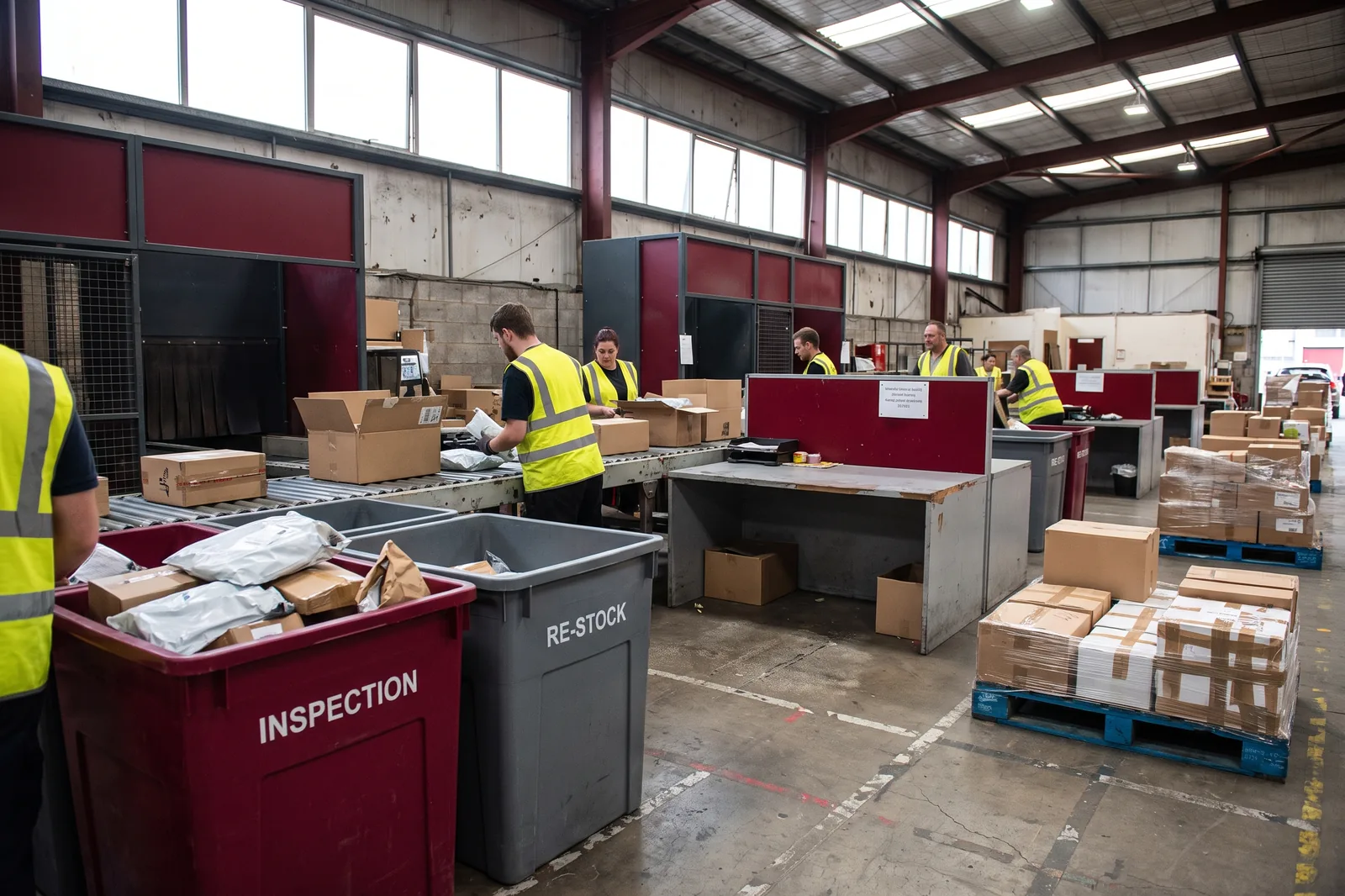
| Step | What happens |
|---|---|
| Receipt | book in the return, record identity and reason |
| Sorting | separate by SKU, customer or destination |
| Condition check | inspect for damage, completeness, hygiene |
| Grading | resellable, B-grade, refurbish or dispose |
| Return to stock | re-label and put sellable items back into sale |
| Consolidation | batch EU-bound returns into one load |
Putting stock back into circulation
The point of grading is to recover value. Items that arrive back as new go straight back into sellable stock; items that need fresh packaging or a new label are re-labelled, which ties into our article on re-labelling and GS1 barcodes for UK retail. Where a return is breached or its packaging is spoiled but the product is sound, we repack it, as covered in our article on repacking in the UK warehouse. Only what genuinely cannot be recovered is routed for disposal, and we record what and why.
Consolidating returns back to the EU
Rather than send returns back to the EU one parcel at a time, we hold and batch them, then move a single consolidated load back across the Channel. One consolidated movement is cheaper per unit and simpler to clear than a stream of individual returns, and it keeps the reverse flow predictable.
The customs side of a UK return
Goods returning from the United Kingdom to the EU are an import into the EU and need clearing like any other import, unless a relief applies. Where goods are being re-imported in an unaltered state, Returned Goods Relief may allow relief from import duty and VAT if the conditions are met, which is a matter for the customs declaration, not an automatic exemption. We do not decide your customs treatment; we flag it and work with the clearance so the return does not stall at the border. The full customs picture is set out in our article on returning goods from the UK to Poland and how customs clearance works. For low-value consignments, the UK's 135 GBP threshold changes how VAT is handled at import, which the e-commerce article above covers.
Why the UK and not one parcel at a time
Handling returns in the destination market recovers value fast and keeps the reverse flow under control. Returns land at the warehouse, get graded within days, and sellable stock is earning again while the rest waits to travel back as one clean load. Letting returns trickle back individually loses the resale window, multiplies the customs work and buries the value in handling cost.
What do we need from you?
To handle returns well we need your grading rules (what counts as resellable, B-grade or disposal), what to do with each grade, and the destination for the consolidated EU-bound load. We record every item and its outcome, so you get a clear reverse-logistics trail rather than a black hole at a UK address.
Where do we do it?
We run returns and reverse logistics in our Milton Keynes warehouse between London and Birmingham, within our warehousing and cargo handling services. The central location keeps collection and consolidation efficient across the UK.
Step by step
- Receiving the return. Registering the returned item at the Milton Keynes facility.
- Inspection and grading. Checking the condition of the goods and assigning them to a defined category.
- Return to local inventory. Placing resellable items back into UK stock for immediate sale.
- Export consolidation. Gathering items destined for Europe and completing the required customs documentation.
- Cross-border transport. Shipping the consolidated freight from the UK to the main distribution hub in Poland.
Definitions
- Reverse logistics: The flow of goods back from the customer or point of sale towards the seller or supplier.
- Grading: Sorting returned items by condition into specific categories for resale, refurbishment or disposal.
- B-grade stock: Items with minor cosmetic defects or opened packaging that can be resold at a discount.
- Consolidation: Combining multiple smaller returned parcels into a single larger freight shipment.
The OTSL role
We manage reverse logistics flows between the UK and the European Union through our facilities in Milton Keynes and Kielce. By handling receiving, item classification, and customs declarations, we allow you to move consolidated goods back to the EU using Groupage (LTL) services. This structured process helps retrieve value from returned inventory, following principles similar to those detailed in Logistyka powystawowa, odbiór i powrót towarów.
Sources
- GOV.UK: Returned Goods Relief when re-importing goods (conditions apply)
- GOV.UK: tax and duty on goods sent from abroad, including the 135 GBP threshold
Returns building up at a UK address with no plan? Describe the flow in the contact form and we will receive, grade and consolidate your UK returns, putting sellable stock back into circulation and moving the rest back to the EU.
For sellers without their own UK warehouse we run a permanent British returns address with inspection, photo reports and consolidation back to the EU: UK returns address and returns handling (ReturnHub).