 AI image
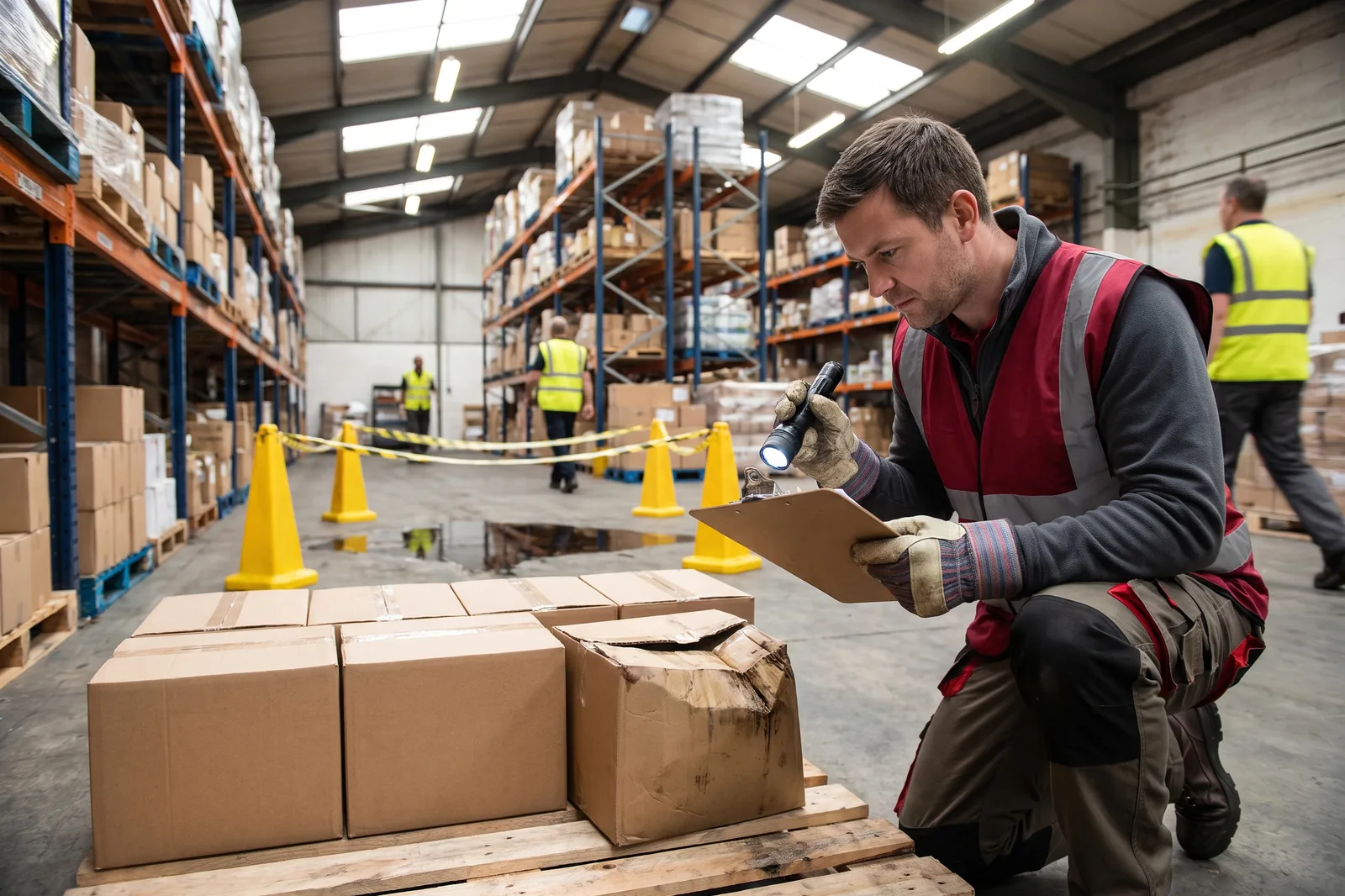
A cargo contamination inspection is the assessment of goods after a leak, spillage, fluid ingress or a collapsed load: what is intact, what goes into quarantine, and what goes for disposal. In our Milton Keynes warehouse we isolate the batch, assess the extent of the contamination, separate goods fit for sale from contaminated ones and document it all for the consignee and insurer.
The Polish-language version of this article is the reference one. This is an informational translation.
Where does contamination in transit come from?
The most common causes are a fluid leak from one pallet onto another, a spill after packaging bursts, fluid ingress of water or another liquid into cartons in a leaking trailer, and the effects of a collapsed or shifted load that has crushed and breached the packaging. The result is the same: part of the load has had contact with a substance that should not be there, and without an inspection you do not know which part.
How does the inspection run?
| Step | What we do |
|---|---|
| Isolation | we separate the suspect batch so the contamination does not spread |
| Assessing the extent | we establish how far the fluid or substance reached and which pallets had contact |
| Segregation | we split into intact goods, doubtful (on hold) and contaminated |
| Documentation | photographs, a description of the event, the extent of the contamination, the decisions taken |
| Decision | fit goods return to circulation, doubtful ones wait for assessment, contaminated ones go for disposal |
Food and FMCG: more careful and by the rules
With food and FMCG products (for example branded dairy or other food products in outer packaging) the threshold is higher. Contact with a leak, a spillage or a foreign substance can decide that a batch is not fit for sale, even if the individual packaging looks whole. The decision is made in line with food safety rules and the consignee procedures. We do not rule for the consignee or for an authority, we provide a documented basis: what had contact, to what extent and in what state. We cover this more fully in the articles on food safety after a trailer breach and on sanitary inspection of food cargo.
Whether the goods are fit for sale
This is a question we answer with evidence, not with a guess. We check whether the contamination reached the product itself or only the outer packaging, whether it can be separated, and whether the intact part can be safely repacked. The principle of assessing goods after a breach is covered in the article on whether goods are fit for sale after tampering. When part of the batch is sound, we repack it to a food-grade standard, which we cover in the article on repacking in the UK warehouse.
Quarantine, documentation, disposal
Doubtful goods go on a quality hold: physically separated, labelled, held pending a decision. Contaminated goods that cannot be saved we send for disposal appropriate to their type, and we document the fact and extent of the disposal. The consignee gets a clear picture: what arrived sound, what is waiting for assessment, and what was withdrawn. The sender and cargo insurer get a complete file for settling the loss. What a full warehouse report looks like is described around the value-added services of the Milton Keynes warehouse.
Where do we do it?
We run the cargo contamination inspection in our Milton Keynes warehouse, which works to a food-grade standard, within our warehousing and cargo inspection services. On hygienically sensitive goods we combine it with inspection under UV light, which we describe in the article on UV inspection and UVC decontamination.
Step by step
- Batch isolation. Move the affected goods to a designated area to prevent contact with clean cargo.
- Contamination assessment. Examine how many packages have been directly or indirectly impacted by the fluid leakage.
- Cargo sorting. Separate intact items from those placed under evaluation or designated for disposal.
- Documentation creation. Take clear photographs and draw up a report detailing the scope of damaged items.
- Insurer notification. Forward the compiled evidence to the consignee and insurer to initiate the claims process.
Definitions
- Cargo contamination: Contact between goods and a substance that renders them unfit or doubtful for further trade.
- Quality hold: The temporary retention of a consignment to evaluate its condition and prevent contamination from spreading to sound goods.
- Fluid ingress: The penetration of spilled liquid into carton packaging or the structural layer of goods.
- Collapsed load: A loss of stability and alignment in pallet storage that causes damage or scattering of items.
When does this rule not apply?
This inspection procedure does not apply if the spilled substance is a hazardous material that requires immediate intervention by specialist chemical emergency services.
The OTSL role
Our facility in Milton Keynes manages cargo isolation and damage reports, as outlined in our article on cargo inspection process and reporting. We also ensure smooth onward transport using our groupage transport service.
Sources
- FSA (food.gov.uk): business guidance, including withdrawal of food unfit for consumption
- GOV.UK: guidance for food and drink businesses
Have a load after a leak, a spillage or a collapse on its way to the UK and do not know what is fit for sale? Describe the event in the contact form and we will take the goods in, run the inspection, separate the fit from the contaminated and document it all.