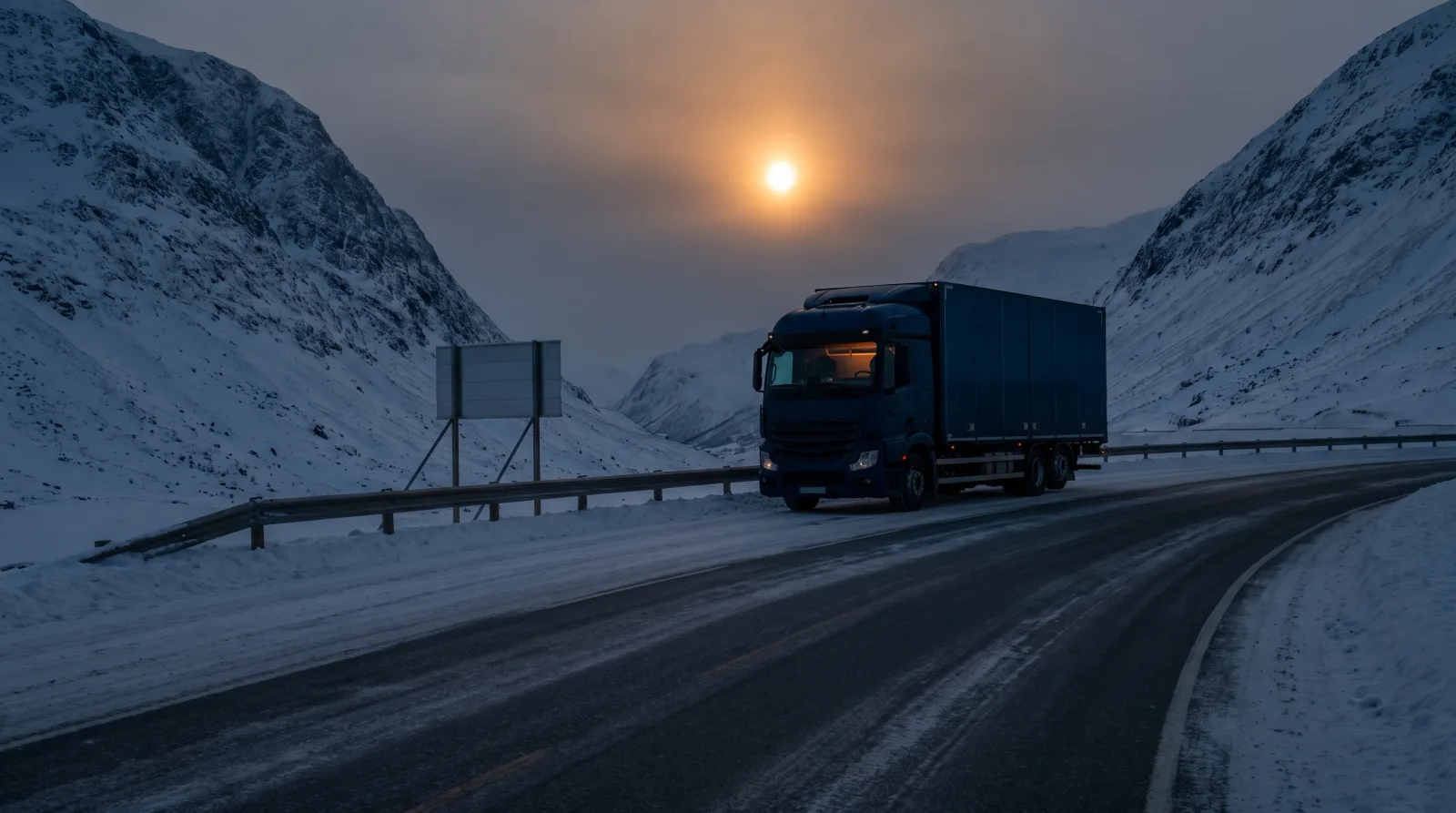
 AI image
Oslo lies in south-eastern Norway and is reached from the Swedish border along the E6 from Svinesund; it is the shortest and most frequently chosen destination for deliveries from Poland. Bergen on the west coast requires a crossing of the mountains: the E16 over the Filefjell pass or the E134 over Haukeli, both with winter restrictions. Stavanger in the south-west is reached along the coastal E39 with ferry crossings en route, or via the E134/E39 from the east. Delivery time from Poland is the sum of several legs, which is why we do not quote it as a single figure.
Why is Oslo near and Bergen far, when the map shows little between them?
From the border at Svinesund the E6 leads to Oslo, a main road with no mountains on the way. A delivery to the capital and its surroundings, Drammen, Lillestrøm or Fornebu, is for a truck from Poland one more leg after the run through Sweden. That is why most groupage and full loads from Poland end here, and why rates and times for Oslo are the most predictable.
Bergen lies on the other side of the mountains. The main options are the E16 over the Filefjell pass and the E134 over Haukeli; both routes are subject to winter restrictions and closures announced by Statens vegvesen. In winter the passes see convoy driving behind a snowplough (kolonnekjøring) and temporary closures, so kilometres on the map say nothing about journey time. The carrier checks road conditions before leaving Oslo, not at the foot of the mountain, because turning a truck and trailer around on a mountain road is not an option.
How is the approach to Stavanger different, and why are there ferries on a trunk road?
Stavanger in the south-west is reached along the coastal E39, on which some sections of the trunk road are ferry crossings, or via the E134 and E39 from the east. A ferry on the E39 is not an attraction but part of the road: the truck waits for the sailing according to the timetable, and the waiting and crossing time counts towards the driver's working hours. That is why planning a delivery to Stavanger starts with the ferry timetable, not with the distance.
For both west-coast cities one more thing matters: groupage to Norway is consolidated in Poland and delivered on fixed routes whose core ends in the Oslo area. Consignments beyond Oslo and the south often need an additional transhipment at a local partner, which we settle at quotation rather than discover en route. A full load travels without transhipment but with the same constraint: mountains and ferries.
Planning a delivery to Norway step by step
- Fix the address and the type of load. Oslo and the south: fixed route, groupage possibly without transhipment. Bergen, Stavanger and beyond: we check whether a local partner is needed or whether it is a full load.
- Choose the crossing to Scandinavia. Ferry from Poland to Sweden or the route through Denmark; the choice depends on total time including driver hours, not on the ticket price alone.
- Plan the border. Digitoll notification before reaching Svinesund, documents in the cab, import clearance prepared by the agent.
- Select the mountain option for Bergen. E16 over Filefjell or E134 over Haukeli, according to current road conditions and Statens vegvesen announcements on the day.
- Write the E39 ferries into the driver-hours plan. For Stavanger the ferry timetable sets the realistic delivery hour; a margin for one missed sailing is part of the plan.
- Confirm the unloading window and the winter buffer. The consignee gets a window, not an hour; in winter we flag the weather risk before departure, not after.
Definitions
- E6 – the main route from the Swedish border at Svinesund to Oslo and on to northern Norway.
- E16 and E134 – the two main options from Oslo to Bergen: the E16 over the Filefjell pass, the E134 over Haukeli; both with winter restrictions.
- E39 – the route along the west coast to Stavanger and Bergen, with ferry crossings forming part of the road.
- Kolonnekjøring – convoy driving behind a snowplough, introduced on the passes in difficult conditions; the driver waits at a designated point to be called forward.
- Statens vegvesen – the Norwegian Public Roads Administration, the source of announcements on closures, convoys and winter requirements.
- Digitoll – the Norwegian Customs (Tolletaten) system for digital notification of vehicle and goods before the border.
Checklist before shipping to Oslo, Bergen or Stavanger
- Delivery address with postcode and whether the consignee has a loading dock and receiving hours.
- Type of load: groupage with possible transhipment at a partner, or a full load.
- Crossing to Scandinavia booked for the right vehicle and date.
- Digitoll notification and customs documents ready before reaching Svinesund.
- For Bergen: E16/E134 option chosen according to Statens vegvesen announcements on the day.
- For Stavanger: E39 ferry timetable written into the driver-hours plan.
When does the fixed route to Norway not apply to your consignment?
The fixed groupage route covers Oslo and the south of the country. It does not apply to consignments for Bergen, Stavanger, Trondheim and further north unless the load is a full load travelling without transhipment; groupage to those areas depends on the local partner and its schedule. Winter route options and times depend on the weather and on Statens vegvesen decisions on the day, so delivery dates to those places are given as a window with a buffer, not as a date and hour. If the consignee requires a fixed hour, we plan arrival a day earlier with a stop nearby, and that goes into the quotation.
The OTSL role
OTSL does not quote fixed delivery times to Norway, because they depend on the sea crossing and the season; it does provide a plan with a buffer and flags the risk before departure. We consolidate groupage to Norway in Poland and deliver it on fixed routes under groupage (LTL), while full loads travel without transhipment under road transport. What makes up the rate and what the border adds is explained in the cost of transport to Norway. The specifics of west-coast deliveries are shown on trade fair examples: Grieghallen in Bergen and Stavanger Forum. The lane as a whole is described on the transport to Norway page.