 AI image
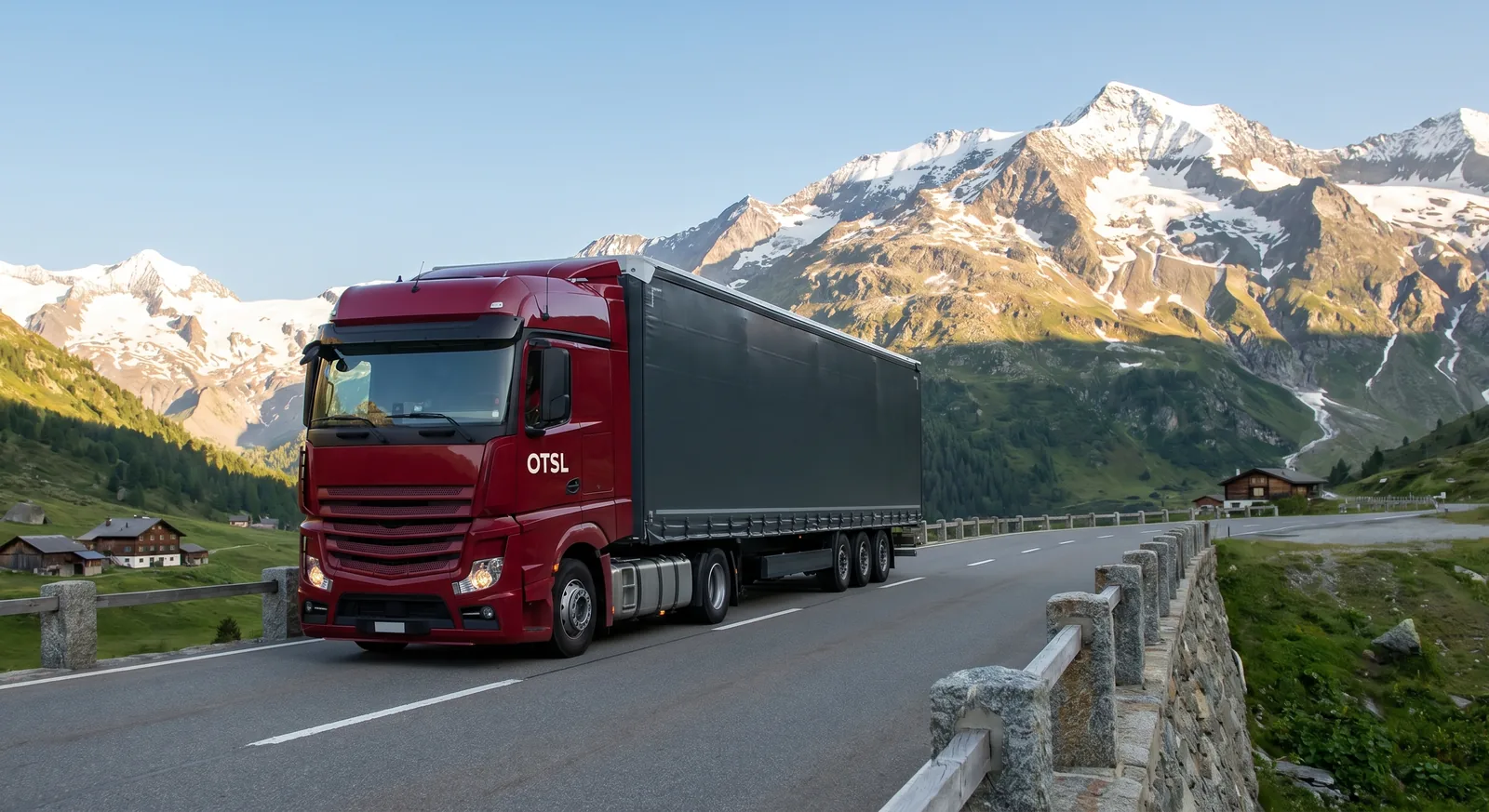
Freight forwarding to Switzerland combines two things: road transport and full customs clearance, because Switzerland is outside the European Union and every commercial consignment goes through clearance. OTSL runs the carriage together with export clearance in the EU and import clearance on the Swiss side, files declarations in the Passar system and settles the LSVA road charge. The cargo does not get stuck at the border, and the client talks to one forwarder in charge, not to three subcontractors. Below we explain what applies between the EU and Switzerland, which documents to prepare, how we plan routes around the driving bans and what makes up the rate.
Duty and customs clearance: what applies between the EU and Switzerland
Switzerland belongs neither to the European Union nor to the European Economic Area, but it has a free trade agreement with the EU. In practice, goods originating in the EU benefit from customs preferences once origin is documented, and since January 2024 Switzerland has additionally abolished import duties on most industrial goods. Important: abolished duties do not mean abolished clearance. The customs declaration, Swiss import VAT and document checks still apply to every consignment.
The standard clearance sequence looks like this:
- Export in the EU. An export declaration with the shipper EORI number, the commercial invoice and the origin document. The goods formally leave the customs territory of the Union.
- Border and Passar. The Swiss-side declaration is prepared in advance in the Passar system, so the truck passes the crossing without unnecessary waiting.
- Import in Switzerland. Settlement of charges, including import VAT, and release of the goods for delivery to the final address.
Goods moving through Switzerland further on, for example to Italy, travel under a transit procedure that must be discharged correctly. An undischarged transit means the customs guarantee is drawn on and demands for duty and VAT follow, so our customs agency watches it, not the driver.
In practice, Passar demands the same thing as any smooth clearance: complete data in advance. A declaration prepared before the truck arrives means the border crossing is a formality; a declaration done at the last minute means a standstill. That is why we collect the declaration data when the order is accepted, not on the day of departure, and run it through our own customs agencies on both sides of the border. The client does not need to know the system or hold accounts in it; a complete set of goods data is enough.
Documents for transport to Switzerland
We confirm the documents before loading, because fixing them at the border always costs more than preparing them in advance. The basic list:
- Commercial invoice with the value, currency, Incoterms and a goods description precise enough to assign a tariff code.
- Packing list with pieces, gross and net weights and the type of packaging.
- Proof of origin: an EUR.1 certificate or an origin declaration on the invoice, the basis for customs preferences in trade with the EU.
- Certificate of origin where the consignee or the nature of the goods requires it.
- EORI number of the exporter for the EU export declaration.
- CMR consignment note documenting the carriage and the condition of the cargo.
- ATA carnet for the temporary admission of exhibition stands, equipment or samples that return to the EU.
An error in the EUR.1 or in the origin declaration can be expensive: the Swiss importer then pays charges that correct documents could have avoided. That is why we verify origin documents at the source, with the shipper, before the truck departs.
Routes, driving bans and the LSVA
Cargo to Switzerland usually enters through the border crossings from Germany, including the Basel area, where the main corridor from the north runs. Three Swiss realities matter in route planning:
- LSVA, the heavy vehicle charge calculated on vehicle weight, distance driven and emission class. We settle it within the order, so the client does not have to track it.
- The night and Sunday driving bans for trucks, which force delivery windows to be planned ahead; a badly timed arrival at the border is a lost day.
- Winter on the passes: we plan Alpine routes around conditions and restrictions, so the delivery does not depend on the weather.
The most frequent delivery destinations are Zurich, Basel, Geneva, Bern and Lausanne, as well as production plants and warehouses outside the big cities. We also handle export from Switzerland to Poland and other EU countries, with clearance on both sides in a single order.
We deliver in both the German-speaking and the French-speaking parts of the country: to logistics centres, production plants and construction sites. For city deliveries we work around the time windows of the consignees and access restrictions; for industrial plants, around notification requirements and unloading rules, so the truck does not return from the ramp empty-handed.
How long does it take and what does it cost
Transit time depends on the lane, the type of cargo and the delivery windows at the consignee, and along the way on the driving bans and the border crossing. Preparing the declarations before departure is the key: a truck with complete documents crosses smoothly, a truck with gaps stands still. The rate is made up of the freight, the LSVA, the cost of export and import clearance and any origin documents; we break these down in the quote, so the client sees what they are paying for. The forwarder confirms a realistic delivery date at the quoting stage.
For the border to be a formality, everything has to match at once: the goods description with the invoice, the invoice with the packing list, the weight with the documents, and the declarations with what is actually in the truck. A discrepancy in one point means questions from the authorities and a standstill for the whole set. That is why we verify before departure, on the documents, not at the border, on the client time.
What we carry to Switzerland
- FTL, full loads: curtainsiders and full sets on regular export and import lanes.
- LTL and groupage: part loads from a single pallet, consolidated on the same lane.
- ADR: dangerous goods with full documentation and trained drivers.
- Reefer: temperature-controlled cargo, with a temperature record on request.
- Oversized loads: machinery and structures, with permits where required.
- Trade fair transport: stands and exhibits for fairs in Basel, Geneva and Zurich, with an ATA carnet for temporary admission.
Trade fairs in Switzerland and the ATA carnet
Basel, Geneva and Zurich are fixed points in the exhibitor calendar, and fair transport runs on its own deadlines: stand build-up and dismantling windows do not wait for a late truck. An exhibition that returns to the EU travels on an ATA carnet: the document covers the equipment list, simplifies clearance on the way in and out and avoids charges on the exhibition goods. We keep the carnet list consistent with what is actually in the truck, because a discrepancy surfaces on the way out, at the worst possible moment of the fair schedule. Fair deliveries are planned with a buffer for driving bans and queues on the fairground.
How an order to Switzerland runs step by step
We start with an enquiry containing the goods description, dimensions, weight and the loading and delivery points. The forwarder confirms a quote broken down into freight, LSVA and clearance costs, plus a realistic delivery date. Before loading, our customs agency prepares the export declaration and the Passar declaration, and for temporary carriage the full carnet documentation. During the carriage the client receives status updates without having to ask, and after delivery the confirmations and customs documents for settlement. For a first shipment to Switzerland we walk the client through every requirement step by step.
Checklist before shipping to Switzerland
- Confirm the consignee details and the delivery point, together with time windows and notification requirements.
- Prepare the commercial invoice and the packing list with a full goods description, weights and value; the two documents must be consistent with each other.
- Establish the origin of the goods and decide on an EUR.1 certificate or an origin declaration on the invoice.
- Check the EORI number and the company registration data for the EU export declaration.
- Flag temporary carriage, if the goods return to the EU, so we prepare an ATA carnet instead of a standard clearance.
- Send the full set to the forwarder before loading; the Passar declarations and border documents are prepared on our side.
Most delays at the Swiss border start with gaps in this list. Complete data in advance means the truck crosses without a stop and the consignee receives the goods in the notified window.
Import from Switzerland to Poland and the EU
The lane works both ways. On imports from Switzerland we handle export clearance on the Swiss side and import clearance in the EU, with origin documents that unlock preferences in this direction too. From the Swiss shipper we need the invoice, the packing list and the origin data; the rest is prepared by our customs agency. The same forwarder runs the cargo as on exports, so companies trading in both directions have one process and one point of contact.
Why OTSL on the Swiss lane
- Transport and clearance in one order. We run clearance through our own customs agencies, so formalities move in parallel with the carriage.
- One forwarder in charge. The same person watches the loading, the border and the delivery, and answers questions without passing you on.
- Round-the-clock support. For cargo on the move we are available 24/7, weekends included.
- Documents checked before departure. We verify EUR.1, invoices and declarations before loading, not at the border.
What to watch out for when shipping to Switzerland
- An error in the origin document means full charges on the importer side and a difficult conversation with the consignee.
- Ignored driving bans push the delivery back a day, even though the truck is standing a few kilometres from the ramp.
- An undischarged transit comes back to the shipper as a payment demand long after delivery.
- A generic goods description on the invoice prolongs clearance and invites extra questions from the authorities.
See also
- Transport to Switzerland, customs and documents
- Deliveries to Switzerland, Passar, LSVA and charges
- Export to Switzerland from outside the EU, customs procedures
- Transport to Switzerland in winter: passes, the night driving ban and route planning
- How much does transport to Switzerland cost: what makes up the rate
- Trade fair transport to Switzerland, Basel, Geneva, Zurich
- ATA carnet for trade fairs, when it is needed and how it works
- An error in the EUR.1 or origin declaration for Switzerland: why the Swiss importer pays full duty
- Customs clearance