 AI image
Freight transport to the Netherlands is intra-EU carriage: no customs clearance, no border stop, and transit from Poland that normally fits within one or two driving days. OTSL arranges full truckloads (FTL) and groupage (LTL) to Rotterdam, Amsterdam, Utrecht, Eindhoven and Venlo, and for importers we collect containers from the port of Rotterdam with clearance under procedure 42. Below: the road corridors trucks actually use, the driving bans that apply in transit through Germany, and what to watch so the delivery hits its booked slot and the container does not run up idle charges.
Road corridors from Poland to the Netherlands
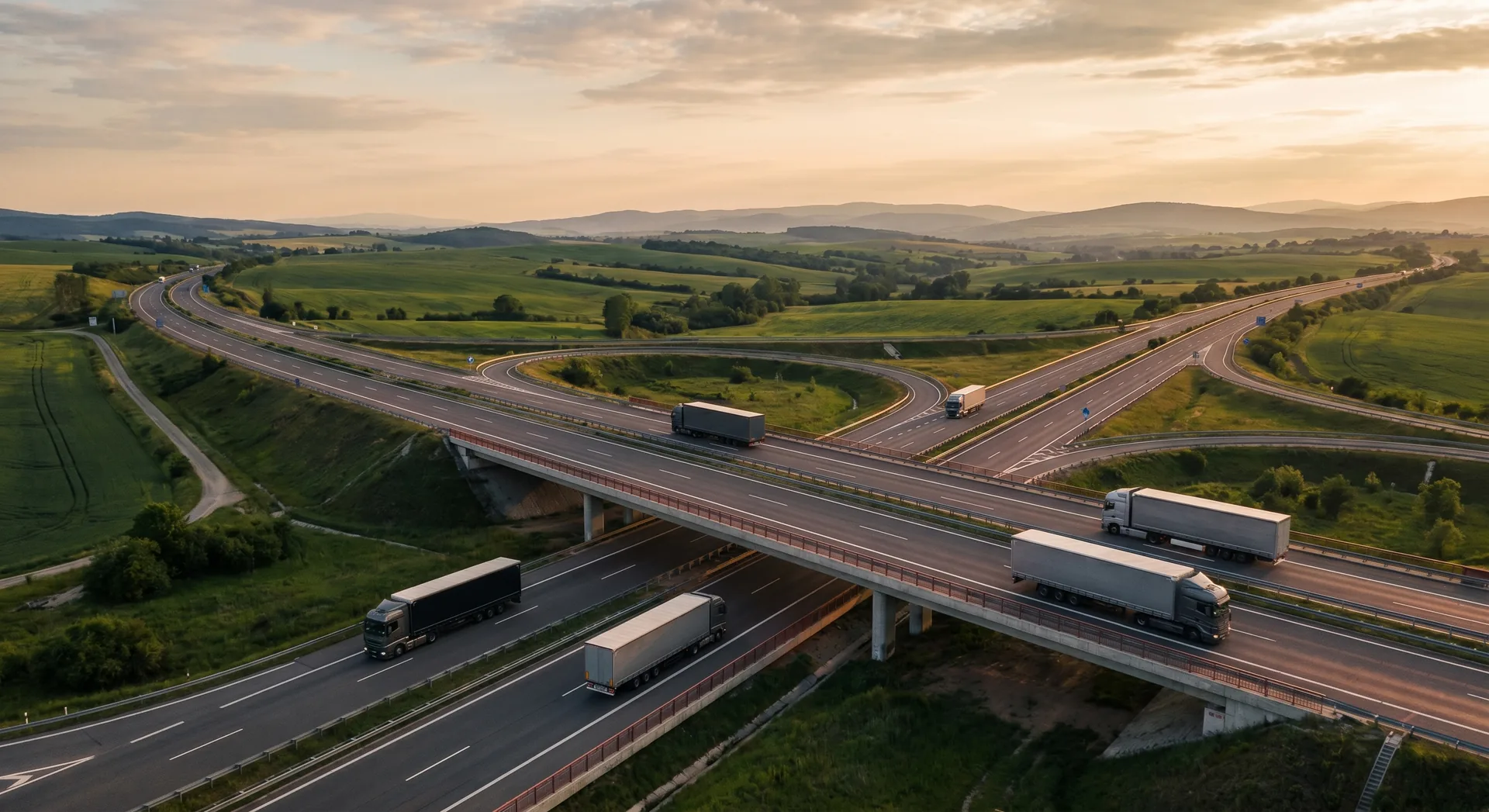
The main corridor runs along the Polish A2 motorway through Poznań to the border at Świecko, then over the German autobahn network towards Hannover and Osnabrück. Trucks usually enter the Netherlands at one of three points: Bad Bentheim onto the Dutch A1 towards Amsterdam, Emmerich onto the A12 towards Arnhem and Utrecht, or Venlo onto the A67 towards Eindhoven and on to Rotterdam. We match the crossing to the delivery point and to conditions on the German network at planning stage, not mid-route.
Distances: western Poland to the eastern Netherlands is in the range of 800 km, central Poland to Rotterdam around 1200 km. Regulation (EC) No 561/2006 caps daily driving time at 9 hours, extendable to 10 hours twice a week. In practice a load from western Poland arrives the day after loading; longer relations need a second day. The forwarder confirms a binding date at quotation, because loading and unloading slots decide the real timeline, not distance alone.
Driving bans: the constraint is Germany, not the Netherlands
The Netherlands has no general Sunday driving ban for trucks. Every load from Poland transits Germany, however, where vehicles over 7.5 tonnes are subject to the Sunday and public holiday driving ban under section 30 of the German road traffic act (StVO), plus additional Saturday restrictions on designated routes during the summer holiday season. Public holidays differ between federal states, so a date that looks like a normal working day can park a truck for hours. A Monday morning delivery in Rotterdam is therefore planned backwards: loading, the German transit and an arrival buffer must fit before the ban starts. The full picture is in our guide to HGV driving bans in Europe.
The second layer of constraints is local: booking slots at distribution centres and environmental zones. A growing number of Dutch cities are introducing zero-emission zones for delivery vehicles in their centres, so for inner-city deliveries we check zone requirements before assigning a vehicle.
Market profile: the port, food exports and distribution hubs
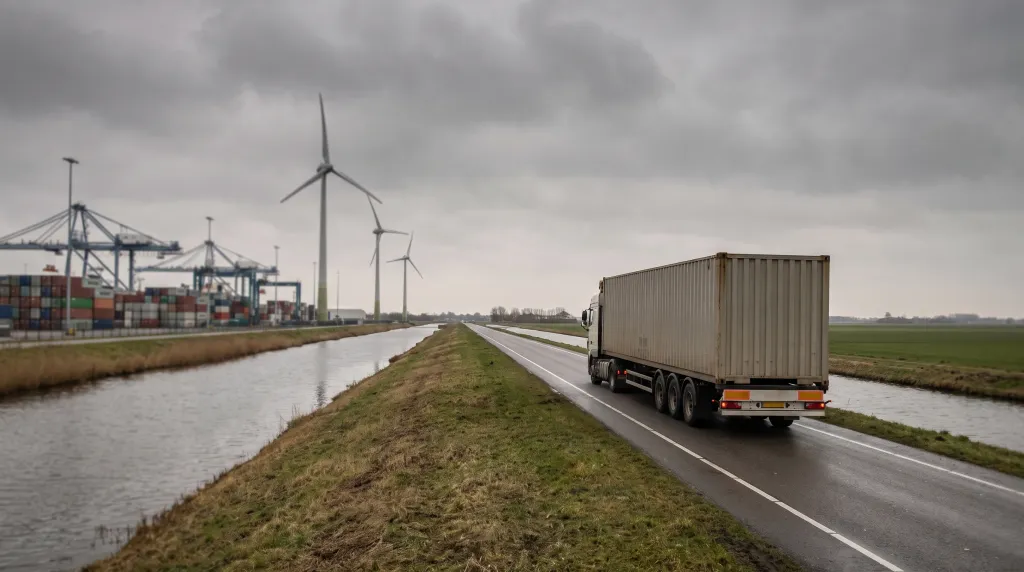
Rotterdam is the largest seaport in Europe and the point where road haulage meets deep-sea cargo: a container comes off the vessel and continues by truck to a warehouse in the Netherlands, in Germany or straight to Poland. Venlo, on the German border, is one of the country's largest warehousing clusters and a frequent delivery address for e-commerce and Benelux distribution. Eindhoven concentrates the technology industry, while Amsterdam and Utrecht run a dense trade fair calendar that we serve through trade fair transport to the Netherlands.
The second pillar is food: according to CBS, the Dutch national statistics office, the Netherlands ranks among the world's largest exporters of agri-food products, from greenhouse vegetables to flowers and dairy. For transport planning this means a strong flow of refrigerated loads in both directions and consignees who hold the carrier to every degree of temperature and every minute of the delivery window.
Containers from Rotterdam and procedure 42
For importers we arrange the full package: container collection at the terminal, import clearance and road transport to Poland or to a warehouse in Europe. Where goods move directly to another EU country, procedure 42 applies; we cover the economics in when procedure 42 is worth it. The stakes are concrete: a container standing beyond its free time accrues demurrage and detention day by day, and a machine stuck in a Dutch port can cost more than the freight itself. How those charges work is explained in container demurrage and detention, and machinery customs clearance in the Netherlands has its own guide.
FTL, LTL and specialised transport
- FTL, full truckloads: curtainsiders and full sets on regular relations; when a dedicated truck beats a part load is covered in FTL or LTL.
- LTL and groupage: from a single pallet, consolidated westbound within our groupage service.
- Reefer: temperature-controlled carriage in line with the ATP agreement, with temperature records on request; details under temperature-controlled transport.
- ADR: dangerous goods with complete documentation, also as groupage.
- Out of gauge and machinery: with permits where required.
- Containers: port drayage and onward carriage under our container transport service.
What OTSL arranges on the Dutch corridor
We run the order from enquiry to confirmed delivery: vehicle selection, route planning around driving bans, delivery notifications, CMR transport documents, and for port cargo the clearance handled by a customs agency. Westbound consolidation runs from our warehouses in Kielce and Legnica, described in the origin side in Poland and Poland as a sourcing base. The corridor works both ways: we also carry imports from the Netherlands to Poland, including refrigerated loads.
What can go wrong
- The weekend in Germany. A load that misses the window before the Sunday ban loses a day, and the consignee loses the unloading slot.
- A broken cold chain. Food cargo without a continuous temperature record is often unsellable; see broken cold chain, unsellable goods.
- Demurrage and detention. Every day beyond free time costs money, whatever the reason for the standstill.
- The carrier's liability limit. The CMR Convention caps compensation at 8.33 SDR per kilogram (Article 23(3)), so for high-value goods we recommend cargo insurance.