 AI image
Re-palletising and straightening pallets is load recovery after a tilt or collapse: assessing the state, re-arranging and securing the goods so they are fit for onward transport or sale. It often saves a large part of a batch that looks like a loss at first glance. At OTSL we do this at the UK warehouse.
When re-packing makes sense
- A pallet tilted in transit but the goods are not destroyed.
- Wrapping and securing gave way and products shifted.
- Some packaging needs replacing but the contents are sound.
What does it look like?
First we assess and document the state, then we separate the sound from the damaged. Sound products are re-arranged, secured and prepared to travel on. Damaged ones are described in the report, which eases settlement with the insurer. We decide on facts, not by eye.
How do we work?
We run re-packing at the Milton Keynes warehouse in the UK, which has facilities for assessment, re-packing and pallet rebuilding. So recovery happens close to the place of the event on the UK market, without hauling goods back and forth.
See inspection and recovery, the UK warehouse with re-packing and warehousing.
How do you determine whether a tilted pallet requires a complete rebuild or just re-strapping?
When a pallet leans by more than 8 cm over a height of 1.8 metres, centrifugal forces during heavy braking on motorway routes produce lateral pressure exceeding the tensile limit of standard 23-micron stretch film. If the centre of gravity for a load weighing over 500 kg shifts by more than 10%, the probability of the entire column collapsing onto adjacent cargo increases threefold. In such cases, simply applying additional layers of film without dismantling the top layers is an operational error, as the compressed bottom cartons have already lost up to 40% of their original Box Compression Test strength.
You begin the recovery process by measuring the tilt displacement and inspecting the structural integrity of the base layer. If the shift affects only the top 2 layers, you remove those levels and restack them onto a sound pallet within roughly 30 minutes. However, when the corrugated boxes at the bottom tier are crushed, you must fully unload all 1200 kg of cargo, isolate damaged stock, and rebuild the unit load from the wooden pallet up, which takes between 1.5 and 2 hours per pallet.
Note that these standard operational limits do not apply to dangerous goods governed by ADR (the Accord governing international carriage of dangerous goods by road) regulations or temperature-controlled chilled freight maintained between 2°C and 6°C. For these specific commodity classes, any stack displacement exceeding 3 cm immediately halts handling and triggers mandatory safety protocols under the supervision of a Dangerous Goods Safety Adviser prior to customs clearance updates in CDS.
- Displacement under 4 cm: re-tensioning polyester strapping and re-wrapping with stretch film is sufficient.
- Displacement between 4 cm and 8 cm: removal of top layers and realignment of the central load axis is required.
- Displacement over 8 cm or base damage: complete restacking, pallet swap, and full rebuild from the ground up.
Step by step
- Inspection and documentation. You assess the tilt of the cargo and photograph any damage before disturbing the pallet.
- Goods sorting. You separate sound products from those that are damaged or require repackaging.
- Packaging replacement. You transfer intact goods into fresh outer cartons or onto clean pallets if needed.
- Restructuring and alignment. You arrange the items evenly on the pallet, ensuring a stable centre of gravity.
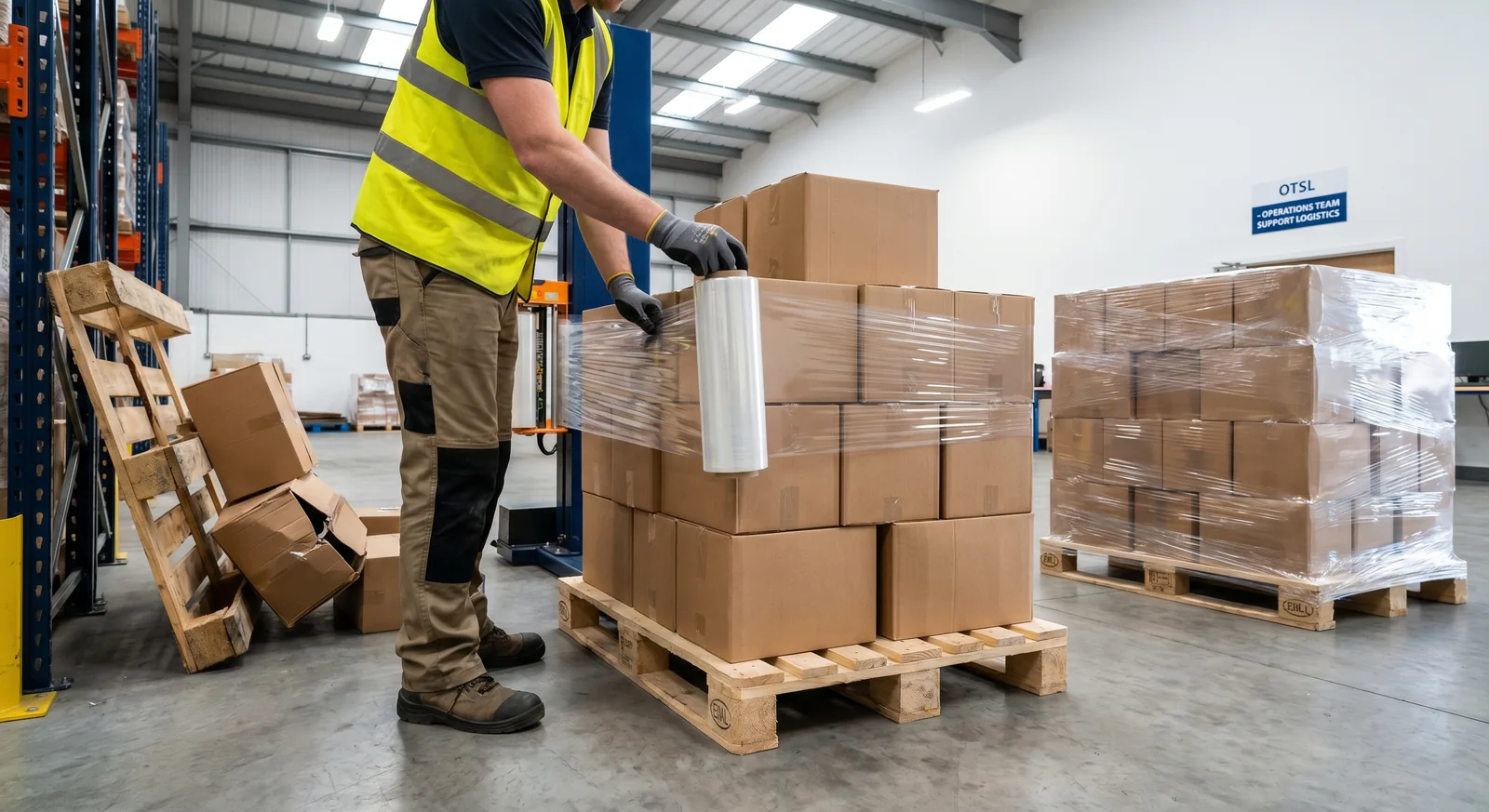
- Securing and final check. You wrap the pallet with stretch film, apply strapping, and verify stability before onward dispatch.
Definitions
- Re-palletising and straightening: Re-arranging and aligning goods on a pallet after shifting or tilting during transport.
- Load recovery: Emergency operations restoring damaged or shifted goods to a state fit for trade or onward transport.
- State assessment: Detailed inspection of the cargo to separate sound products from damaged ones requiring repacking.
- Pallet rebuilding: Restructuring and securing a unit load using fresh wrapping, strapping, or new outer packaging.
When does this rule not apply?
This process does not apply if the cargo involves hazardous chemical spills or contamination that prevents safe handling inside the warehouse.
The OTSL role
At our facility in Milton Keynes, OTSL provides cargo recovery and pallet restructuring. You can combine this with our groupage (LTL) services, or read more details in our guide on UK warehouse cargo recovery.