 AI image
Belgium is a close, fast lane: the run from Poland usually takes about a day, and the logistics hub around Antwerp and Brussels offers plenty of freight both ways. The price is shaped mainly by the Belgian kilometre charge levied on all roads, German transit tolls, and dense congestion that stretches time in the cities.
A kilometre charge on every road
Belgium is distinctive, because it charges trucks not only on motorways but across almost the whole road network. That matters for cost planning, since it cannot be avoided by taking side roads.
Belgium has charged trucks over 3.5 tonnes a kilometre charge since 1 April 2016: it applies across the country's three regions (Flanders, Wallonia, Brussels), and every vehicle must run a switched-on on-board unit that records the kilometres driven (source: Viapass). The rate depends on weight, emission class and region, and driving without a working unit risks a fine.
Transit through Germany and local congestion
Before the cargo reaches Belgium, most of the route runs through Germany, where a motorway toll is charged per kilometre driven (source: Toll Collect). Alongside the Belgian kilometre charge, this is the second main road cost on the lane. At the end comes time in dense traffic: standing in jams and waiting for an unloading slot can be a real cost the per-kilometre rate does not show.
Ports and the logistics hub
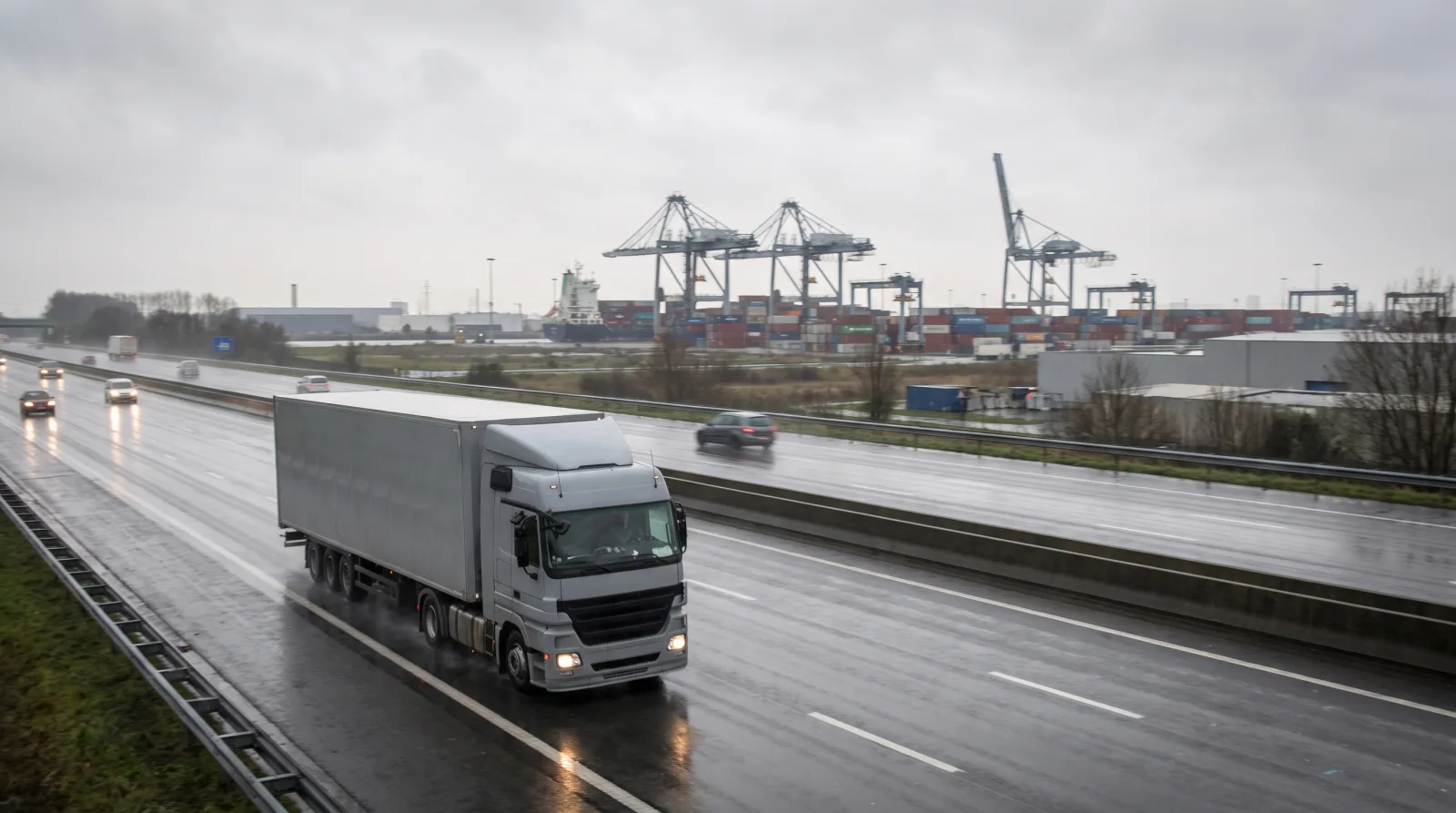
Antwerp is one of Europe's largest ports, and a vast warehousing and distribution base is clustered around it. Much of the freight is collecting or delivering to terminals and logistics centres. The upside of this lane is two-way traffic, so a return load is easier to find, which helps the price. The downside is congestion: the Antwerp and Brussels ring roads are among the busiest in Europe, and time spent in jams and waiting for a slot can be a real cost.
How long does delivery take and how do you order?
A full load to Belgium usually takes about a day, and over such a short distance the date depends more on city traffic and the unloading window than the drive itself. For smaller batches groupage works well, for full ones road transport. Lane details are on the transport to Belgium page. Send us the loading place, delivery address and goods type through the form, and we will prepare a quote.
How should you plan loading times and time slots to avoid delays at Belgian distribution centres?
A standard 13.6 metres trailer accommodates 33 Euro-pallets with a maximum payload of up to 24,000 kg. Deliveries to Belgian logistics hubs around Brussels strictly require exact delivery time slots. If the driver misses the scheduled appointment by more than 15 minutes, the receiving warehouse reserves the right to reject the vehicle on that day or postpone unloading by at least 24 hours. This dependency stems from tight loading bay schedules engineered for 100% capacity utilisation.
When calculating transit times, you must factor in German Sunday driving bans and statutory rest requirements. If driver driving hours expire before reaching the Belgian border, the vehicle will remain stationary for a minimum 9 hours mandatory rest period, which directly impacts the downstream schedule.
Note the exact operational boundaries where these constraints do not apply:
- Strict time-slot restrictions and Sunday travel bans do not apply to temperature-controlled vehicles carrying perishable foodstuffs, which receive priority bay allocation.
- Express haulage using vehicles up to 3.5 t gross vehicle weight is exempt from driving rest restrictions on route, though warehouse notification remains mandatory.
- Dangerous goods consignments require an extra 2 hours for site safety verification upon arrival.
Step by step
- Vehicle preparation. Equip the truck with an active on-board unit for automated distance tracking.
- Document check. Verify all shipping paperwork and confirm the vehicle emission standard rating.
- Route planning. Map out the itinerary considering transit tolls and potential urban congestion.
- Cargo loading. Secure the freight properly inside the trailer following standard road safety guidelines.
- Transit monitoring. Track the journey progress and ensure the toll recording device remains operational.
Definitions
- Kilometre charge: A distance-based road pricing scheme applied to heavy goods vehicles in Belgium.
- Viapass: The Belgian interregional public body supervising the toll system for trucks.
- On-board unit (OBU): A device fitted inside the vehicle that automatically registers driven distance on toll roads.
- Logistics hub: A central node for freight distribution connecting regional and international transport routes.
The OTSL role
Organising freight transport to or through Belgium requires clear planning. Explore road transport (FTL) and read our guide on express vans and time-critical transport in Europe to optimize your supply chain.