 AI image
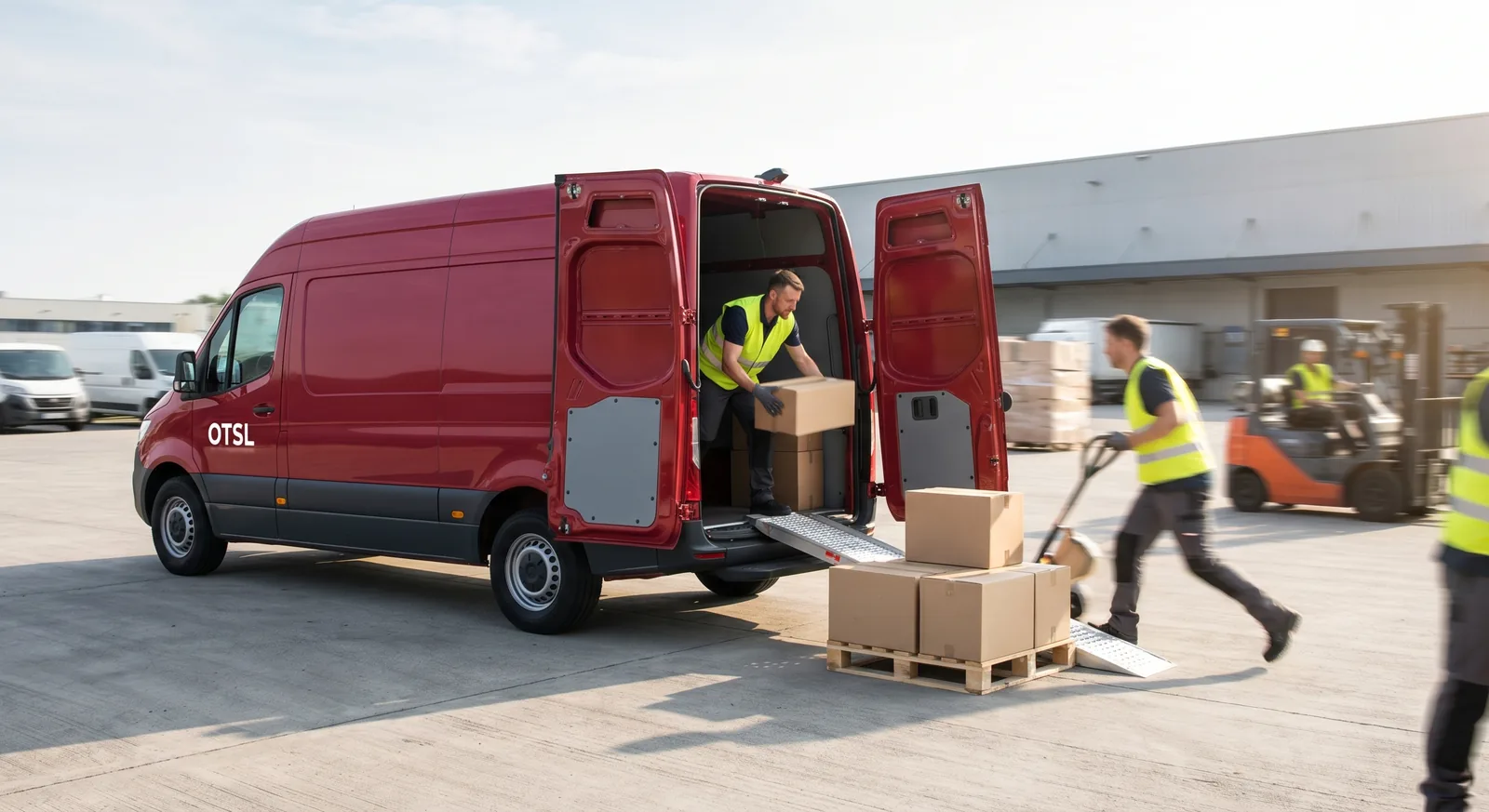
Express transport is a dedicated move, where the vehicle runs for one specific order, with no transhipment and no waiting to fill up with other shipments. At OTSL we run it with vans and as express LTL when time is what counts: a missing part on a production line, goods for a fair, a delivery against a contractual deadline.
When to choose express
- A line stoppage costs more than the premium for urgent transport.
- Goods must be at the venue before the slot closes.
- The delivery date is firm and there is no room for delay.
Express is not only a van
Sometimes the fastest answer is a delivery van, sometimes express LTL, that is priority groupage with a guaranteed date. We match the mode to weight, dimensions and the deadline, instead of forcing every order into one pattern. On the UK lane we plan customs and the crossing ahead, so the border does not eat the time we won.
How do we work under time pressure?
The operations team is available 24/7, and one contact runs the order and knows its status at every stage. We say plainly what is realistic and what is not, rather than promising an impossible date. We treat the client goods as our own, especially when a whole production run or an event is at stake.
See express vans, groupage and LTL, road transport and the full list of services.
Which technical and legal factors determine the actual transit time of an express van?
Transit time in express transport does not depend solely on the vehicle's speed on the motorway, but on strict legal constraints and physical load parameters. A standard curtain-side van with a maximum authorised mass (MAM) of up to 3.5 tonnes accommodates a maximum of 8 euro-pallets, while its net payload typically ranges between 1100 kg and 1200 kg. Exceeding this limit by even 50 kg prevents the use of a light commercial vehicle and forces a switch to a heavy goods vehicle (HGV). This immediately reduces the maximum permitted speed limit from 100 km/h to 80 km/h and triggers mandatory tachograph rules. Under a single driver setup, maximum daily driving time is restricted to 9 hours (extendable to 10 hours twice a week), yielding a daily coverage of roughly 700 km. Utilizing a double-manned crew extends continuous driving time up to 18 hours within a 21-hour shift window, allowing you to complete a journey from central Poland to the United Kingdom in approximately 24 hours.
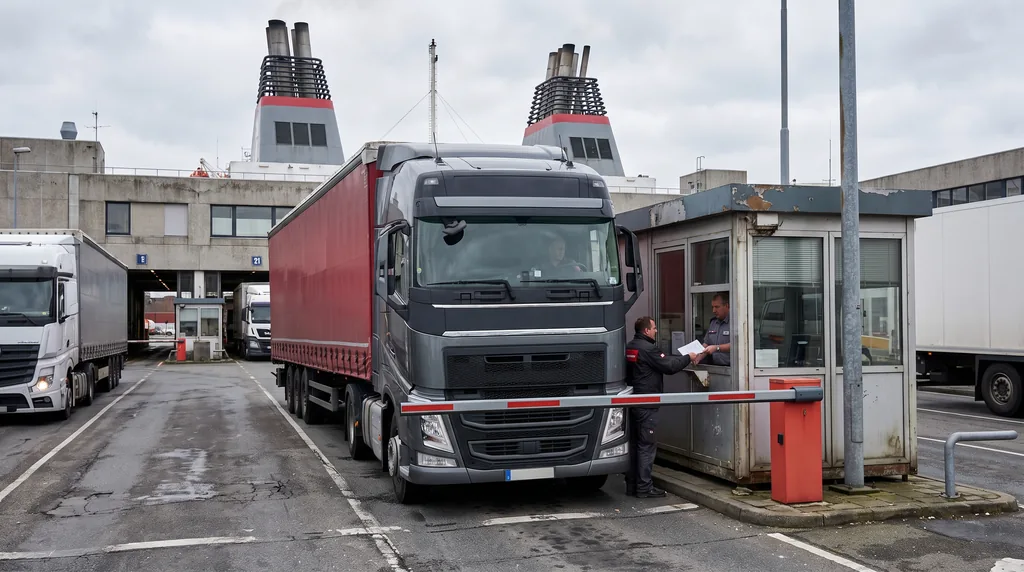
The actual bottleneck in cross-border transport towards Great Britain is rarely the road network itself, but rather the coordination of maritime or shuttle crossings and customs clearance procedures. For a vehicle to clear the Goods Vehicle Movement Service (GVMS) smoothly and board the Eurotunnel shuttle or a ferry at Dunkirk or Calais, customs paperwork must be finalized at least 2 hours prior to arrival at the port gate. An error in the import declaration holds the vehicle at the inland border facility or port holding area for at least 4 hours, eliminating any time saved on the motorway network. Furthermore, heavy cross-Channel traffic during peak hours can add up to 180 minutes of waiting time at border controls.
- When total payload weight exceeds 1200 kg or volume requires more than 8 pallets – transport must be transferred to a vehicle over 3.5 tonnes equipped with a tachograph.
- When UK customs clearance requires physical inspection or export declarations contain incorrect HS commodity codes – the van remains stationary until clearance is granted.
- When the importer's customs broker does not operate on a 24/7 basis – arriving at the border at 2:00 AM will not accelerate delivery prior to 8:00 AM.
This continuous transit principle does not apply when your end consignee operates strict booking slots without early offloading options. If the receiving facility accepts deliveries strictly between 8:00 AM and 2:00 PM, arriving at 3:00 AM offers zero operational advantage. In such cases, maximum driving speed gives way to precise driver rest scheduling. Taking an obligatory 9-hour rest period prior to entering the facility ensures the vehicle arrives exactly within the designated window without obstructing the site or risking penalties for non-compliance with delivery schedules.
Step by step
- Submitting the request. You share cargo parameters, addresses, and the required deadline.
- Matching the vehicle. We select a suitable delivery van or priority express LTL option.
- Cargo collection. The assigned vehicle arrives promptly at the loading point.
- Direct transit. The driver takes the shortest route without collecting extra goods along the way.
- On-time delivery. The shipment arrives at the destination within the strictly designated slot.
Definitions
- Express transport: A direct movement carried out for a specific order without transhipment or delays.
- Express LTL (Less Than Truckload): Priority groupage transport provided with a fixed delivery time.
- Dedicated transport: Movement where the vehicle carries solely your cargo via the most direct route.
- Delivery slot: A scheduled time window during which the cargo must arrive at the venue.
- Time-critical: Urgent freight where any delivery delay results in severe operational costs.
The OTSL role
At OTSL, we manage time-critical freight across European routes to ensure your goods arrive strictly on schedule. By deploying our express vans, we reduce delays, fully aware that poor exhibition logistics costs more than the transport itself. See also: Airport-to-airport transport, when every detail counts.