 AI image
The cost and time of transport to Italy depend mainly on three things: distance, road charges along the whole route, and how the Alps are crossed. Italy sits far to the south, and the road runs through tolled motorways in Germany, Austria or Switzerland and through Alpine tunnels. Each stretch adds to the rate.
What raises the cost of a run to Italy
Distance comes first. The industrial north (Milan, Turin, Bologna, Venice) is a shorter drive than Rome, Naples or the far south, where extra hundreds of kilometres and more driver hours pile up. Second are road charges. The Italian motorway network is almost entirely tolled, on top of transit-country tolls and separate tunnel fees. Third is load balance: if there is little freight for the return leg in a given week, the carrier prices in the empty running, which lifts the round-trip rate.
The trailer type matters too. A standard curtain-sider is one thing; temperature-controlled cargo, out-of-gauge loads or goods needing special securing are another. We break down how the rate is built in our note on loading metres (LDM).
The Alps: tunnels, passes and ADR limits
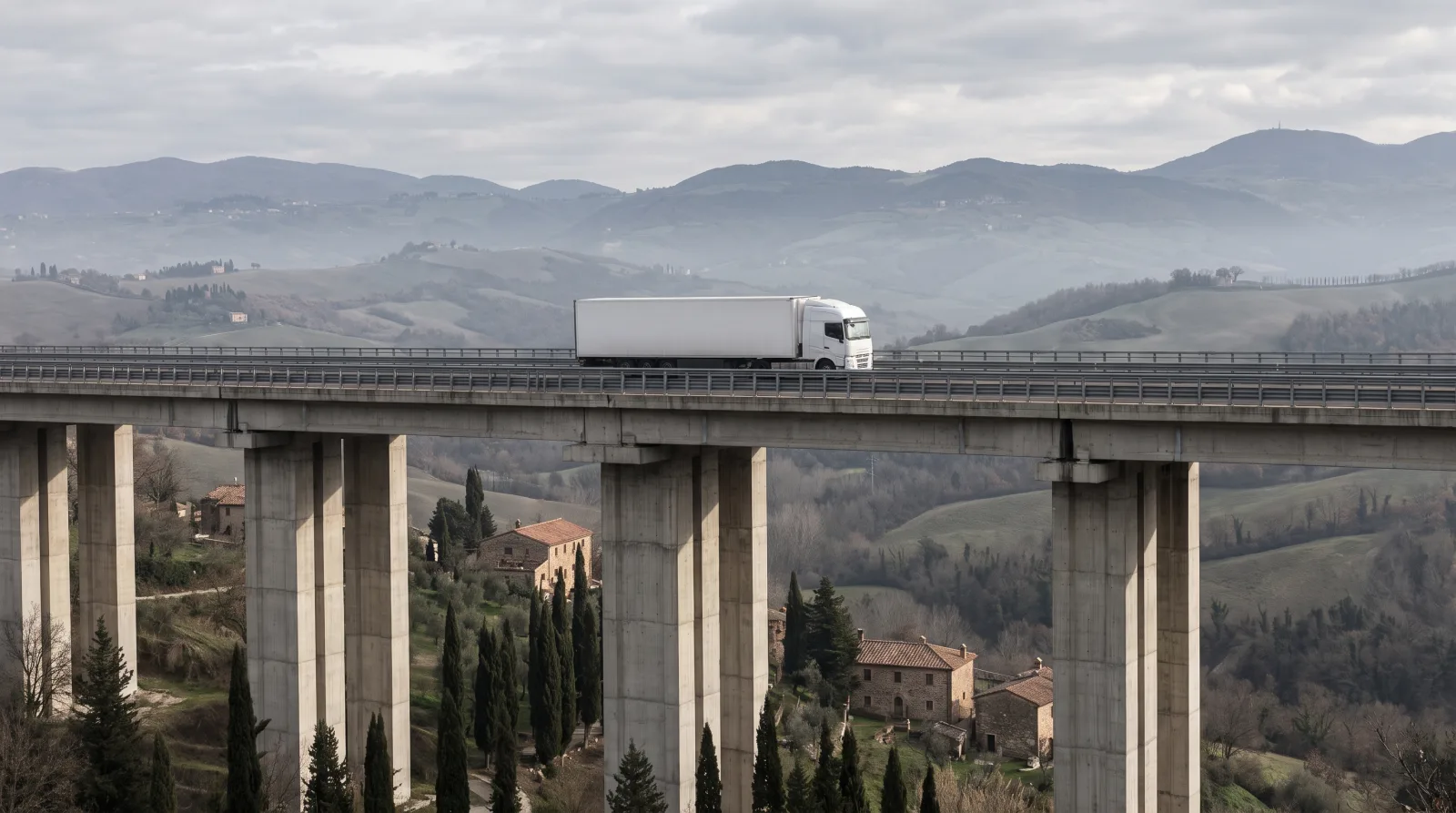
Entering Italy from the north means one of the Alpine corridors: the Brenner pass (from Austria), the Frejus or Mont Blanc tunnel (from France), or routes through Switzerland. Tunnels are charged separately and, for an articulated truck, that is a noticeable cost line. In winter, vehicle equipment and the risk of a temporary pass closure also count.
Alpine tunnels have the strictest rules for dangerous goods: the Mont Blanc tunnel is classed as a category E tunnel, the most restrictive under the ADR (the Accord governing international carriage of dangerous goods by road) agreement, and bans many classes of dangerous cargo (source: Tunnel du Mont-Blanc). With ADR freight the crossing must be planned in advance, because the wrong route means a long detour.
Tolls and driving bans in Italy
In Italy charges are usually distance-based: you pay for the section driven and the vehicle class. On top of that come Italian truck bans on some Sundays and public holidays and seasonal limits during the summer months. A driver who hits such a ban has to wait, which stretches delivery time.
How long delivery takes and what sets the date
A full load to northern Italy usually runs about two days; central and southern Italy take longer. The real date depends on driver hours, queues at the tunnels, weekend bans, and whether we move a full truck or a groupage load that picks up and drops other shipments on the way. For an urgent deadline we route around expected blockages and confirm the delivery window before loading.
How to arrange transport to Italy
We match the trailer and the crossing to your cargo and give a realistic date. See our road transport for full loads and groupage for smaller batches. More on the lane is on the transport to Italy page. Send us the loading place, delivery address and goods type through the form and we will prepare a quote.
What influences the total transport cost to Italy?
The total cost depends on the distance to the destination region, transit motorways and Alpine tunnel charges, as well as the balance of available return freight.
Step by step
- Specify cargo requirements. You prepare details regarding the weight, volume and specific conditions of your shipment.
- Select the transport method. You choose between standard or specialized trailers depending on the cargo type.
- Plan the transit route. You evaluate the optimal path via transit countries and calculate expected Alpine tolls.
- Prepare the documentation. You verify consignment notes and required transport papers before dispatch.
- Track the delivery. You monitor the vehicle progress until the goods reach their destination in Italy.
Definitions
- FTL (Full Truckload): full trailer transport where the entire cargo space is allocated to a single shipper.
- LTL (Less Than Truckload): groupage transport combining shipments from multiple senders on one route.
- Road toll: a charge levied for using designated motorways and transit roads across countries.
- Alpine tunnels: specifically charged mountain pass tunnels requiring separate toll payments.
The OTSL role
OTSL coordinates cross-border freight runs to Italy, providing efficient solutions such as road transport. We assist shippers in selecting the optimal option, explaining choices in express vans and time-critical transport.