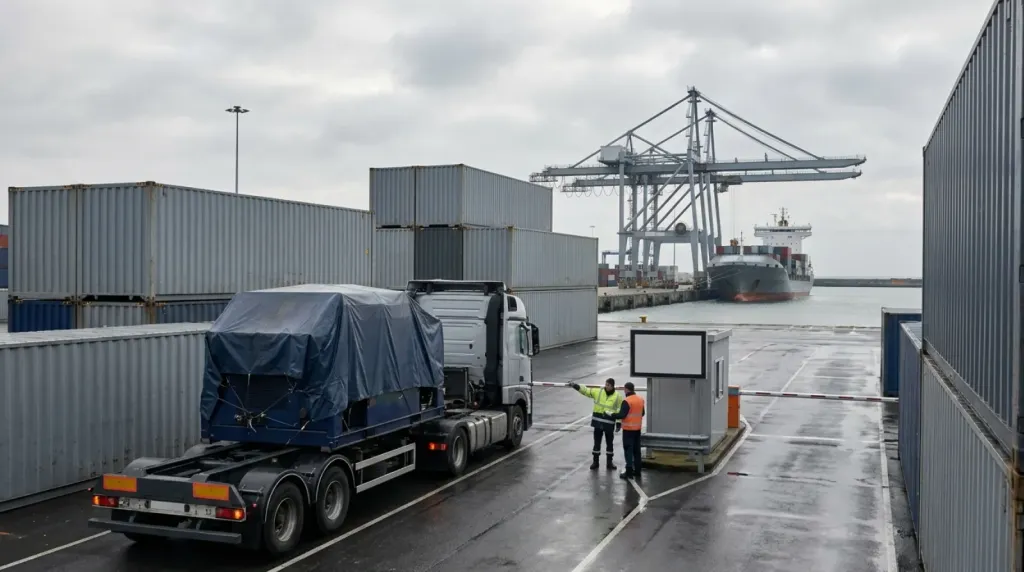
 AI image
An ADR check at the border and en route verifies that a dangerous goods movement complies with ADR: it inspects the transport document, marking and hazard labels, orange-coloured plates, vehicle and driver equipment, the driver's ADR certificate, and the consistency of packaging and packages. Any missing or incorrect element can mean the vehicle is immobilised, a fine, and delay.
What does an ADR check verify?
A check compares what is actually in the trailer with what the paperwork declares and what the marking communicates. In practice inspectors look at several areas at once:
- the dangerous goods transport document,
- marking and hazard labels on the packages and on the transport unit,
- orange-coloured plates,
- the vehicle equipment and the driver's equipment and protective gear,
- the driver's ADR certificate,
- consistency of the packaging and the number of packages with reality.
Checks happen both at border crossings and during routine roadside inspections. A mismatch in any one area is enough for the transport to be held until it is clarified.
Documents that must match
At the heart of a check are the dangerous goods transport document and the driver's ADR certificate. The data in the document must match what is actually in the vehicle and what the marking on the packages shows. A discrepancy between paper, label and cargo is one of the most common reasons for intervention.
When the movement also crosses a customs border, ADR documentation runs alongside customs procedures. It pays to organise both flows in advance: read more about the customs side on our customs clearance page, and about crossing the border itself on our border procedures page.
Marking and hazard labels
Marking must make it unambiguous to anyone who comes into contact with the load what hazard they are dealing with. A check looks at the hazard labels on the packages, the marking of the transport unit, and the orange-coloured plates. Their presence, condition and correct placement are a safety element, not a formality.
The problem is often not only missing marking, but marking that is out of date, damaged, or left over from a previous load. That is why marking is set up afresh for every movement.
Common faults that stop the transport
Most often it is not one major irregularity but a cluster of small gaps that together immobilise the vehicle. The recurring ones are:
- a missing or incomplete dangerous goods transport document,
- missing, out-of-date or damaged hazard labels and marking,
- missing or wrongly placed orange-coloured plates,
- incomplete vehicle or driver equipment,
- no valid driver ADR certificate,
- packaging or the number of packages not matching the document.
The consequences are concrete: the vehicle immobilised until the fault is fixed, a fine, and a delay that spreads through the whole supply chain. It is cheaper and faster to catch gaps before loading than to explain them on the hard shoulder.
How to prepare an ADR movement with OTSL
OTSL arranges international road transport and helps put the documentary and border side of a movement in order. Before the load sets off, we keep the documentation and marking consistent with the paperwork and align the movement with border procedures and customs clearance where the route requires it. The goal: to make the check a formality, not a surprise on the road.
Planning a movement that may fall under ADR? Describe the direction and type of cargo through our contact form, and together we will check what must match before the truck leaves.
Step by step
- Verifying documentation. Check the transport document for accuracy and complete entries regarding dangerous goods.
- Inspecting vehicle marking. Ensure orange-coloured plates are correctly mounted and clearly visible.
- Checking emergency equipment. Test fire extinguishers and confirm the completeness of the safety kit and protective gear.
- Validating driver qualifications. Verify the validity of the driver's ADR certificate and personal identity documents.
- Inspecting cargo condition. Assess packaging integrity, seal tightness, and hazard labels on individual packages.
Definitions
- ADR (European Agreement concerning the International Carriage of Dangerous Goods by Road): An international treaty setting standards for the safe transport of dangerous goods by road.
- ADR transport document: A consignor declaration containing detailed information regarding the dangerous material, its classification, and volume.
- Orange-coloured plates: Reflective hazard plates displayed on the transport unit to notify authorities and road users of dangerous cargo.
- Driver ADR certificate: An official permit confirming that the driver has completed specialized training for transporting dangerous goods.
- Hazard labels: Diamond-shaped labels attached to packages or transport units indicating specific risks.
When does this rule not apply?
This rule does not apply to shipments of dangerous goods moved under limited quantity provisions or statutory threshold exemptions.
The OTSL role
At OTSL, we organise compliant movements of dangerous goods, ensuring all documentation and markings are correct before departure. Discover our professional ADR transport services and learn more about requirements in our guide on ADR transport, moving dangerous goods step by step.