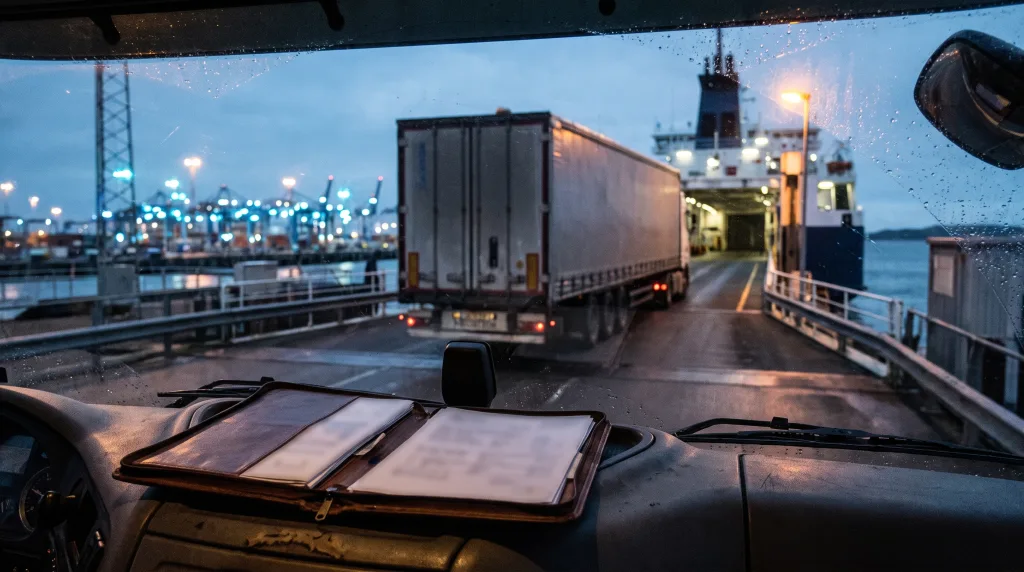
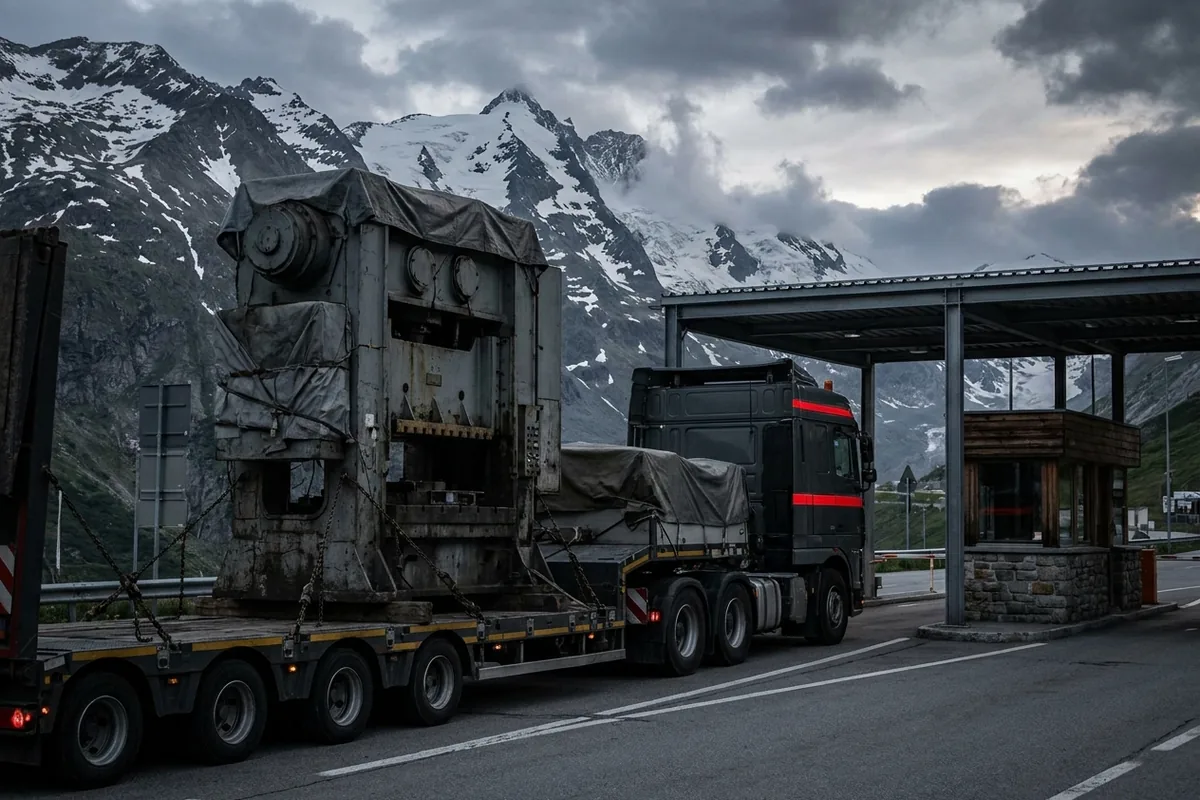
 AI image
Transporting a machine to Switzerland looks different now than a few years ago. Since 1 January 2024 Switzerland has scrapped customs duty on industrial goods, so machinery (HS headings 84 and 85) enters duty-free regardless of origin. The real fiscal cost that remains is import VAT of 8.1 percent, plus customs formalities and permits if the unit exceeds size or axle-load limits.
Why machinery is the hard case
A single production machine is typically heavy, expensive and awkwardly sized. A press, a CNC machine, a generator set or a packaging line can weigh well over ten tonnes and exceed the standard trailer envelope. On top of that, Switzerland is not part of the EU customs union, so every shipment goes through full clearance at the border. Three concerns overlap: the fiscal settlement (today mainly VAT, not duty), the customs formalities and the dimensions. Neglect any one of them and the transport can be stopped at the crossing or generate a charge the client never expected. We map the full border path in our piece on exporting to Switzerland and customs procedures.
Duty and origin: for machinery the rate is now zero
Until the end of 2023, exporters guarded the EUR.1 certificate because it was what brought duty to zero. Since 1 January 2024 Switzerland has unilaterally abolished customs duty on industrial goods (tariff chapters HS 25-97, with a few agricultural exceptions). Machinery falls within that scope, so its import is now duty-free regardless of origin, and the standard rate for such a heading is zero. In practice, EUR.1 for import duty alone is usually no longer needed for a machine. The Swiss Federal Office for Customs and Border Security (BAZG) confirms the change at bazg.admin.ch.
Origin and EUR.1 keep their weight in two situations. The first is goods that remain dutiable, chiefly agricultural and food products (HS headings 1-24), where duty by gross weight still applies. The second is onward trade: origin cumulation or re-export, where preferential origin must be documented despite the zero rate on entry into Switzerland. So if EUR.1 is needed, the rules of origin for the specific tariff heading apply.
The essence of the rules of origin has not changed. A machine assembled in the EU from components sourced worldwide does not automatically qualify as EU-originating. You have to check the rule for the specific tariff heading, for example the threshold for non-originating materials or a change-of-classification requirement. You can verify whether a given HS code is dutiable in the Swiss customs tariff Tares.
- Determine the machine's tariff code (HS) before shipping and check whether the heading is dutiable (Tares).
- For machines in HS 84 and 85 duty is usually zero, so EUR.1 is not required for import clearance itself.
- If EUR.1 is needed (re-export, cumulation, dutiable goods), issue it for consignment value above EUR 6,000, and an invoice declaration below that.
- Gather production records proving the origin of components if you claim preference.
Import VAT and weight: what you actually pay
With duty on machinery at zero, the main fiscal cost of importing into Switzerland is import VAT. The standard rate is 8.1 percent (the reduced 2.6 percent rate covers a narrow range of goods, not machinery). The basis is not the machine's price alone but the customs value plus the cost of transport and insurance up to the Swiss border. For a company registered for VAT in Switzerland the tax is usually deductible, but it still has to be settled at clearance. You can check the rate and the rules with BAZG at bazg.admin.ch.
Weight still matters, just for different reasons than before. For goods that remain dutiable (agricultural), it is gross weight that drives the duty, together with the mass of the crate, pallet and securing. We break that mechanism down in our article on Swiss customs duty by weight. For machinery, weight and dimensions decide the choice of trailer and whether the transport becomes an abnormal load, and the transport cost feeds into the VAT base.
Electronic clearance on the Swiss side now runs in the Passar system, which replaced the former e-dec. The declaration is prepared by a customs agency, and accurate value, weight and tariff data determine both the correct VAT settlement and whether clearance goes smoothly.
Dimensions: when a machine becomes an abnormal load
If the machine together with the trailer exceeds permitted dimensions or axle loads, the transport becomes abnormal. Permits are then required, and for larger excesses also an escort vehicle and an agreed route. We cover the rules and categories in our guide to abnormal load transport, permits, escorts and clearance envelope.
- Height, width, length and total mass determine the permit category.
- The route must account for bridges, tunnels, roundabouts and vertical clearance.
- Large dimensions require a pilot vehicle, sometimes a full escort.
- Permit lead times must be built into the schedule, as they can extend delivery.
In Switzerland, heavy transport is additionally subject to the LSVA road charge, levied on heavy goods vehicles based on weight, emissions and kilometres driven. It is a carrier cost, but it feeds directly into the freight price, especially for heavy loads over long stretches inside Swiss territory.
Three layers of documents that must agree
The most common mistake is a mismatch between documents. The tariff code on the invoice, the description on the CMR (the Convention on the contract for international carriage of goods by road), the weight and value in the customs declaration and any proof of origin all have to form one consistent set. A discrepancy will be caught at clearance and the transport stops.
| Area | Document | Risk if wrong |
|---|---|---|
| Duty and origin | EUR.1 or invoice declaration (if goods are dutiable or re-exported) | For machinery duty is zero anyway; for agricultural goods duty on full value |
| VAT and clearance | Declaration in the Passar system | Wrong VAT base, correction, penalty, delay |
| Dimensions | Permit and route plan | Turned back at the border, fine, delay |
How do we run this transport at OTSL?
We run machinery transport to Switzerland as one coherent order, with a single point of contact from the first quote to delivery. We handle clearance in our own customs agency, so the tariff code, the VAT base and any proof of origin are agreed under one roof rather than bounced between firms. We match the trailer to the dimensions and, where limits are exceeded, arrange permits and escorts. There is more about the scope on our Switzerland destination page and in the overview of our services.
Planning to ship a unit or a production line to Switzerland? Send us the weight, dimensions and delivery point through our contact form. We will come back with a concrete plan: the customs and VAT status, the clearance path and, if needed, abnormal-load permits. No surprises at the border.
Step by step
- Verification of machine parameters. Analyse the dimensions, weight and HS tariff classification for the transported equipment.
- Preparation of customs documentation. Gather the commercial invoice, packing list and any relevant origin declarations.
- Obtaining abnormal load permits. Apply for special transit permits with relevant authorities if the consignment exceeds standard dimensions.
- Arranging customs clearance. Declare the goods for Swiss import procedures and settle the applicable import VAT.
- Executing the transport and delivery. Transport the machinery to its destination in line with safety requirements and schedules.
Definitions
- HS (Harmonised System): An international goods classification system used to identify machinery and equipment for customs purposes.
- EUR.1 (EUR.1 Movement Certificate): A customs document confirming the preferential origin of goods in international trade.
- Import VAT (Einfuhrsteuer): A Swiss tax levied on imported industrial goods and machinery upon entry into the country.
- Out-of-gauge transport: The movement of cargo that exceeds standard legal dimensions or axle weight limits.
The OTSL role
OTSL coordinates the international transport of industrial machinery and handles customs formalities at the Swiss border. Offering specialized out-of-gauge loads services, the company helps choose suitable transport solutions and route options. Read more about handling complex shipments in our guide to out-of-gauge and special loads.