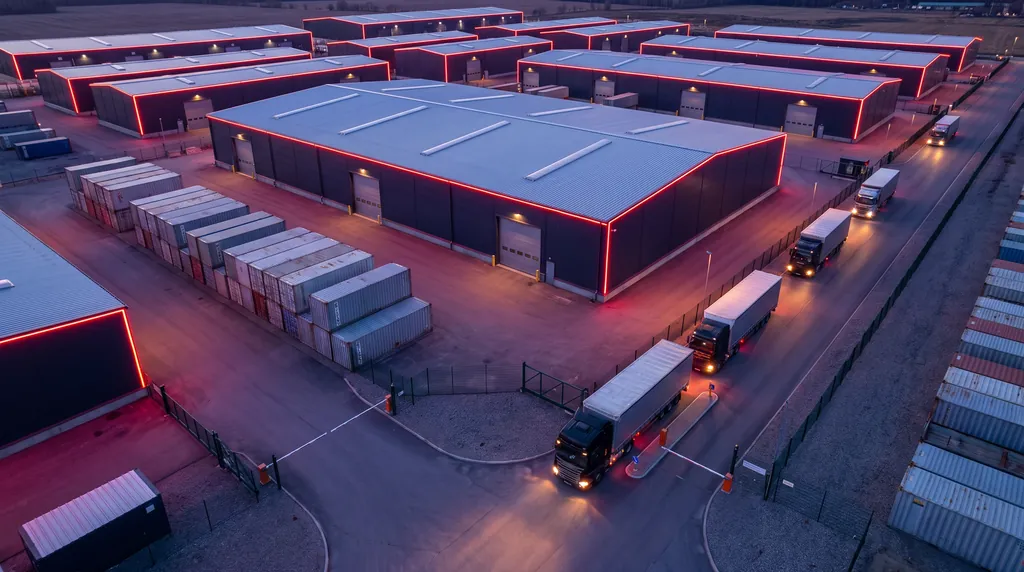
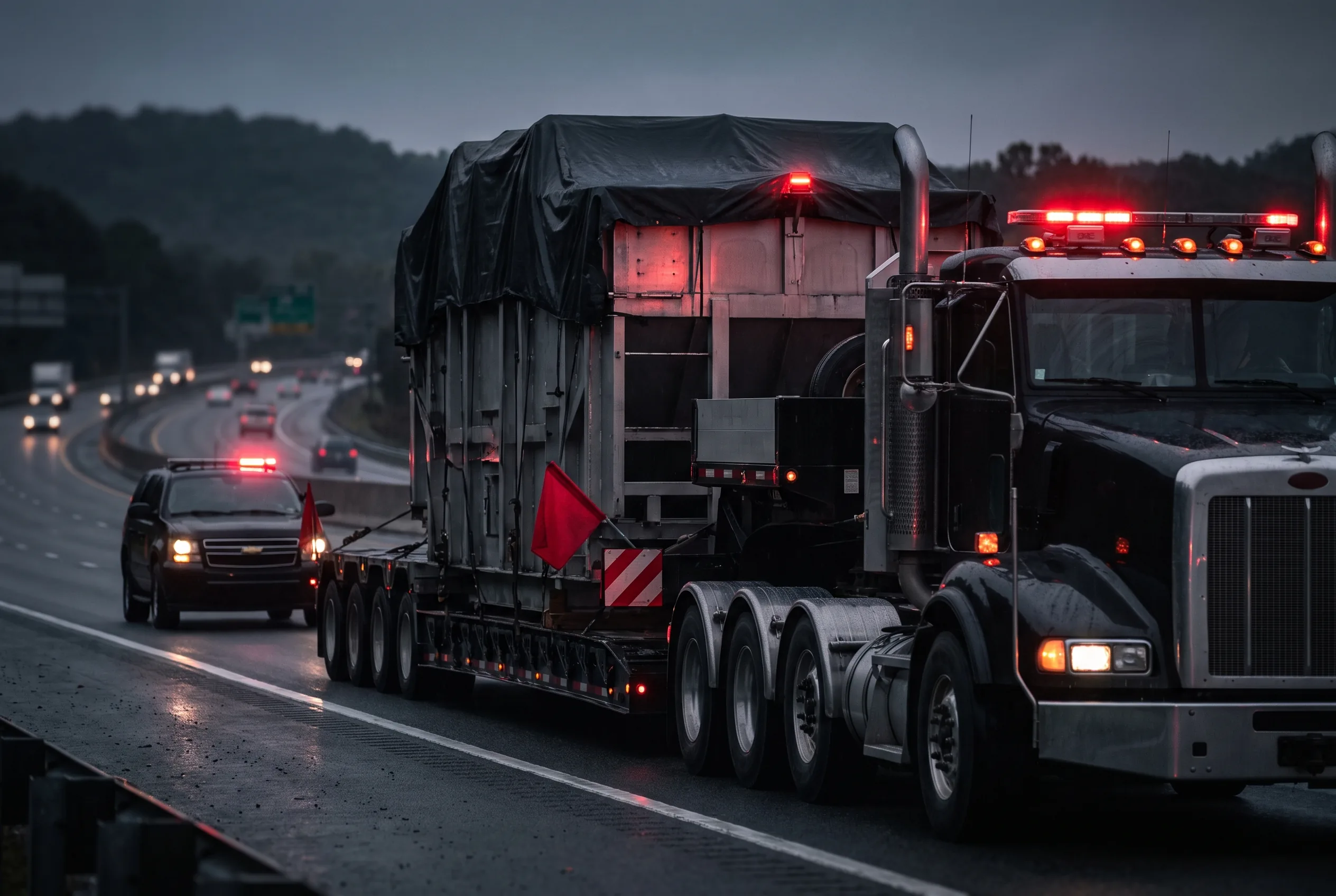
 AI image
Abnormal load transport means moving a vehicle that exceeds the permitted dimensions, weight or axle loads. In Poland it requires a permit in one of five categories (I-V), issued depending on the category by the road administrator, the county head or GDDKiA, and above certain dimensions also escort vehicles. In the United Kingdom oversized loads move under STGO rules, with notifications in the ESDAL system.
The Polish-language version of this article is the reference one. This is an informational translation.
What dimensions and weights are standard
In EU haulage the standard is: width up to 2.55 m (2.6 m for refrigerated bodies), height up to 4 m, length up to 16.5 m for a tractor with semi-trailer and 18.75 m for a road train, and a gross vehicle weight up to 40 t. Anything above these values is oversized transport and needs a permit before departure, not after the fact.
Permit categories in Poland: five, not seven
Older guides still list seven permit categories (I-VII). That division no longer applies: since March 2021 the Polish Road Traffic Act provides for five categories.
- Category I: slow-moving vehicles and agricultural tractors with special trailers. Issued by the road administrator.
- Category II: width up to 3.2 m, length up to 15 m (single vehicle) or 23 m (combination), height up to 4.3 m, axle loads and weight within limits. Issued by the county head, for 1, 6, 12 or 24 months.
- Category III: width up to 3.4 m, length up to 15 m, 23 m or 30 m (combination with steering axles), height up to 4.3 m, axle loads and weight within limits, on national roads. Issued by GDDKiA; it also covers Category II rights.
- Category IV: dimensions as in Category III, but width up to 4 m on motorways and expressways and an actual gross weight up to 60 t. Issued by GDDKiA.
- Category V: everything beyond Categories I-IV. A permit for a designated route, for a single movement (valid 14 days) or multiple movements (valid 30 days).
For entry into Poland from abroad, permits of some categories are also issued by the head of the customs and tax office. The paperwork is done before the movement; an abnormal movement without a permit means administrative fines and a stopped transport.
When an oversized movement needs an escort
Under the Polish regulation on escorting non-standard vehicles, one escort vehicle is required when the vehicle exceeds even one of these values: length 23 m, width 3.2 m, height 4.5 m or actual gross weight 60 t. Two escort vehicles, one in front and one behind, are required above: 30 m in length, 3.6 m in width or 4.7 m in height, and also when non-standard vehicles move in a convoy.
Clearance and route planning
The permit is not everything. The route of an abnormal movement is planned around the clearance of specific structures: overbridges, footbridges, overhead lines, roundabouts, traffic islands and bridges with limited load capacity. Preparing the movement therefore includes route verification, sometimes detours counted in tens of kilometres, and for the largest dimensions arrangements with road administrators.
How does it work in the United Kingdom: STGO?
In the UK indivisible abnormal loads move under STGO (the Special Types General Order) in three categories: Category 1 up to 46 t (with at least 5 axles) or 50 t (with 6 axles), Category 2 up to 80 t, Category 3 up to 150 t, with axle load limits. The movement requires prior notification to highway and bridge authorities and the police: as a rule 2 working days for Categories 1 and 2 and 5 working days for Category 3. Notifications are handled by the ESDAL system run by National Highways. An attendant is required, among other cases, at a width above 3.5 m or an overall length above 25.9 m.
Step by step
- Parameter verification. You check the exact dimensions, total weight, and axle loads of the planned cargo.
- Route planning. You analyze the intended corridor taking into account infrastructure height and weight limits.
- Permit application. You submit the request for the required permit category to the competent road authority.
- System notification. You register the movement in the ESDAL system for transport routes involving the UK.
- Escort organisation. You arrange escort vehicles and pilot assistance along the route according to regulatory demands.
Definitions
- Abnormal load transport: The movement of a vehicle or combination that exceeds permitted dimensions, total weight, or axle loads.
- Non-standard vehicle: A vehicle defined under the Polish Road Traffic Act whose axle loads, dimensions, or actual gross weight exceed standard limits.
- GDDKiA (Generalna Dyrekcja Dróg Krajowych i Autostrad): The Polish General Directorate for National Roads and Motorways issuing heavy transport permits.
- ESDAL (Electronic Service Delivery for Abnormal Loads): The UK system used to notify police and road authorities about oversized cargo movements.
- STGO (Special Types General Order): The UK regulatory framework governing the road movement of specialized non-standard vehicles.
When does this rule not apply?
The special permit procedure does not apply if the vehicle dimensions and gross weight remain within standard EU limits, such as a maximum width of 2.55 m and gross weight up to 40 tonnes.
The OTSL role
When moving oversized cargo across international borders, OTSL assists with routing and regulatory compliance. Learn more about our out-of-gauge loads services and read our guide on out-of-gauge and special loads to understand the requirements.
Sources
- GDDKiA (gov.pl), non-standard movements
- biznes.gov.pl, Category II-IV permits
- biznes.gov.pl, Category V permit
- GOV.UK, Special types enforcement guide (STGO)
- National Highways, ESDAL, advice for hauliers
Planning an oversized movement? See our out-of-gauge loads service or describe the cargo in the contact form: we will select the equipment, the permit category and the escort.