 AI image
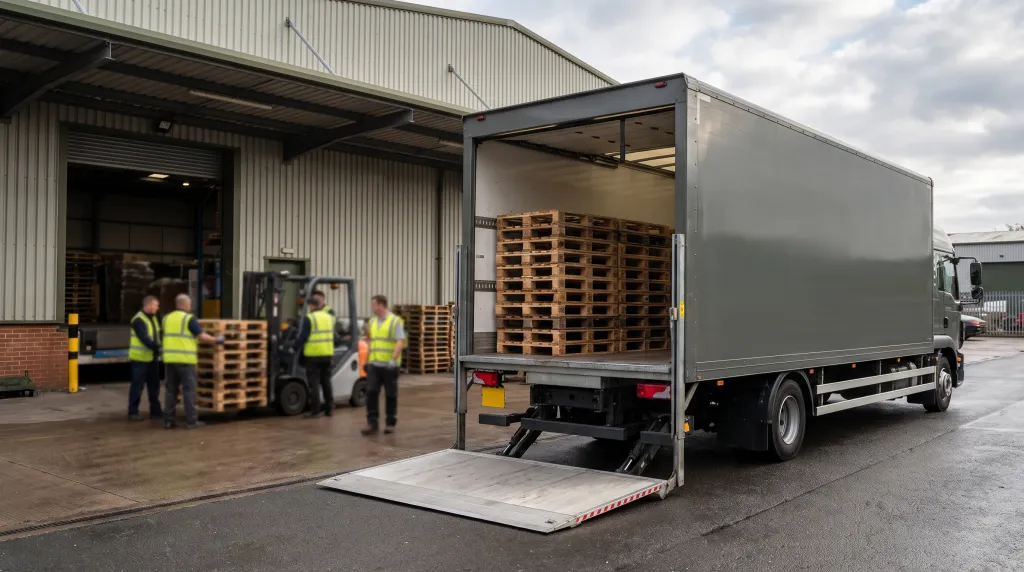
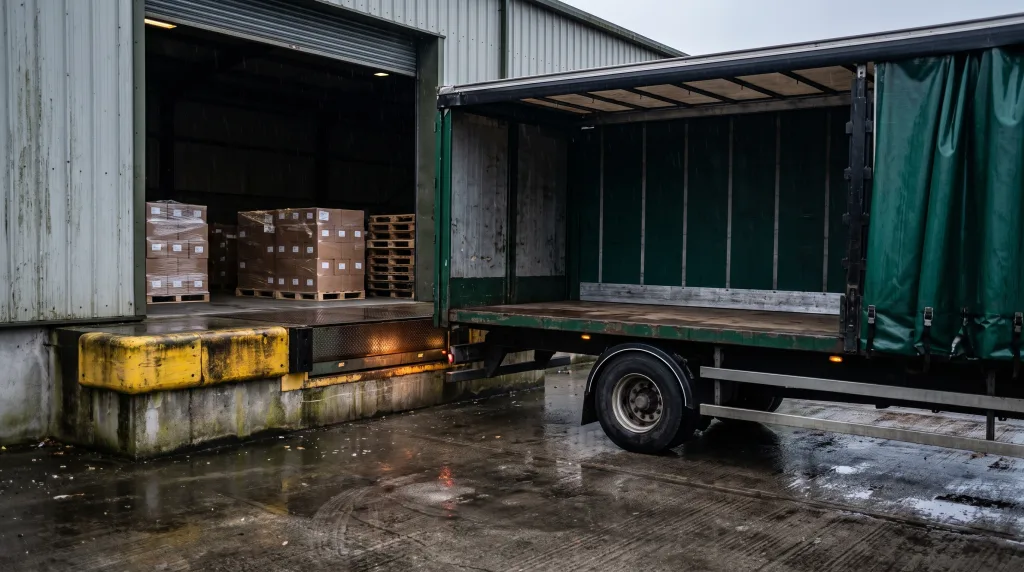
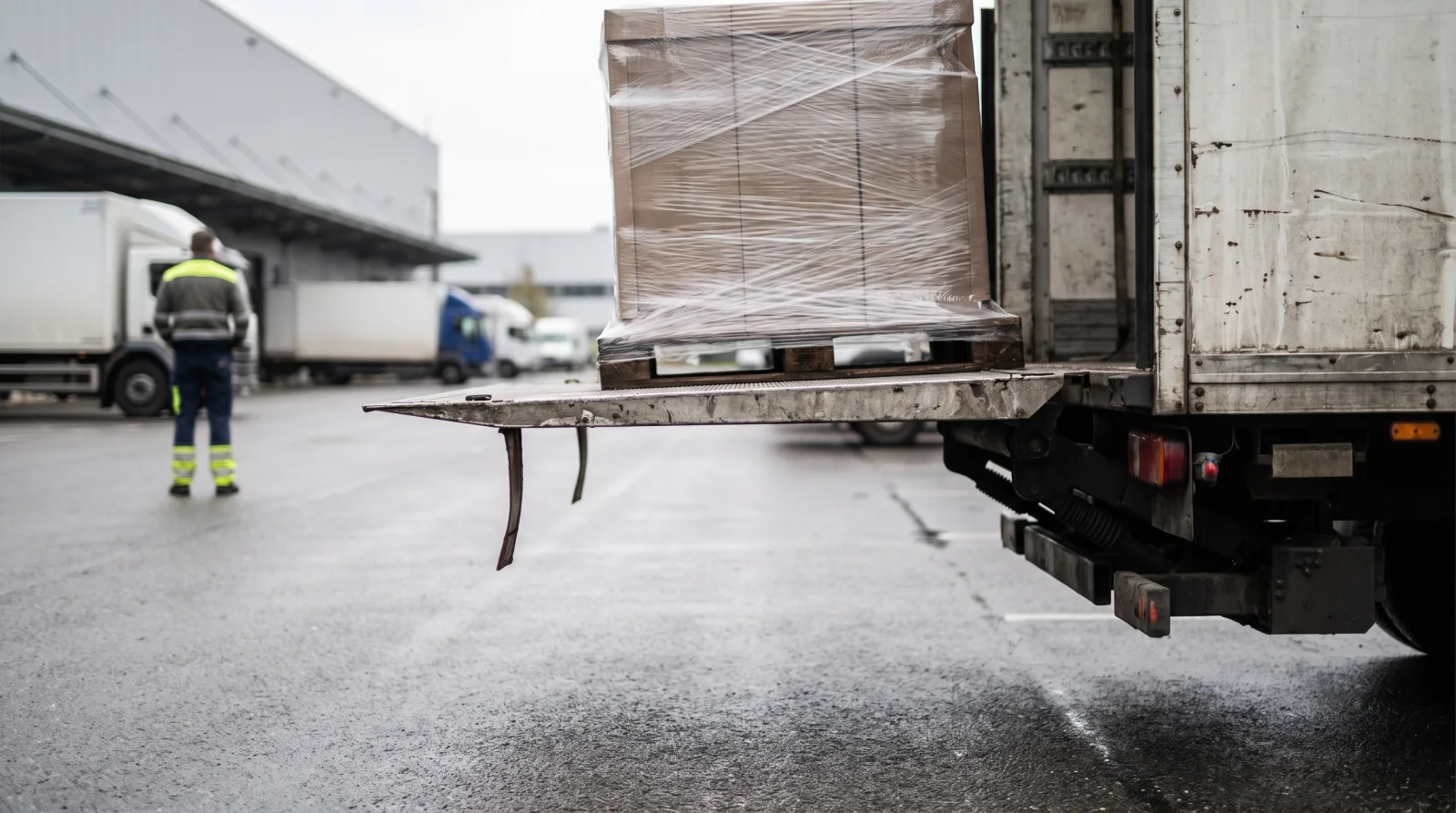
If the consignee has no ramp or dock, there are three options: a tail lift (up to 1.5 t per cycle, the standard for palletised goods), a lorry-mounted crane (heavy, long or over-the-fence placements) or unloading by the consignee with their own forklift. The choice determines the vehicle type, and therefore price and lead time, so it has to be settled before quoting rather than on delivery day.
Comparison
| Tail lift | Lorry crane | Consignee dock | |
|---|---|---|---|
| Typical limit | up to 1.5 t per cycle | several tonnes, boom dependent | no lift limit |
| Where it places | right behind the vehicle | within boom reach | at dock level |
| Pallet truck needed | yes | no | consignee forklift |
| Space required | approx. 3 m behind | room for outriggers | turning area |
| Time per drop | 15–40 min | 30–90 min | 10–20 min |
When a tail lift is enough
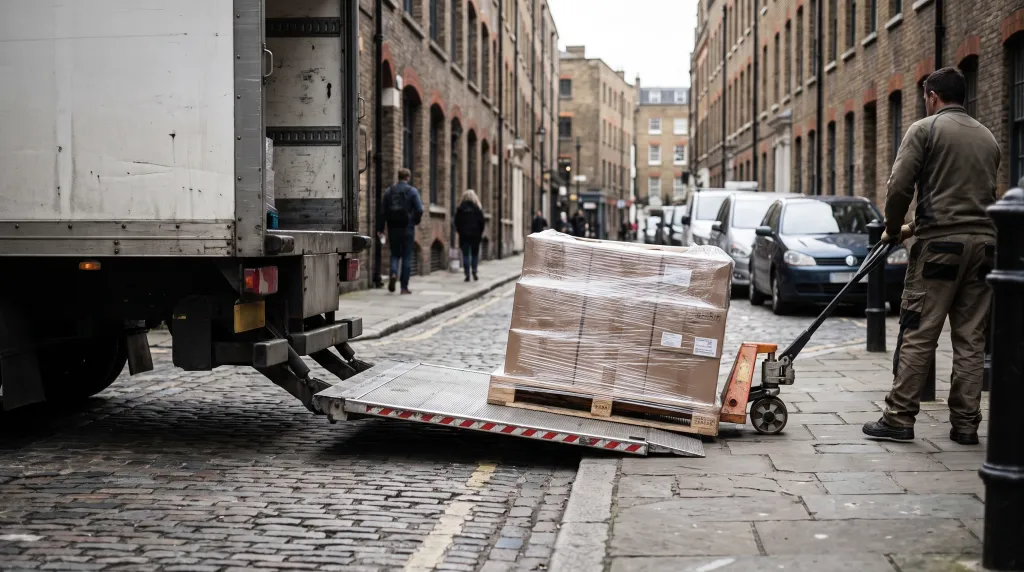
A tail lift is the right call for palletised goods where no single pallet exceeds 1.5 tonnes, the ground behind the vehicle is firm and reasonably level, and there is room to roll off with a pallet truck. That covers the large majority of deliveries to shops, workshops, offices, exhibition halls and smaller plants.
When a tail lift is not enough
- A single item over 1.5 tonnes: machinery, a transformer, a tank.
- The load must be placed deep in a yard, behind a fence or on a slab.
- The ground behind the vehicle is sand, mud, a sloped kerb or a step with no drop.
- Non-palletised goods that cannot be moved with a pallet truck.
These need a crane or consignee unloading. It is not a surcharge on the same vehicle; it is a different vehicle and a different slot.
Settle this before quoting
- Does the consignee have a ramp or dock. First and most important question.
- Weight of the heaviest single pallet or item.
- Ground condition and room to roll off behind the vehicle.
- Whether someone will be on site, and during which hours.
What does the three option cost in practice?
A tail lift is included in the vehicle rate rather than billed separately, but it narrows the pool of available vehicles, so at short notice it can raise the freight price. A crane is a different vehicle and a different cost class, usually billed with crane working time. Consignee unloading is cheapest but shifts risk onto the consignee: if the forklift breaks down or the operator does not turn up, the vehicle waits and demurrage runs.
The common trap: "the consignee has a forklift"
A statement that the consignee has a forklift can be true and useless at the same time. A warehouse truck will not drive out onto block paving, an electric one will not cross an uneven yard, and the licensed operator may happen to be off. For one-off deliveries to a new consignee it is safer to order a tail-lift vehicle even where a forklift theoretically exists.
Multi-drop runs
On a route with several drops the tail lift changes the arithmetic even more. One tail-lift vehicle serves every point regardless of whether any of them has a ramp. Without one, the route has to be built so that every consignee can unload, and a single point without equipment collapses the plan and forces a separate return run.
What does OTSL do?
We run distribution with 12 and 18 tonne rigids with tail lifts to Germany, the Netherlands, Belgium, France and Austria, and on exhibition work across Europe. We ask about the ramp and the pallet weight ourselves, so the vehicle that turns up can actually unload.
Specification, parameters and a quote form: rigid truck with tail lift, 12 t and 18 t.
Definitions
- Lorry-mounted crane (HIAB): A hydraulic crane installed on a vehicle, used to lift cargo over the sides and place it within boom reach.
- Tail lift: A mechanical lifting platform attached to the rear of a vehicle that lowers goods vertically to ground level.
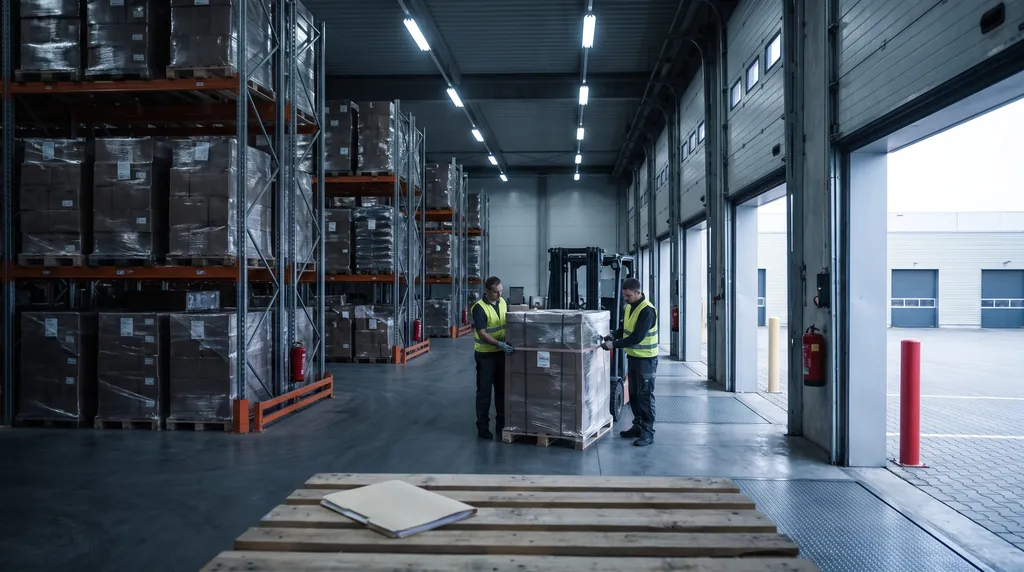
- Loading dock: An elevated warehouse platform matching the height of the vehicle floor to enable smooth loading and unloading.
- Pallet truck: A manual or powered tool used to move palletised loads across flat surfaces or inside the cargo bed.
When does this rule not apply?
This rule does not apply if the consignee provides their own forklift on site with adequate capacity to unload the goods directly from the vehicle.
The OTSL role
OTSL helps select the appropriate vehicle type for destinations without unloading infrastructure, offering solutions such as Groupage (LTL). Detailed parameters regarding vehicle capacities are described in the article How many pallets fit on a 12 t and 18 t rigid truck, and what the tail lift carries. See also: Delivering where there is no ramp: how to prepare so the truck does not leave loaded.