 AI image
Since 31 January 2025, every import from the European Union into Great Britain requires an ENS (Entry Summary Declaration) safety and security declaration, lodged before the goods arrive. In the ro-ro model the carrier is responsible as a rule, although the obligation can be transferred by contract to another party. Great Britain also requires a reduced dataset.
The end of the post-Brexit transition
The safety declaration requirement for EU goods did not appear out of nowhere. After Brexit, Great Britain ran a transition period for several years and did not enforce ENS for imports from the EU. That period is definitively over: since 31 January 2025 a safety and security declaration has been required for imports from the EU into Great Britain, just as it was already required for goods from the rest of the world. Anyone planning a supply chain on the UK lane needs ENS built into the process permanently, not treated as a temporary formality.
Who files the ENS in the ro-ro model
In ferry and Eurotunnel traffic, the ro-ro model, responsibility for lodging the ENS rests as a rule with the carrier or the operator of the means of transport. The rules do allow this obligation to be transferred by contract to another party in the chain, for example the forwarder handling the customs work. And this is where the practical problem starts: as a rule the carrier, plus transferable by contract, adds up to real room for misunderstanding in a live supply chain. The worst scenario is the one where every participant assumes somebody else has filed the declaration.
So the first rule of working with ENS is: state explicitly in the transport order who lodges the declaration. Not the carrier will sort it out, but a named party, a named system and proof of lodging kept with the transport file. In regular trade lanes it pays to fix this split of duties once, in the framework agreement, and apply it consistently.
When is it lodged and what it contains?
The ENS is lodged before the goods arrive in Great Britain, so that the British authorities can run their risk analysis before the unit boards the ferry or the shuttle. The content is exactly the data that analysis needs: who ships and who receives the goods, what is moving, how it is packed, by which route and by which means of transport.
The good news for UK-bound operations: Great Britain has reduced the set of required fields compared with the full dataset. A reduced dataset means fewer boxes to fill and fewer chances to get one wrong. It does not change the principle that the data must be consistent with the rest of the transport documents; discrepancies between the declaration and the customs paperwork are a short path to questions from the authorities.
ENS is not ICS2. Two systems, two directions
| Criterion | S&S GB (ENS) | ICS2 (EU) |
|---|---|---|
| Direction | imports into Great Britain | goods entering the European Union |
| Administered by | the British authorities | the EU authorities |
| Dataset | reduced compared with the full set | full set required by EU rules |
Confusing the two systems is a common mistake in companies hauling both ways. The ENS in S&S GB covers goods heading into Great Britain. On the way back, into the EU, the EU ICS2 applies with its own requirements, including a strict approach to goods descriptions, which we cover in the article on banned goods descriptions in ICS2. One ferry rotation, two different security systems.
ENS and GVMS: one crossing, several filings
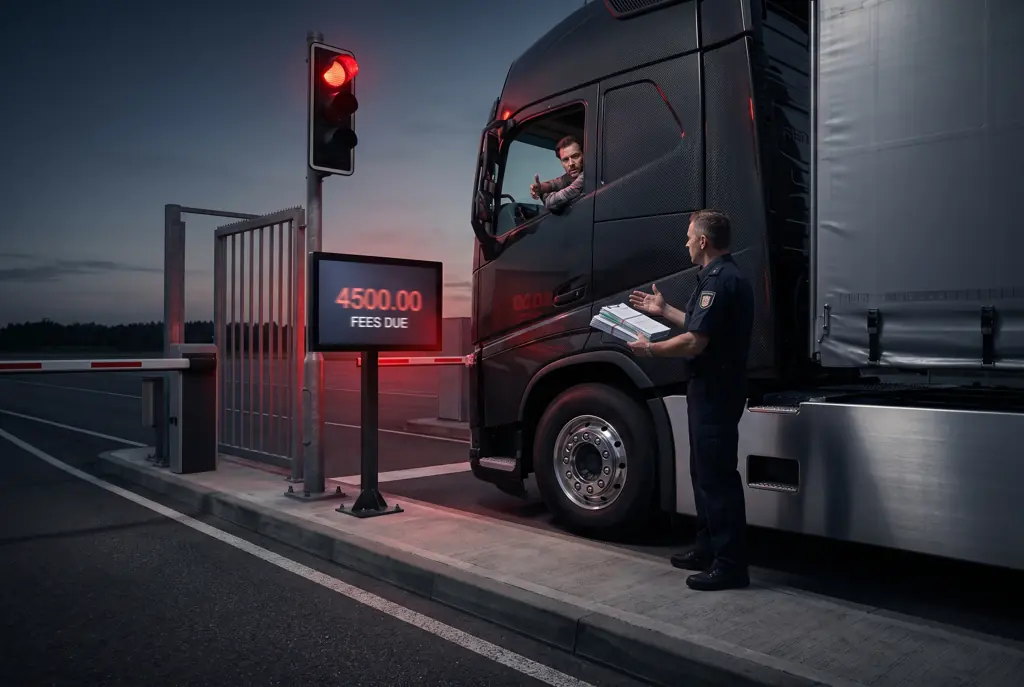
The safety declaration does not replace customs clearance or the border system entry. On the UK lane a unit needs the full set: customs declarations, the ENS and a GMR (Goods Movement Reference) reference in GVMS, which we explain step by step. A missing element can stop the truck at the terminal; what such a hold looks like and what every hour of standstill costs is described in our piece on border holds on the UK frontier. We will not price the penalties here; it is enough to say that a held unit with a time-critical load always costs more than properly prepared filings.
ENS step by step
- Establish who formally lodges the ENS: for unaccompanied ro-ro it is the ferry operator, for accompanied traffic the carrier; the contract of carriage can shift this duty to the forwarder.
- Collect the consignment data before departure: consignor, consignee, goods description, HS code, number and type of packages, gross mass and the vehicle registration numbers.
- Lodge the declaration in the S&S GB service before the deadline: at least 2 hours before arrival for short-sea ro-ro crossings.
- Record the MRN you receive and link it to the rest of the clearance in GVMS, so the GMR covers every filing for the crossing.
- If the ferry, the route or the cargo data change, correct the ENS before arrival: mismatched data holds the vehicle in port.
How does OTSL close the loop with its own customs clearance?
We run our own customs clearances on the UK lane, so ENS is not a bolted-on extra step for us but part of a single process: data from the commercial documents flows consistently into the customs declarations, the safety declaration and the GMR. We fix in the transport order who is responsible for the declaration, make sure it is lodged before arrival and check that the data matches across systems. Write to us if you ship to Great Britain and want the full set of filings in one pair of hands, or browse our knowledge base.
Definitions
- ENS (Entry Summary Declaration): A safety and security declaration lodged before goods enter Great Britain.
- S&S GB (Safety and Security Great Britain): The British IT system used to receive security declarations and conduct risk analysis.
- ICS2 (Import Control System 2): The European Union system used for security risk analysis of goods entering EU territory.
- Ro-Ro (Roll-on/Roll-off): A maritime transport method allowing wheeled vehicles to drive on and off ferries or vessels.
When does this rule not apply?
This requirement does not apply to goods moved under transit procedure or personal luggage, unless specialized border rules require otherwise.
The OTSL role
OTSL assists carriers and traders in fulfilling British border security standards efficiently. We handle International road transport operations and keep your supply chain compliant during critical situations like those described in our guide on trailer breach driver safety scenario. See also: CBAM and steel or aluminium imports into the EU: the free reporting phase is over.
Sources
GOV.UK, Safety and security requirements on imports and exports (gov.uk)