 AI image
CBAM, the EU carbon border adjustment mechanism, has left its free reporting phase: since 1 January 2026, importing steel and aluminium into the EU requires authorised CBAM declarant status, and the emissions embedded in the goods must be covered with certificates priced against EU ETS allowances. The obligations sit with the importer, not the carrier. A 50 tonne annual threshold exempts the smallest importers.
The timetable: from free reports to real money
The mechanism arrived in stages. From 1 October 2023 to 31 December 2025 the transitional period ran: importers filed quarterly CBAM reports on embedded emissions, within one month of the end of each quarter, with no payments attached. The report for the fourth quarter of 2025 closed that stage in early 2026. Ignoring the reports carried a price of its own: penalties between 10 and 50 euro per tonne of unreported emissions under Commission Implementing Regulation (EU) 2023/1773.
Since 1 January 2026 the definitive period applies. CBAM goods may only be imported by an authorised CBAM declarant, and the emissions embedded in goods released for free circulation must be settled with certificates whose price tracks the average auction price of EU ETS allowances. The amendment to the Regulation adopted in 2025 moved the start of certificate sales to February 2027, but it did not move the meter: certificates bought in 2027 will cover emissions from imports made from 1 January 2026 onwards. The cost arrives late and accumulated, so it belongs in this year's steel and aluminium contracts, not in next year's surprise.
| Stage | Timing | What applies | Who it concerns |
|---|---|---|---|
| Transitional period | 1 Oct 2023 to 31 Dec 2025 | quarterly reports on embedded emissions, no payments | importer or indirect customs representative |
| Definitive period | from 1 Jan 2026 | imports only with authorised declarant status, annual CBAM declaration | importer (authorised CBAM declarant) |
| Certificate sales | from February 2027 | purchase of certificates covering emissions counted from 1 Jan 2026 | authorised CBAM declarant |
| UK CBAM | planned from 1 Jan 2027 | a British counterpart for imports into the UK | importer into the UK market |
Who CBAM applies to: the importer, not the carrier
The obligations are addressed to the importer: the person declaring the goods for release for free circulation or, under the conditions set in the Regulation, an indirect customs representative who has agreed to take on the role. The carrier and the freight forwarder have no CBAM reporting duties of their own: a truck moving steel coils from Turkey or aluminium profiles from the United Kingdom is not subject to the mechanism, the import clearance of its cargo is. In practice, CBAM cost and risk are planned where duty and VAT are planned: when the Incoterms are set and when the parties decide who acts as declarant.
The 2025 amendment introduced a de minimis threshold: 50 tonnes of CBAM goods per importer per year, replacing the old exemption for consignments worth up to 150 euro. According to the European Commission, this releases around 90 percent of importers from the obligations while the mechanism still covers over 99 percent of the embedded emissions in imports. The trap sits in the counting: the 50 tonnes add up across the calendar year and across all CBAM goods of a given importer. A company bringing in a few pallets of bolts, fittings and profiles every month crosses the threshold faster than a single invoice suggests, and once crossed, the obligations attach to further imports.
Steel and aluminium: what exactly is covered
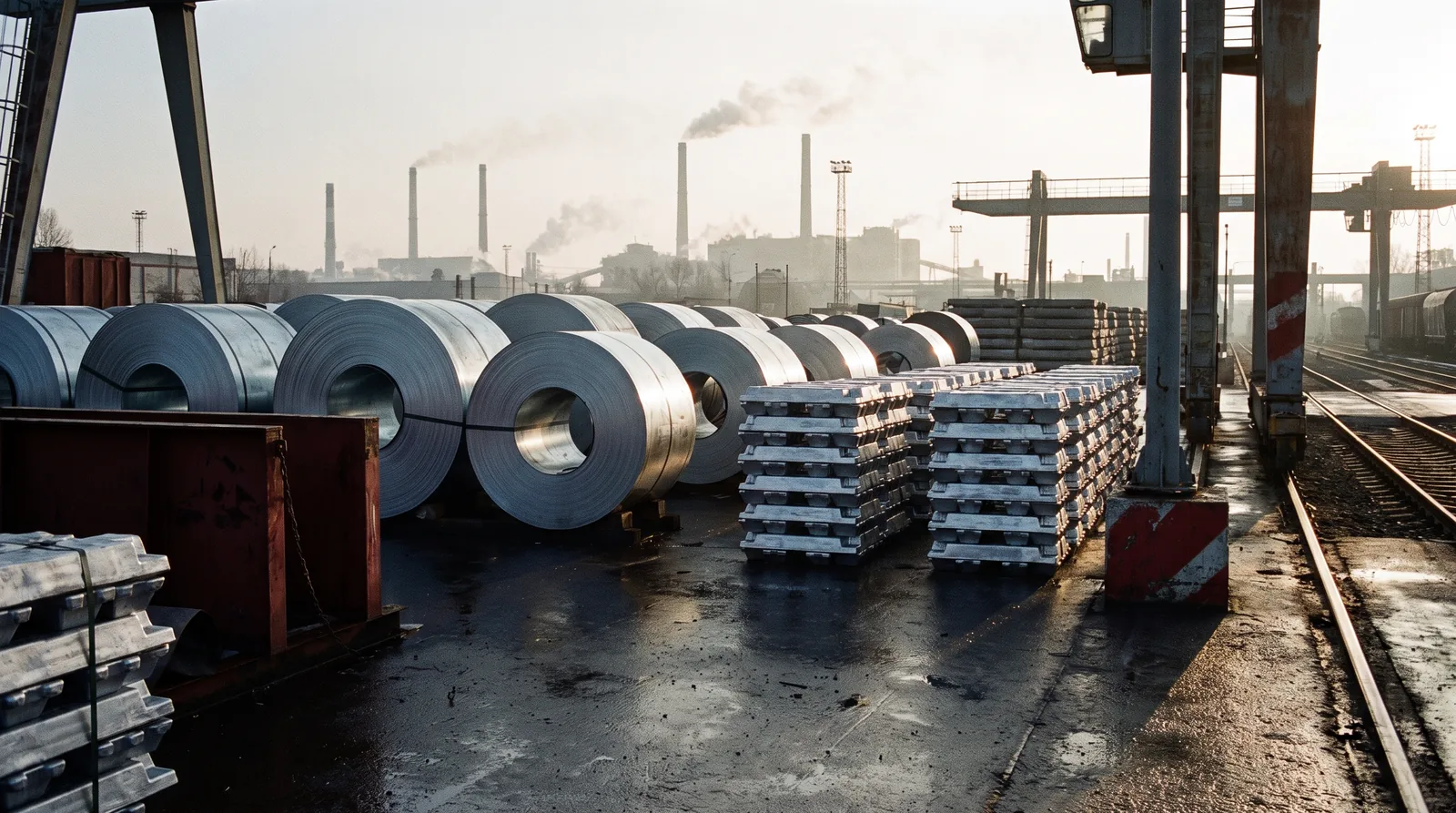
The scope is defined by the CN codes listed in Annex I of the Regulation. On the iron and steel side this means not only pig iron, billets and sheets from chapter 72, but also a long list of chapter 73 products: tubes, structures, even screws, bolts and nuts (CN 7318). On the aluminium side: unwrought metal, sheets, foil, profiles and structures from chapter 76. Whether a line item falls under CBAM is decided by tariff classification, so a wrong code now costs more than a duty reassessment alone; we show how to establish the code in our guide to the CN/HS customs tariff code.
For iron, steel and aluminium the definitive period settles direct emissions, in line with Annex II of the Regulation. There are also geographic exceptions: CBAM does not cover goods originating in Iceland, Liechtenstein, Norway and Switzerland, listed in Annex III, because those countries participate in the EU ETS or run a system linked to it. Steel bought from a Swiss producer therefore stays outside the mechanism, while imports from the United Kingdom, Turkey, China or India fall fully within it. What counts is the origin of the goods, not the country of dispatch.
Supplier data: what to request now
The settlement is built on actual embedded emissions, calculated by the operator of the installation where the goods were produced. Without the supplier's cooperation the importer is left with the default values published by the Commission, set conservatively high because they mirror emission-intensive production routes. The gap between actual and default values can decide the margin of an entire contract, which is why emissions data has stopped being an ESG side topic and become part of purchasing negotiations.
- Installation identification. The name and location of the plant where the goods were actually produced, not just the seller's details; in trade through intermediaries this is the most common gap.
- Direct emissions per tonne of product. Calculated with a method compliant with the CBAM implementing rules, with the reporting period stated.
- The CN code of every line item. It decides whether the item enters CBAM at all and which default value will apply when data is missing.
- A contractual clause. An obligation to deliver emissions data in every settlement period and supplier liability for its accuracy.
The UK plans its own CBAM from 2027
In its response to the public consultation, the UK government confirmed the intention to introduce a UK CBAM from 1 January 2027, covering aluminium, cement, fertilisers, hydrogen and iron and steel; glass and ceramics were left out of the initial scope. This is still a legislative plan, not law in force, and details may change before the start. For exporters of steel products from Poland it means mirror obligations on the side of the British importer. A separate thread is the announcement from the May 2025 UK-EU summit of an intention to link the two emissions trading systems: if such an agreement enters into force, imports from the United Kingdom could eventually be excluded from the EU CBAM, as imports from Switzerland are today. Until then the general rules apply, and we describe the clearance practice in that direction in our article on importing from the UK to Poland.
Carbon prices do not stop at the border or at the mill: from 2027 the ETS2 system will cover fuels burned in road transport, which we break down in our piece on ETS2 and CO2 costs in transport. A company importing steel will pay for emissions twice: once in the price of the goods, once in the freight rate.
The OTSL role
As an international freight forwarder we organise road transport of industrial cargo, including steel and aluminium products, between Poland, the United Kingdom, Switzerland and the rest of Europe, together with import and export customs clearance. CBAM does not change our role, but it raises the weight of the data in the paperwork: we watch the CN codes, the completeness of the clearance documents and the consistency of the records on which the importer builds its declaration. Our warehouses in Kielce, Legnica and Milton Keynes allow batches to be buffered and consolidated before clearance. The full scope sits on our customs clearance page, we break down the price of a clearance in customs clearance costs, and you can discuss a specific import through the contact form.
Who is responsible for CBAM compliance when transporting steel and aluminium?
The obligations regarding emission reporting, securing authorised declarant status, and purchasing and surrendering certificates lie entirely with the importer of the goods, rather than the carrier or transport company.
Step by step
- Check the TARIC commodity code. Verify whether the imported steel or aluminium falls under the scope of CBAM rules.
- Determine total import volume. Establish if your annual volume of imported goods exceeds the 50-tonne exemption threshold.
- Obtain declarant status. Apply for authorised CBAM declarant status prior to your planned import clearance.
- Calculate embedded emissions. Collect accurate data from your foreign supplier regarding emissions generated during manufacturing.
- Purchase and surrender certificates. Acquire the required number of CBAM certificates and settle them within the designated timeframe.
Definitions
- CBAM (Carbon Border Adjustment Mechanism): The European Union instrument adjusting border prices based on carbon emissions embedded in imported goods.
- EU ETS (European Union Emissions Trading System): The emissions trading scheme of the European Union providing the price benchmark for climate certificates.
- Embedded emissions: The greenhouse gas emissions generated directly and indirectly during the manufacturing process of goods outside the European Union.
- Authorised CBAM declarant: The official status required for an importer to bring CBAM-covered goods into the European market following the transitional period.