 AI image
Transporting and importing a screener (German: Siebanlage) from the United Kingdom to the European Union requires specialized heavy haulage permits and customs clearance. Weighing typically between 8 and 45 tonnes, these machines fall under CN code 8474 10. Although screeners usually require dismantling prior to transport, their overall dimensions after folding generally exceed standard road limits, necessitating out-of-gauge transport clearance.
Why does importing a screener from a UK auction require out-of-gauge permits?
Acquiring a screener at a UK auction involves immediate logistical planning for collection and transport across international borders. These industrial machines, used in crushing and screening applications, typically range in mass from 8 to 45 tonnes. Collection deadlines, site access rules, and loading conditions depend on the specific auction house terms and the guidelines stated in the exhibitor manual. Buyers must ensure that all logistical requirements are addressed before arranging collection.
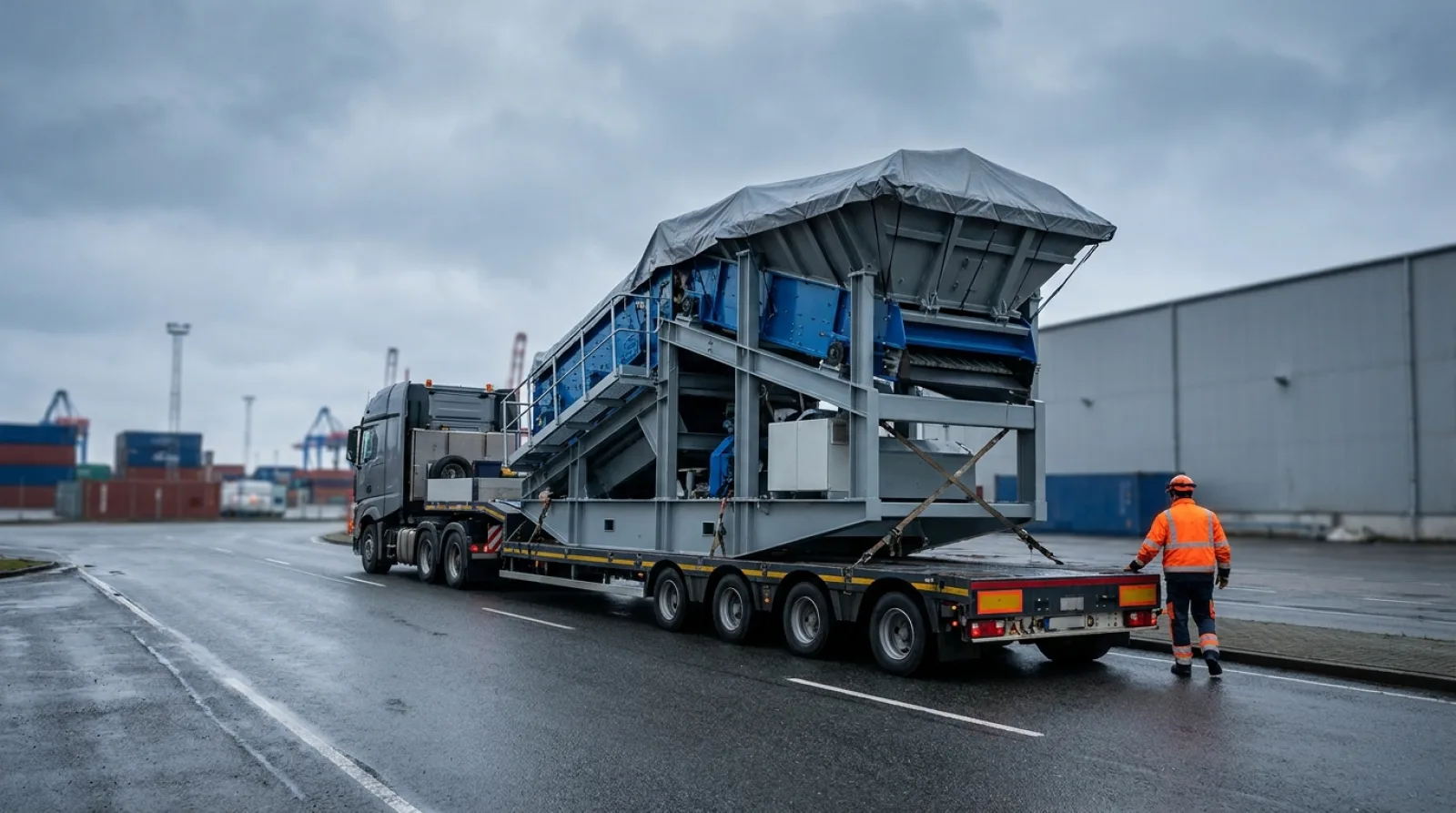
Much like a mobile crusher, a screener usually requires dismantling of side conveyors, hoppers, or screen decks for transit. However, even after folding and partial disassembly, the overall transport dimensions usually exceed standard road gauge limits. Consequently, transport cannot be performed using standard curtain-side trailers. Moving such equipment across the UK, transit countries, and into the EU mandates low-bed trailers, escort vehicles, and formal out-of-gauge transport permits.
How are screeners classified under CN code 8474 10 for customs clearance?
When entering the European Customs Union from the United Kingdom, every screener must undergo formal customs declaration. Under the Combined Nomenclature tariff system, screeners are classified under CN code 8474 10, which covers machinery for sorting, screening, separating, or washing earth, stones, ores, or other mineral substances in solid form. Accurate commodity coding is essential to ensure correct duty assessment and compliance with import regulations.
Customs clearance requires a complete set of documentation, including the commercial invoice from the auction house, bill of lading or transport document, and detailed packing list. Import VAT and applicable customs duties are determined based on the customs value of the machinery and the regulations of the entering EU member state. Importers may utilise deferred VAT mechanisms or inland customs clearance where applicable.
How to organise the import of a screener step by step?
- Review auction conditions and machine dimensions. Verify technical specifications, total weight within 8–45 t, and pickup rules specified in the auction terms or exhibitor manual.
- Dismantle and prepare the screener. Fold conveyors, remove screen extensions, and secure moving parts, noting that folded dimensions usually still exceed standard transport limits.
- Secure out-of-gauge transport permits. Arrange low-bed trailers and apply for abnormal load permits across the UK, transit routes, and destination countries.
- Complete UK export and EU import customs filings. Submit export declarations with HMRC and prepare import filings under CN code 8474 10 for EU customs.
- Execute transit and border crossing. Coordinate ferry or tunnel crossings and execute road movement according to route approvals and escort schedules.
- Deliver and finalize customs entry. Unload the machine at the destination site, verify physical condition, and complete final customs clearance documentation.
Definitions
- CN (Combined Nomenclature): The European Union eight-digit coding system used for classifying goods for customs tariffs and foreign trade statistics.
- HMRC (Her Majesty's Revenue and Customs): The United Kingdom tax authority responsible for border controls, customs duties, and trade compliance.
- Screener: Industrial machinery designed to separate raw materials or crushed rock into specified particle sizes using vibrating screen decks.
- EORI (Economic Operators Registration and Identification): A unique identification number required by businesses interacting with EU and UK customs authorities.
Checklist for importing a screener from the UK
- Obtain commercial invoice and release notes from the UK auction site.
- Confirm exact operating and transport weight within the 8–45 tonne range.
- Verify commodity classification under CN tariff code 8474 10.
- Apply for abnormal load route clearances and escort arrangements across all jurisdictions.
- File pre-departure UK export declarations with HMRC systems.
- Prepare EU import paperwork and select appropriate customs procedures.
When do these transport and import rules not apply?
The outlined out-of-gauge transport permits and import customs procedures do not apply if the machine is transported entirely within the European Single Market without crossing non-EU borders. The rules also do not apply if a machine is moved under an ATA (Admission Temporaire, the temporary admission document) Carnet for temporary exhibition or demonstration purposes, unless the equipment is subsequently sold within the destination country. Actual collection schedules and freight requirements depend on the contractual terms of the auction house and individual transport agreements.
The OTSL role
OTSL Sp. z o.o., headquartered in Kielce with operational facilities in Milton Keynes, England, manages international freight forwardings for heavy plant and industrial equipment. We offer specialized services for out-of-gauge cargo transport and full assistance with customs clearance for machinery originating in Great Britain. To learn more about importing machinery through European ports, read our guide on machinery customs clearance in the Netherlands and explore Regime 42 for EU import deferred VAT.