 AI image
Transport and import from the United Kingdom of agricultural machinery in the category plough and cultivator (German: Pflug und Grubber) requires formal customs clearance when crossing the EU border. These implements typically weigh between 0.5 and 6 t and usually do not require disassembly for transport. Classed under CN code 8432, as a mounted attachment they are easy to add to the transport of a tractor bought at the same auction.
What customs requirements apply when importing a plough and cultivator from the UK?
When purchasing agricultural machinery at a auction in the United Kingdom, full customs procedures apply before the goods can enter the European Union. Because Great Britain is outside the EU customs zone, every import must be declared to customs authorities. The primary supporting document is the invoice issued by the auction house, which confirms the sales transaction, item description, and total price.
Customs classification relies on the Combined Nomenclature, where a plough and cultivator falls under CN code 8432. The importer must possess an active EORI number registered within the EU and handle standard export formalities from the UK. Specific conditions regarding pickup windows, document handovers, and site clearance rules depend on the exhibitor manual and individual auction terms.
Why is a plough and cultivator easily transported alongside a tractor?
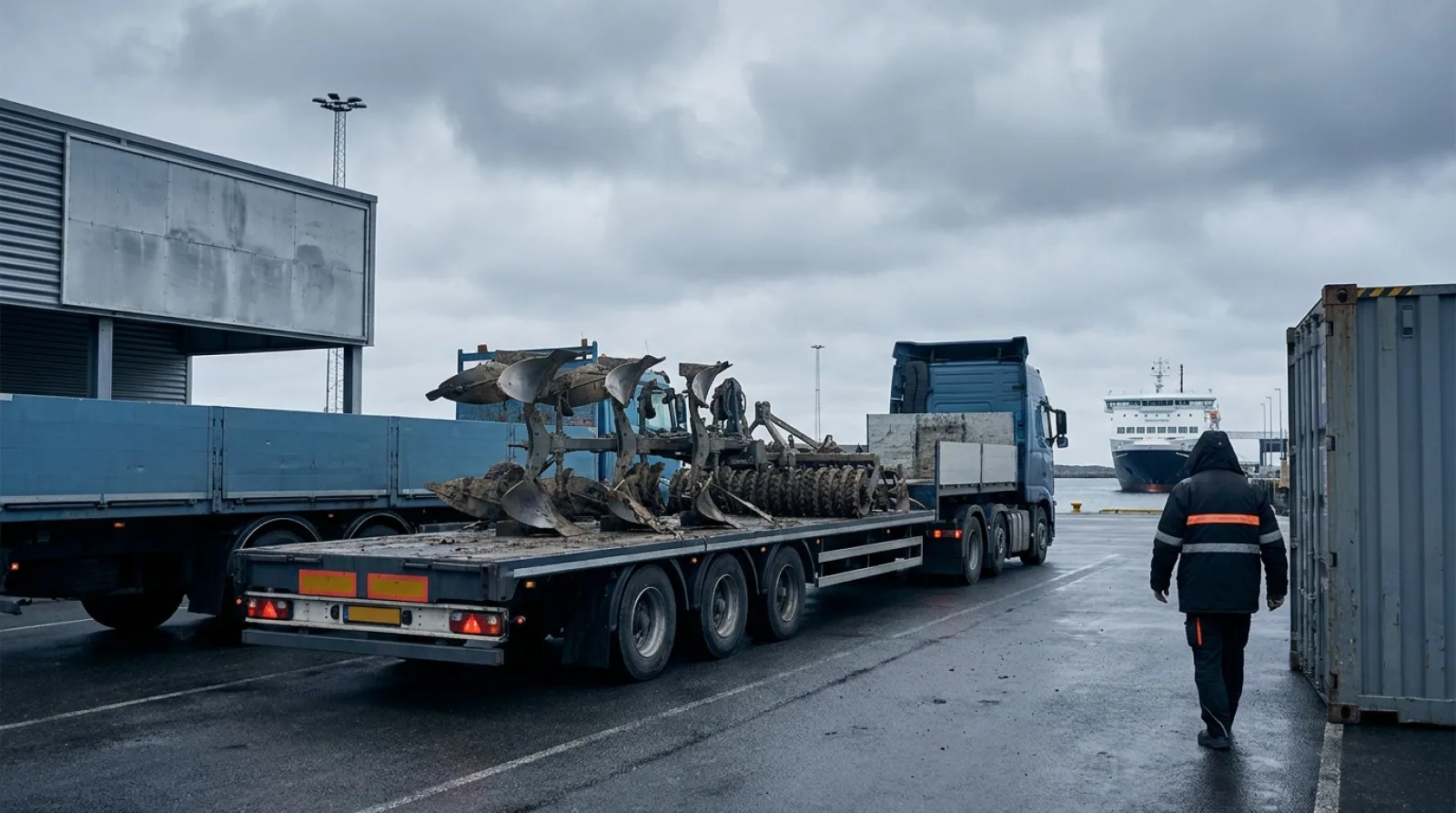
A plough and cultivator is designed as a mounted attachment intended for coupling with a farm tractor. This mechanical design feature means that in road freight, it is easy to add to the transport of a tractor bought at the same auction. When space permits on a flatbed or low-loader trailer, both items can be consolidated onto a single transport run, reducing logistics overheads.
With a typical weight range of 0.5–6 t, a plough and cultivator adds manageable mass to the vehicle payload without exceeding standard road axle weight limits. Furthermore, this category usually does not require disassembly for transport, which speeds up handling operations at the auction yard and simplifies offloading at the final destination in Europe.
How to organise transport from a UK auction step by step?
- Obtain sales documentation. Collect the invoice and purchase confirmation from the auction house showing CN code 8432.
- Prepare customs declarations. Submit commercial documents to a customs broker for UK export and EU import filing.
- Plan trailer consolidation. Arrange with the carrier to add the mounted attachment alongside a tractor bought at the same sale.
- Schedule yard collection. Coordinate collection times with the auction site in accordance with their exhibitor manual.
- Secure the load. Fasten the plough and cultivator onto the trailer deck using certified lashing straps without disassembling components.
- Cross border and finalize clearance. Complete transit formalities at the border and deliver the equipment to its final destination.
Definitions
- Combined Nomenclature (CN): The European Union goods classification system used for customs tariffs and international trade statistics.
- EORI number (Economic Operators Registration and Identification): A unique reference number required for businesses undertaking customs procedures in the EU and UK.
- Mounted attachment: An agricultural implement designed to be attached directly to a tractor hitch mechanism rather than being self-propelled.
- Plough and cultivator: Soil preparation farm machinery used for tilling, ploughing, and breaking up land prior to planting.
Checklist for preparing a plough and cultivator for transport
- Verify that CN code 8432 is specified correctly on invoice documentation.
- Ensure the unit weight is within the typical 0.5–6 t range.
- Confirm with the auction site that no disassembly is required before loading.
- Coordinate joint transport if purchasing a tractor at the same auction.
- Inspect designated lashing points before the transport vehicle leaves the site.
When do these transport rules not apply?
These standard rules do not apply if the equipment exceeds legal road width or weight parameters, requiring specialist out-of-gauge permits. They also do not apply to goods moved under temporary transit procedures to non-EU third countries, unless specific trade agreements are in place. Exact pickup schedules and yard storage rules depends on the auctioneer terms outlined in the auction manual.
The OTSL role
Freight forwarding company OTSL Sp. z o.o., headquartered in Kielce, Poland, with operational facilities in Milton Keynes, UK, handles cross-border machinery logistics. We provide full machinery transport for agricultural equipment purchased across the UK, seamlessly adding attachments to main vehicle shipments. Our team also manages customs clearance for goods under CN code 8432. For more background on industry events, consult our guide on Agrotech in Kielce or read about buying at Bonhams auction in the UK and machinery transport.