 AI image
Importing a site container and cabin (German: Baucontainer) from the United Kingdom into the European Union requires specific logistical and customs preparations. With a typical weight range of 1–4 t, these units usually do not require disassembly for transport. Their physical dimensions dictate the required transport method: this is not a load for a standard curtainside trailer, but for a flatbed platform. Assigned to CN tariff heading 9406, units purchased at UK auctions pass into the EU via formal customs clearance.
How is customs clearance handled for auction site cabins from the UK?
Purchasing site infrastructure and equipment at British auctions is subject to UK export and EU import customs regulations. Once an auction is won, the auction house issues an invoice or bill of sale that serves as formal proof of transaction. This document establishes the customs value of the item. Under the Harmonised System, a site container and cabin is classified under CN heading 9406 as a prefabricated building. To declare the item for import clearance in an EU member state, complete commercial and transport documentation must be presented.
Before leaving the UK auction yard, an export declaration must be lodged in the British HMRC system. Goods bound for the European Union travel under the NCTS transit procedure using a T1 document or proceed directly to final customs clearance at the border or an inland customs agency in the destination country. All import duty payments and value added tax settlements depend on the importer tax status and chosen customs regime in the EU.
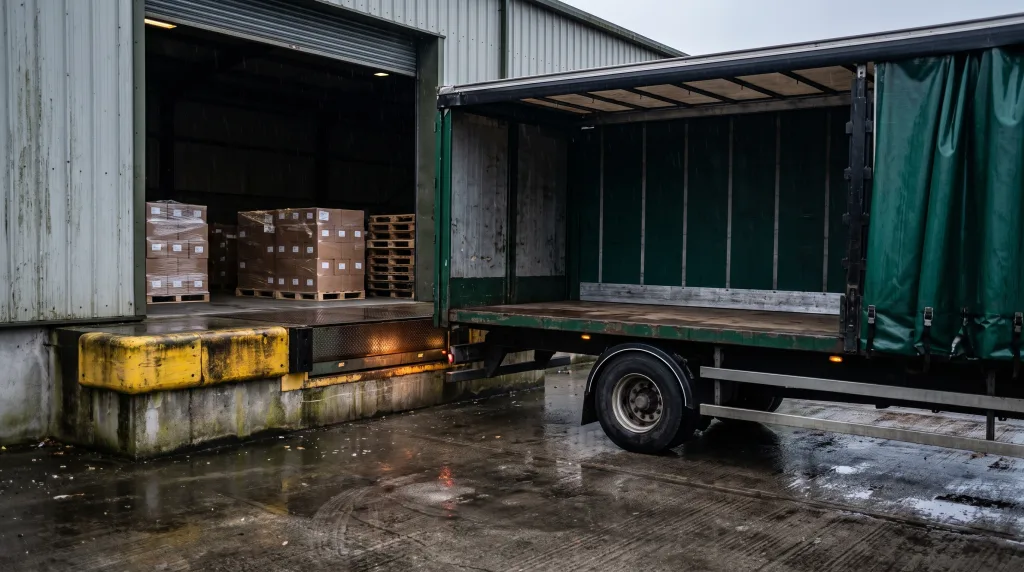
Why is a flatbed platform required instead of a curtainside trailer?
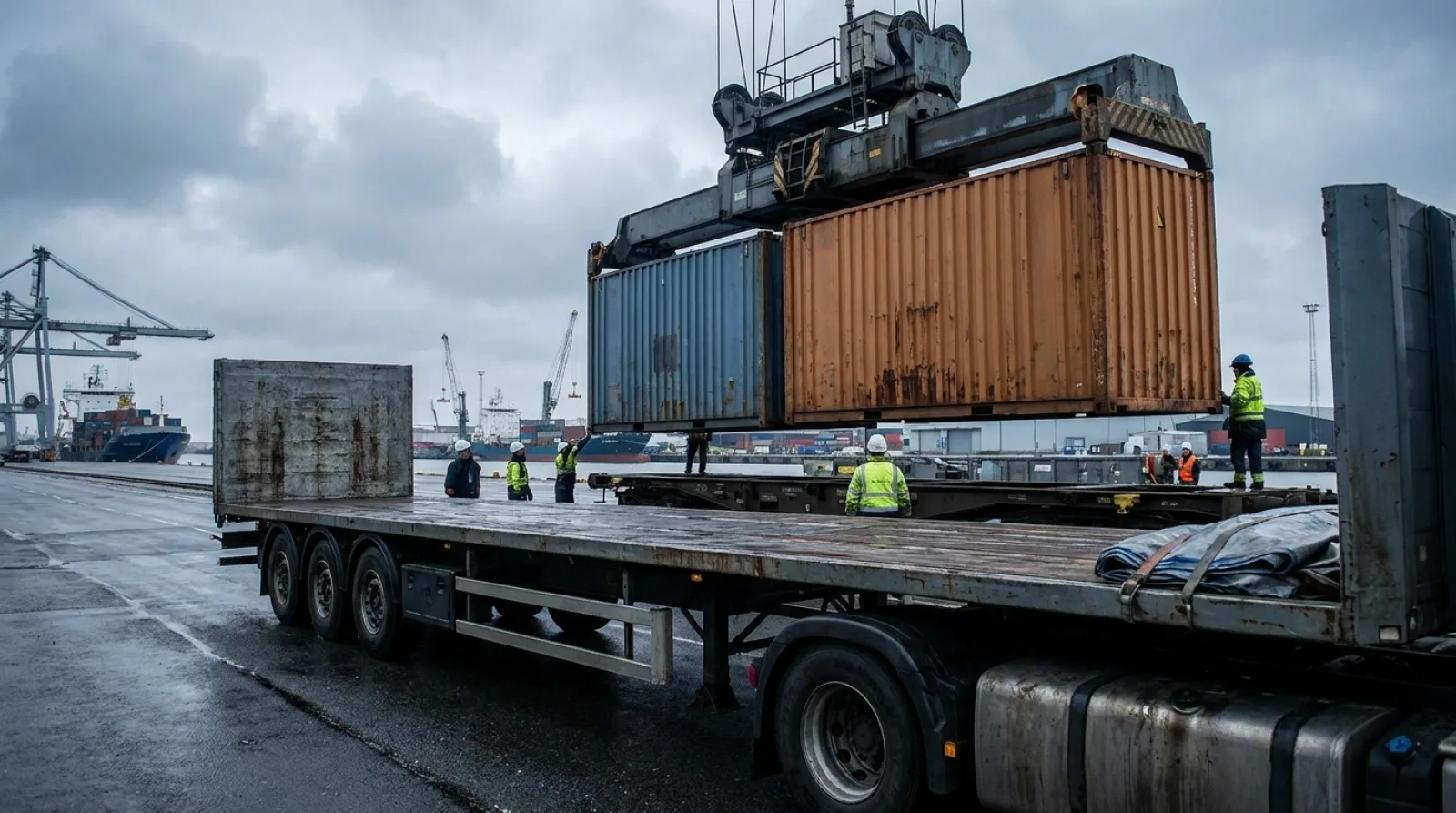
The rigid steel frame and external dimensions of a site cabin make loading into a conventional curtainside trailer impractical and unsafe. Standard curtainsiders have fixed roof structures and side pillars that obstruct overhead or side lifting operations when handling a rigid structure weighing between 1 and 4 tonnes. Consequently, the container dimensions dictate transport on an open flatbed platform, enabling straightforward loading from above or the side using a crane or heavy-duty forklift.
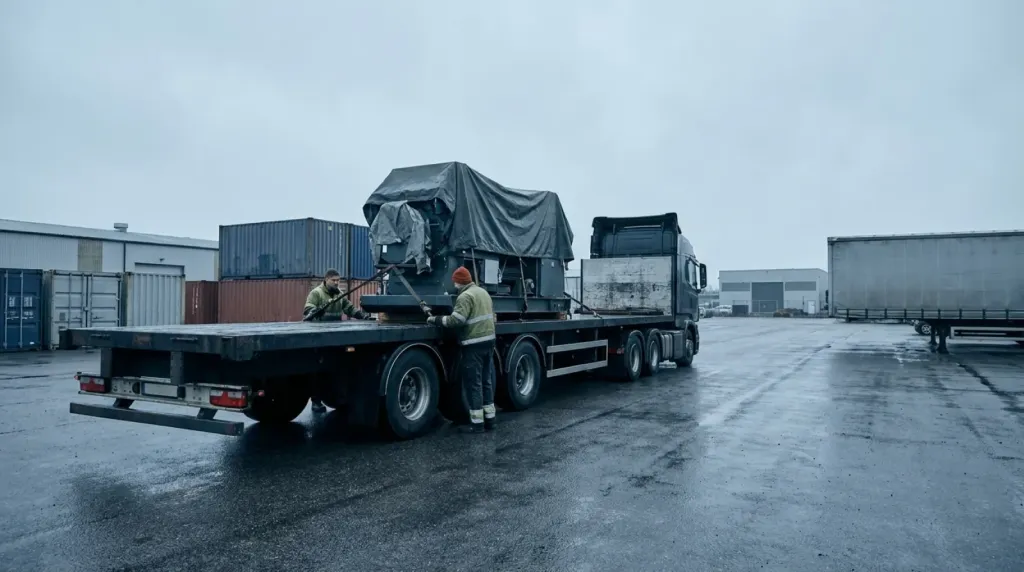
Securing the cabin onto a flatbed platform requires appropriate lashing straps and dedicated anchor points to prevent movement during road transit and ferry crossings. Because the unit usually does not require disassembly for transport, handling time at the pickup site is minimal. However, precise measurement of the total vehicle height with the container loaded is essential to avoid exceeding road clearance limits along the transit routes in the UK and Continental Europe.
Importing a site cabin step by step
- Review auction documentation. Obtain the invoice from the auction house, confirm tariff code CN 9406, and verify that the weight falls within the 1–4 t range.
- Book flatbed transport. Provide exact dimensions and weight so that the carrier assigns a suitable flatbed platform rather than a curtainside trailer.
- Issue UK export customs declaration. Generate the EX1 export declaration in the HMRC system prior to collection from the UK auction site.
- Arrange T1 transit or border clearance. Open an NCTS transit procedure when exiting the UK or prepare final clearance documentation for arrival at the EU border.
- Load and secure the unit. Lift the container onto the flatbed using a crane or forklift and secure it thoroughly with lashing straps.
- Complete EU customs clearance. Present the documentation at the destination customs office, settle applicable taxes, and unload the cabin at the site.
Definitions
- CN: Combined Nomenclature, the European Union eight-digit coding system used for classifying goods for customs tariffs and international trade statistics.
- EORI: Economic Operators Registration and Identification number, a legal identifier required for businesses performing customs procedures in the EU and UK.
- NCTS: New Computerised Transit System, a system managing and controlling European transit procedures under T1 documentation.
- SAD: Single Administrative Document, the official multi-copy customs declaration form used for international trade transactions with non-EU countries.
Checklist for site cabin import
- Obtain technical specifications and weight verification (1–4 t) from the auction seller.
- Confirm classification under CN tariff code 9406.
- Book an open flatbed trailer equipped with certified lashing straps and securing points.
- Verify active GB EORI and EU EORI numbers for the clearance process.
- Ensure the EX1 export declaration is lodged before truck arrival at the UK site.
- Prepare transit documents or direct import clearance for entry into the EU.
When do these transport and customs rules not apply?
The transport and customs procedures described here do not apply to shipments moved entirely within the European Union single market, where customs borders do not exist. These rules also do not apply if a modular cabin is completely dismantled into individual flat panels transported inside a standard box trailer, unless individual component dimensions still force the use of an open trailer. Furthermore, the selection of the customs clearance point depends on agreements with the customs representative and the applicable tax framework in the destination state.
The OTSL role
OTSL Sp. z o.o., based in Kielce with a logistics warehouse in Milton Keynes, England, manages specialized freight transport between the UK and the European Union. We support your logistics requirements through dedicated container transport services using suitable flatbed trailers. Our operations team handles all administrative formalities including customs clearance and deferred VAT options such as regime 42 EU import deferred VAT. With our facility in Milton Keynes and operations centre in Kielce, we ensure compliant and structured cross-border movements.