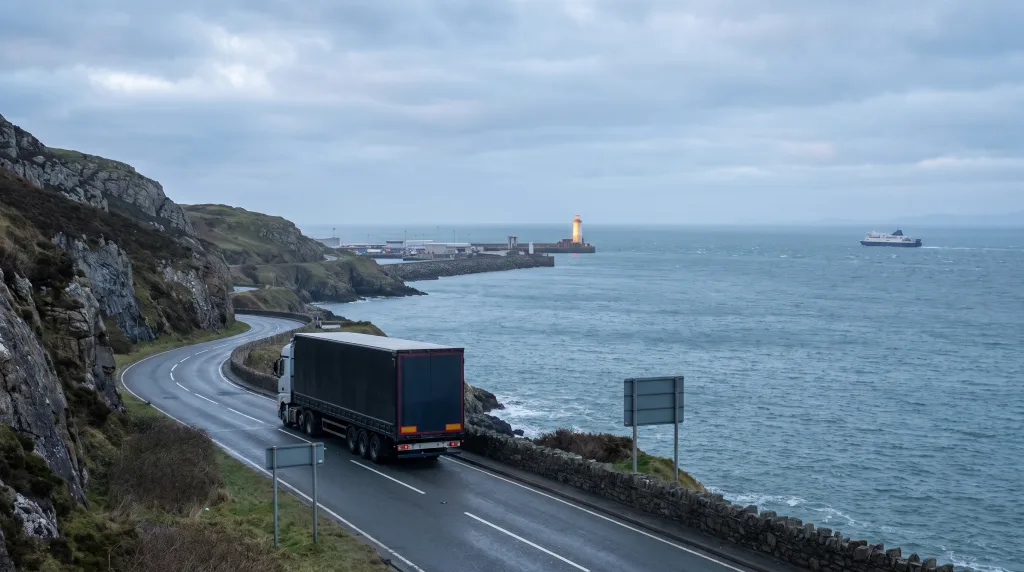
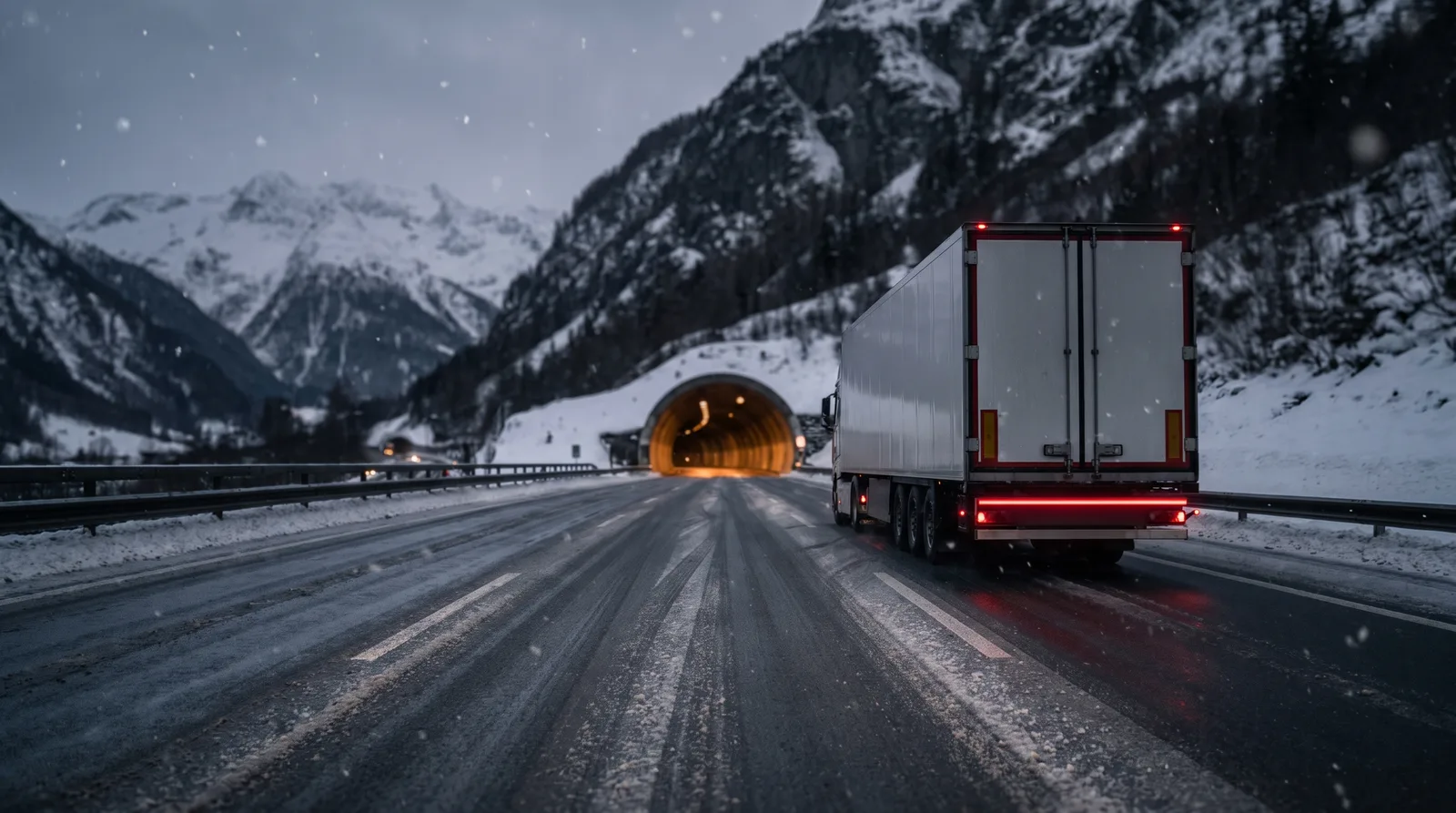
 AI image
Winter transport to Switzerland is planned around three constraints: the night driving ban for trucks from 22:00 to 05:00, the Sunday ban, and border customs clearance, because Switzerland is not part of the EU customs union. Add winter pass closures and metered truck traffic at the Gotthard tunnel. The key is a real time buffer and a booked unloading slot.
Three constraints you cannot drive around
Night driving ban: 22:00 to 05:00
Trucks with a maximum permissible weight above 3.5 tonnes may not drive in Switzerland at night. The ban runs from 22:00 to 05:00 and comes directly from the Swiss road traffic rules. In practice this means the vehicle has to leave the road before 22:00, and parking areas along the main corridors fill up much earlier. If the driver does not manage to cross the border and reach the unloading point within the daytime window, the delivery slips by a whole night, and sometimes by two days when a weekend gets involved.
The Sunday ban
On Sundays and public holidays heavy goods traffic in Switzerland stops. A load that reaches the border on Saturday evening moves on only on Monday morning, together with a wave of other trucks waiting for clearance. That is why departures from Poland are planned so that the border crossing falls between Monday and Friday, with a margin for the queue at the crossing.
Border clearance
Switzerland is not part of the EU customs union, so every transport needs an export declaration on the EU side and an import declaration on the Swiss side. Declarations run through the Swiss customs systems, with e-dec gradually being replaced by the new Passar platform. Queues build up at the main crossings such as Basel (Weil am Rhein) and Chiasso at peak times. A complete set of documents prepared before departure keeps the stop short: we describe exactly what you need in our article on customs and documents for transport to Switzerland, and the declarations and charges in the piece on the e-dec system and charges for deliveries to Switzerland.
Winter: the Gotthard tunnel and the passes
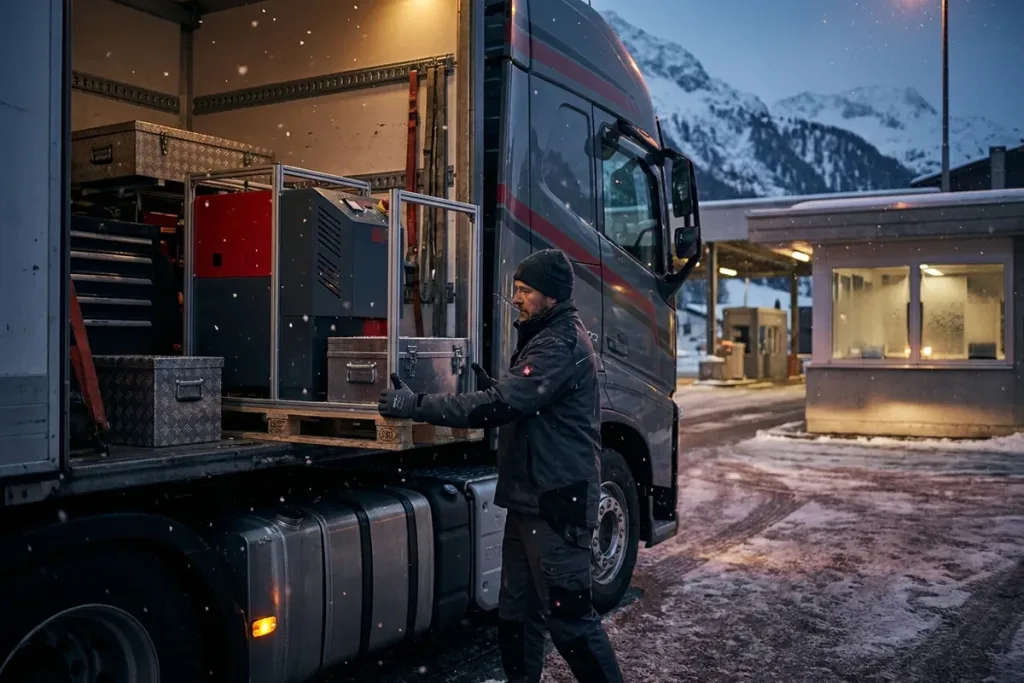
In winter the high Alpine passes, including the Gotthard pass road, are closed, and all transit traffic across the Alps moves through the tunnels. At the Gotthard tunnel a metering system controls heavy traffic: trucks are released in batches, which at busy times produces queues measured in hours. The A13 route through the San Bernardino tunnel can be an alternative, but in winter it is subject to weather restrictions as well. Sudden snowfall can close an access section within an hour, so a winter route plan should always carry a fallback option and a driver who knows where to wait safely.
Winter tyres and snow chains
Switzerland has not introduced a rigid calendar-based winter tyre obligation. What applies instead is the rule that the vehicle must be fit for the conditions on the road. A driver who blocks traffic because the rig cannot grip a snow-covered carriageway has to expect a fine and responsibility for the disruption caused. On sections marked with the mandatory sign, snow chains are compulsory. In practice, a carrier running Alpine routes in winter carries chains at all times and fits them whenever the sign or the conditions require it.
What goes into the transport plan
| Element | Effect on planning |
|---|---|
| Night ban 22:00-05:00 | the last leg of the day ends before 22:00, parking chosen in advance |
| Sunday ban | cross the border between Monday and Friday, Saturday only with a wide margin |
| Border clearance | documents completed before departure, buffer for the queue at the crossing |
| LSVA | a tonne-kilometre charge added to the route cost, depending on weight and emission class |
| Gotthard tunnel | metered truck traffic, possible queues measured in hours |
| Alpine weather | a fallback route option and chains on board all winter |
Time windows with a buffer
The most common mistake in winter deliveries to Switzerland is a calendar built as if this were an intra-EU route: depart Thursday afternoon, unload Friday before the weekend, zero margin. One hour of queueing at Basel or metering before the Gotthard is enough to wreck the deadline, and the truck spends the weekend in a parking area. A sensible winter plan looks different:
- an unloading slot booked with the consignee with at least half a day of margin, and a full day on routes through the Gotthard,
- the border crossing scheduled for a working day before noon, when queues are shorter than in the evening,
- customs documents closed before the truck leaves the loading point, not assembled en route,
- constant contact between driver, forwarder and consignee, so a slipping window is reported at once, not after the fact.
Such a plan looks less ambitious on paper, but it is the one that delivers on the date you promised your customer.
The OTSL role
We run regular loads to Switzerland and plan routes around the driving bans, border clearance and Alpine weather. See our guide to Switzerland as a destination or contact us if you are preparing a winter delivery: we will tell you what time window is realistic before you confirm a date to your consignee.
The numbers: according to the Swiss federal department UVEK, trucks make around 960,000 journeys across the Swiss Alpine passes per year (2025), against a statutory target of at most 650,000, and rail carries 68.6% of transalpine freight; the pressure to limit road traffic in Switzerland will not go away (source: UVEK, admin.ch).
Why is precise buffer planning required for winter deliveries to Switzerland?
Winter deliveries to Switzerland require realistic buffers because mountain pass closures, traffic metering at key tunnels, customs procedures, and night driving bans frequently combine to slow down transport timelines.
Step by step
- Check mountain route statuses. Monitor pass conditions and alternative routing options before dispatching the vehicle.
- Factor in driving bans. Schedule the journey to prevent border arrival during night or Sunday driving restrictions.
- Prepare customs documentation. Complete all necessary clearance paperwork in advance to ensure smooth border crossing.
- Add a buffer for tunnel metering. Include extra driving time for areas with regulated truck entry near major tunnels.
- Secure a firm unloading slot. Confirm the exact delivery window with the recipient to account for winter road delays.
Definitions
- LSVA (Leistungsabhängige Schwerverkehrsabgabe / RPLP): The Swiss heavy vehicle charge calculated on kilometres driven, maximum weight and emission class.
- Night driving ban: A national restriction prohibiting heavy goods vehicle traffic across Switzerland during night hours.
- Gotthard tunnel traffic metering: A regulated system controlling the flow of heavy trucks entering the tunnel to prevent congestion.
- Border customs clearance: The mandatory customs process required because Switzerland lies outside the EU customs union.
- Pass closures: Seasonal shutdowns of high-altitude mountain routes caused by severe winter conditions.
When does this rule not apply?
The night driving ban does not apply to light commercial vehicles below the heavy transport weight threshold, unless specific local restrictions state otherwise, or to transports holding special authorization permits.