 AI image
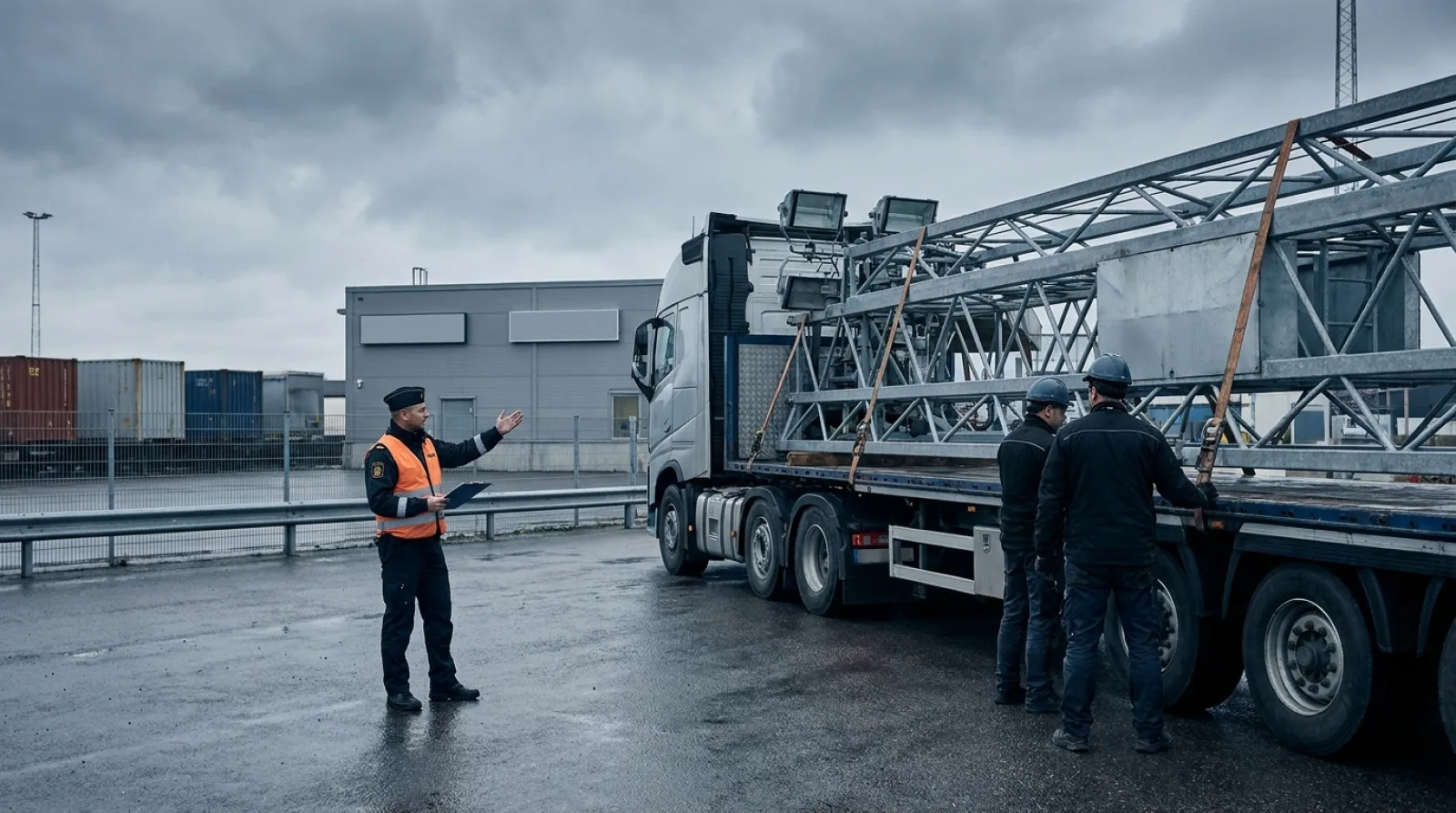
Transporting a lighting tower (German: Lichtmast, Polish: wieża oświetleniowa) from the United Kingdom to the European Union is typically carried out as groupage freight. With a typical weight range of 0.5–2 t and compact dimensions once the mast is retracted, the equipment usually does not require disassembly. Following purchase at a UK auction, the goods pass through customs clearance under CN tariff heading 9405.
How is a lighting tower transported from a UK auction?
Machinery purchased on British auction platforms enters the European Union through customs declarations and road haulage. When you move a lighting tower, the mast is folded down into its transport position, which significantly reduces the space needed on a trailer. A typical mass between 0.5 and 2 tonnes makes this equipment ideal for groupage shipment, which helps to keep transport logistics cost-effective.
Many buyers ask whether the unit needs to be taken apart before transport. For standard designs, the answer is no — the factory mast retraction mechanism is sufficient to prepare the unit for loading onto a trailer or a rigid truck. However, pickup conditions and release schedules at the site depend on the rules set by the auction house in the buyer manual.
Does importing a lighting tower require customs clearance?
Any goods entering the EU from the UK must complete customs procedures. To make an accurate declaration, you must use the correct classification. For equipment such as a lighting tower, the relevant tariff classification is CN 9405, covering lamps and lighting fittings. The precise sub-heading depends on the technical specification and the onboard power supply, such as an integrated diesel generator.
Customs clearance can take place at the border or at an inland customs office. If you route the transport through our consolidation facility in Milton Keynes, the cargo can be combined with other goods and cleared before onward journey to the facility in Kielce or directly to the final recipient. This prevents unnecessary delays at port terminals.
Importing a lighting tower step by step
- Purchase and documentation verification. Obtain the commercial invoice or auction bill of sale and verify that the technical details match the purchase documentation.
- Booking the auction collection. Arrange a collection time slot, which depends on the auction terms and conditions specified in the seller manual.
- Retracting the mast and securing the load. Ensure that the lighting mast is fully folded, locked in place, and strapped down without taking elements apart.
- Preparing the customs filing. Submit the invoice and specification under CN heading 9405 to the customs broker for UK export and EU import entries.
- Groupage transport and consolidation. Transport the unit to the warehouse in Milton Keynes or directly to continental Europe alongside other groupage items.
- Final clearance and delivery. After customs release for free circulation, the equipment is delivered to the final destination or stored at the Kielce hub.
Definitions
- CN (Combined Nomenclature): The goods classification system used by the European Union for tariff and international trade statistics.
- EORI (Economic Operators Registration and Identification): A unique reference number used by businesses when interacting with UK and EU customs authorities.
- LTL (Less than Truckload): A freight method where a shipment does not occupy an entire trailer, allowing shared cargo space.
- MRN (Movement Reference Number): A unique tracking number assigned to customs declarations in transit or export control systems.
Checklist for lighting tower transport
- Confirm that the mast is fully retracted and secured with its mechanical safety lock.
- Ensure operating fluids and fuel levels adhere to carrier safety guidelines.
- Verify that the weight within the 0.5–2 t range matches the shipping paperwork.
- Prepare the auction invoice showing CN code 9405 for customs classification.
- Check EORI numbers for both sender and importer before dispatch.
- Review site collection procedures stated in the auction house manual.
When do these transport rules not apply?
The described procedures do not apply if the lighting tower is permanently mounted on a road-registered trailer chassis with its own number plate and valid road approval. In such cases, the unit is handled as a vehicle rather than loose cargo on a trailer, altering customs paperwork and transit rules. Furthermore, these rules do not apply if the equipment moves under temporary admission using an ATA (Admission Temporaire, the temporary admission document) Carnet, or if the shipment stays entirely within the Schengen zone without leaving EU customs territory. Different rules also apply if mechanical damage prevents retracting the mast, which depends on individual arrangements with the carrier and technical requirements of the unit.
The OTSL role
At OTSL Sp. z o.o., based in Kielce, we manage the transportation of machinery and equipment from the United Kingdom. We offer efficient groupage LTL services that allow multiple smaller shipments to be combined into single vehicle movements. With our operational warehouse in Milton Keynes, England, and our hub in Kielce, we manage smooth transloading and storage for goods bought at UK auctions. We handle customs formalities under CN heading 9405, and you can read more about organising machinery shipments in our article Poland as a sourcing base: one transport instead of five shipments.