 AI image
Transporting pharmaceuticals under Good Distribution Practice (GDP, EU guidelines 2013/C 343/01) means keeping and documenting the required conditions throughout the journey. Chilled products usually move at 2-8 degrees C, room-temperature products most often at 15-25 degrees C (industry-typical ranges; the label and marketing authorisation decide). Vehicle qualification, temperature mapping, continuous monitoring with a record and a defined deviation procedure are all mandatory. An ordinary reefer without these does not meet GDP.
Why an ordinary reefer is not enough
A food reefer cools the cargo space and nothing more. It holds a low temperature on average, but it does not guarantee that every point on the pallet stays inside the narrow 2-8 degrees C window, it does not record the profile in an auditable form, and it has no procedure for the moment the unit stalls for two hours. For a medicine that is the difference between a saleable product and a batch bound for destruction. We set out the losses from a broken cold chain in broken cold chain: unsellable goods.
The stakes run in two directions. On the goods side: a batch of vaccines or insulin that left the permitted range even once does not return to circulation, and the responsible person at the wholesaler has to block it. On the legal and commercial side: undocumented conditions mean not only a damage claim but a problem with the distribution authorisation and with acceptance at a GDP-compliant counterpart. Ordinary carriage leaves no trace; GDP requires a trace at every step.
Six pillars of GDP-compliant transport
- Controlled temperature within a defined range. Chilled products usually move at 2-8 degrees C, room-temperature products most often at 15-25 degrees C. These are industry-typical ranges, but the binding range is always the one on the label, the leaflet and the marketing authorisation. Deep-frozen products and those with tighter demands have their own stricter regimes.
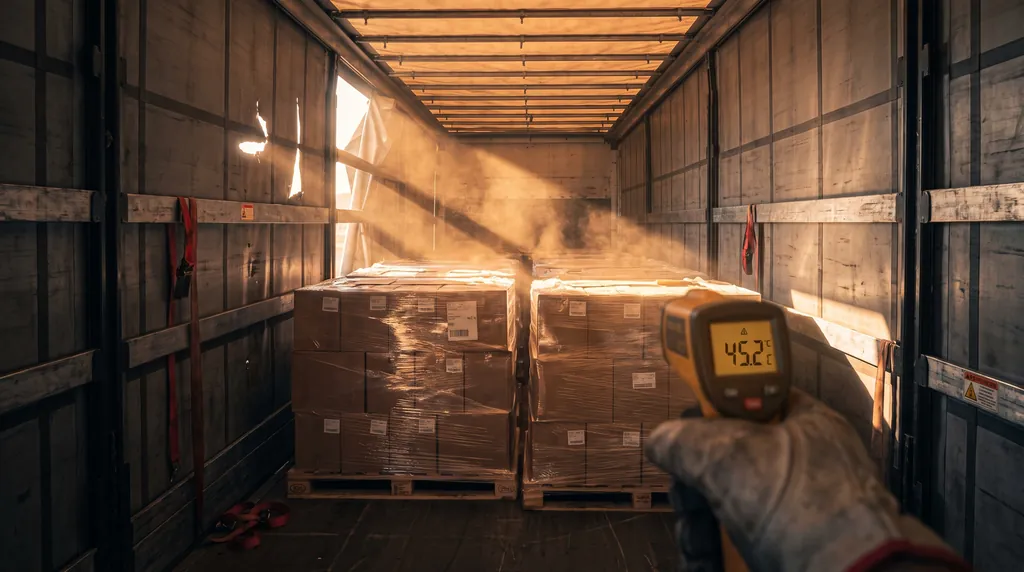
- Vehicle qualification and temperature mapping. Before use, the vehicle or container is qualified and the cargo space is thermally mapped: measurement at multiple points that reveals the warmest and coldest zones when full and when empty. The monitoring sensor goes where the risk of breach is highest, not in a random corner.
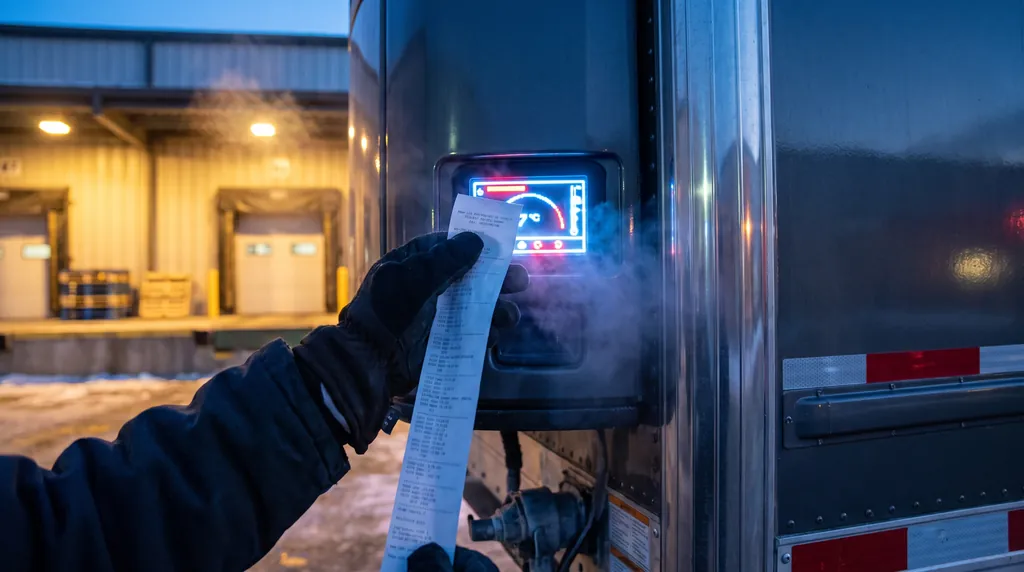
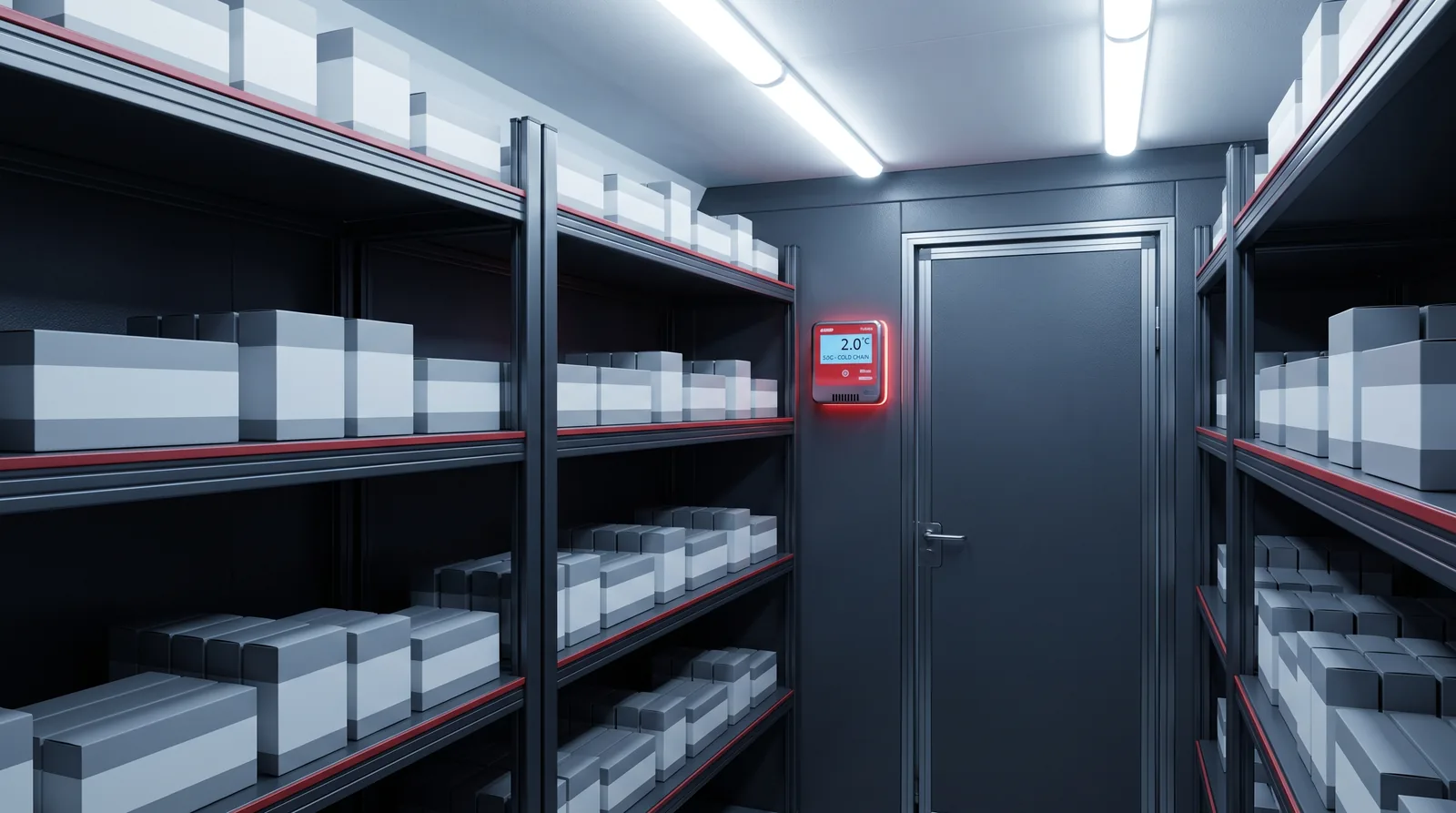
- Continuous monitoring with a record. GDP requires conditions to be recorded throughout the journey in a form that can be reconstructed. A calibrated temperature logger, readable after delivery, is the evidence that the chain was not broken. The unit set point alone is not evidence.
- A deviation procedure. The key question is not whether something will one day go wrong, but what happens when it does. A defined alarm threshold, a notification path, quarantine of the batch and an impact assessment by a qualified person are exactly what ordinary carriage lacks. How a dispute over whether a deviation even occurred plays out is covered in reefer temperature dispute: who is right.
- Documentation and batch traceability. Every shipment must be linkable to its batch number, its transport conditions and its consignee. This is the precondition for a recall if a batch turns out to be defective, and a requirement of any GDP-regulated recipient.
- Qualified personnel and carrier. Drivers and handling staff must know how to react to an alarm, how not to break the chain during transhipment and why the unit must not be switched off at a stop. GDP requires awareness of the process, not just a roadworthy truck.
Chilled versus room temperature: two regimes in one distribution
The distinction between a chilled and a room-temperature product is not cosmetic. The 2-8 degrees C range is narrow and sensitive: a short unit failure in summer, or frost in winter against an unheated trailer, pushes it past the limit within minutes. The 15-25 degrees C room-temperature range is wider, but in winter it is the lower bound that bites when an unheated cargo space drops below 15 degrees C. That is why winter carriage of room-temperature medicines needs heating, not just insulation.
| Element | Typically chilled products | Typically room-temperature products |
|---|---|---|
| Range (industry-typical) | 2-8 degrees C | 15-25 degrees C |
| Main risk | upper limit exceeded in summer, freezing in winter | drop below 15 degrees C in winter, overheating in summer |
| Equipment | reefer unit, mapping, logger, contingency plan | thermally protected space, heated in winter, logger |
| Source of the binding range | the label, the leaflet and the marketing authorisation, not general custom | |
When distribution spans several regimes at once, you need a facility that holds more than one temperature in parallel. How that works in the warehouse is covered in multi-temperature storage.
Liability: where GDP meets carriage law
GDP is a quality regime laid over the distribution of medicines, but the carriage itself is still governed by carriage law. In international road transport that is the CMR Convention: the carrier is liable for loss of or damage to the goods between taking over and delivery (Article 17 CMR), and its liability for damage to the goods is capped in principle at 8.33 SDR per kilogram (Article 23(3) CMR). For an expensive medicine that cap can be far below the real value, which is why a value declaration or separate cargo insurance matters for such loads rather than hoping the capped compensation will cover it. We gather the cold-chain regime in temperature-controlled transport and the cold chain.
The two regimes must be read together. GDP says how the conditions are to be maintained and documented; CMR and the contract say who is liable when they were not. A missing logger record weakens every party in a dispute, because there is no way to show where and when the chain failed.
The OTSL role
OTSL is an international road freight forwarder. We arrange the transport of medicinal products and medical devices under the required conditions in cooperation with qualified carriers and cold-chain equipment providers, matching the transport to the temperature range on the label and authorisation and making sure the journey is monitored and documented as a GDP-regulated recipient expects. We do not replace the wholesaler's responsible person, and we do not declare conditions that cannot be documented. We run traffic between Poland, the United Kingdom, Switzerland and the rest of Europe, with warehouses in Kielce, Legnica and Milton Keynes. More scenarios sit in our transport risks section and the knowledge base, and you can discuss a specific load through the contact form.
Why is a standard refrigerated trailer insufficient for pharmaceutical transport?
A standard refrigerated trailer lacks documented mapping, qualified equipment, continuous recording systems, and formal deviation handling procedures required for compliance.
Step by step
- Requirement check. Review the storage conditions specified on the product label and marketing authorisation.
- Vehicle preparation. Select a qualified transport unit with valid mapping records.
- Cargo loading. Secure the goods properly and activate logging devices before departure.
- Continuous monitoring. Track temperature parameters in real time throughout the journey.
- Data archiving. Download and archive the temperature logs immediately after delivery.
Definitions
- Good Distribution Practice (GDP): Quality standards ensuring that the identity and integrity of medicinal products are maintained throughout transport.
- Vehicle qualification: The documented process of proving that a transport unit reliably maintains the required environmental conditions.
- Temperature mapping: The study of temperature distribution within a cargo space to identify hot and cold spots.
- Deviation procedure: A structured protocol followed whenever temperature readings stray outside acceptable limits.
When does this rule not apply?
This requirement does not apply to general freight that falls outside the regulatory framework for medicinal products.