 AI image
When the consignee claims the cold chain was broken, the outcome turns on temperature records and on who owed which duty. The carrier must run a sound reefer at the agreed set point, the shipper must load goods already chilled. Decisive evidence: the thermograph printout, core temperature readings at loading and unloading, and a written reservation on the CMR note.
The reefer unit maintains temperature, it does not chill the load
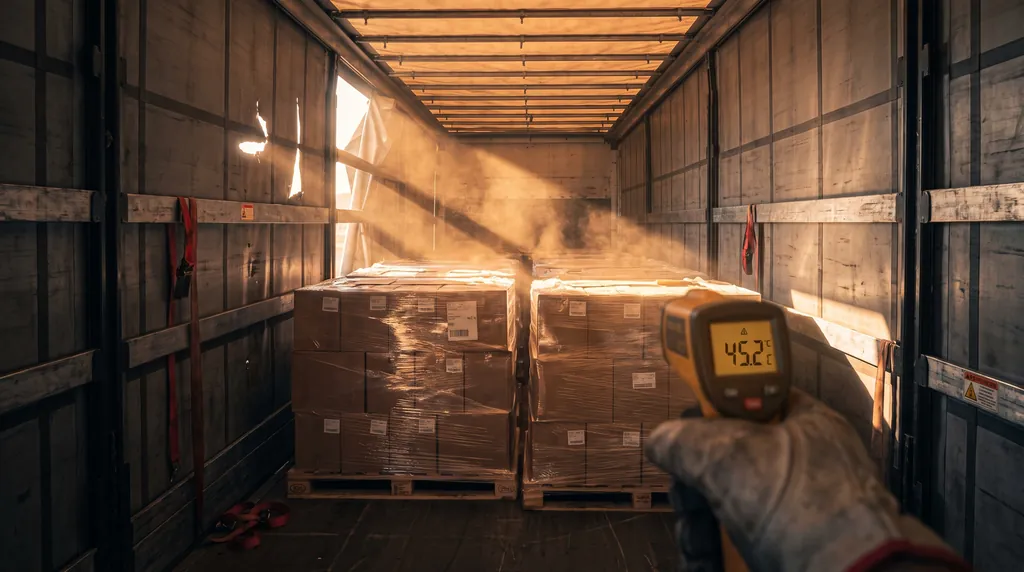
A trailer refrigeration unit is built to hold the temperature of goods that were loaded already chilled. Its capacity offsets heat leaking through the walls and rushing in when the doors open, but it cannot pull the heat out of twenty tonnes of pallets. If product warmer than the carriage temperature went on at the ramp, the unit will run flat out and the chart will show a slow pull-down towards the set point instead of a stable line. To a cargo surveyor, that curve is a clear signal the problem started before loading, not on the road.
The split of roles here is clear. Pre-cooling the trailer, chilling the empty box before it docks, is the carrier's job: it is the carrier's unit, started under the transport order or a special instruction, so the walls, floor and air do not feed heat into the product during the first hours of the journey. The shipper owes two duties. First, checking the box temperature before loading and refusing to load into a warm trailer. Second, and more important, releasing goods already chilled to carriage temperature, confirmed by a core (pulp) temperature reading recorded in the loading documents. The driver normally cannot probe the product without the shipper's consent, so a diligent shipper records the reading themselves and enters it in the release note. For a British consignee buying from a Polish producer, that loading record is the single document that most often decides whether a rejected load can be claimed at all.
Set point is not the same as actual temperature
Disputes regularly confuse three values. The set point is the temperature dialled into the controller. The actual temperature is what the sensors read, and they measure supply and return air, not the product. The core temperature, the only one that matters for food quality, can differ from the air in the box by several degrees, especially after warm loading or when airflow is blocked by pallets stacked to the ceiling or pushed against the bulkhead. A printout showing a flat line at set point therefore does not prove the goods were at the right temperature. It works the other way too: short spikes on the chart do not automatically mean a broken cold chain.
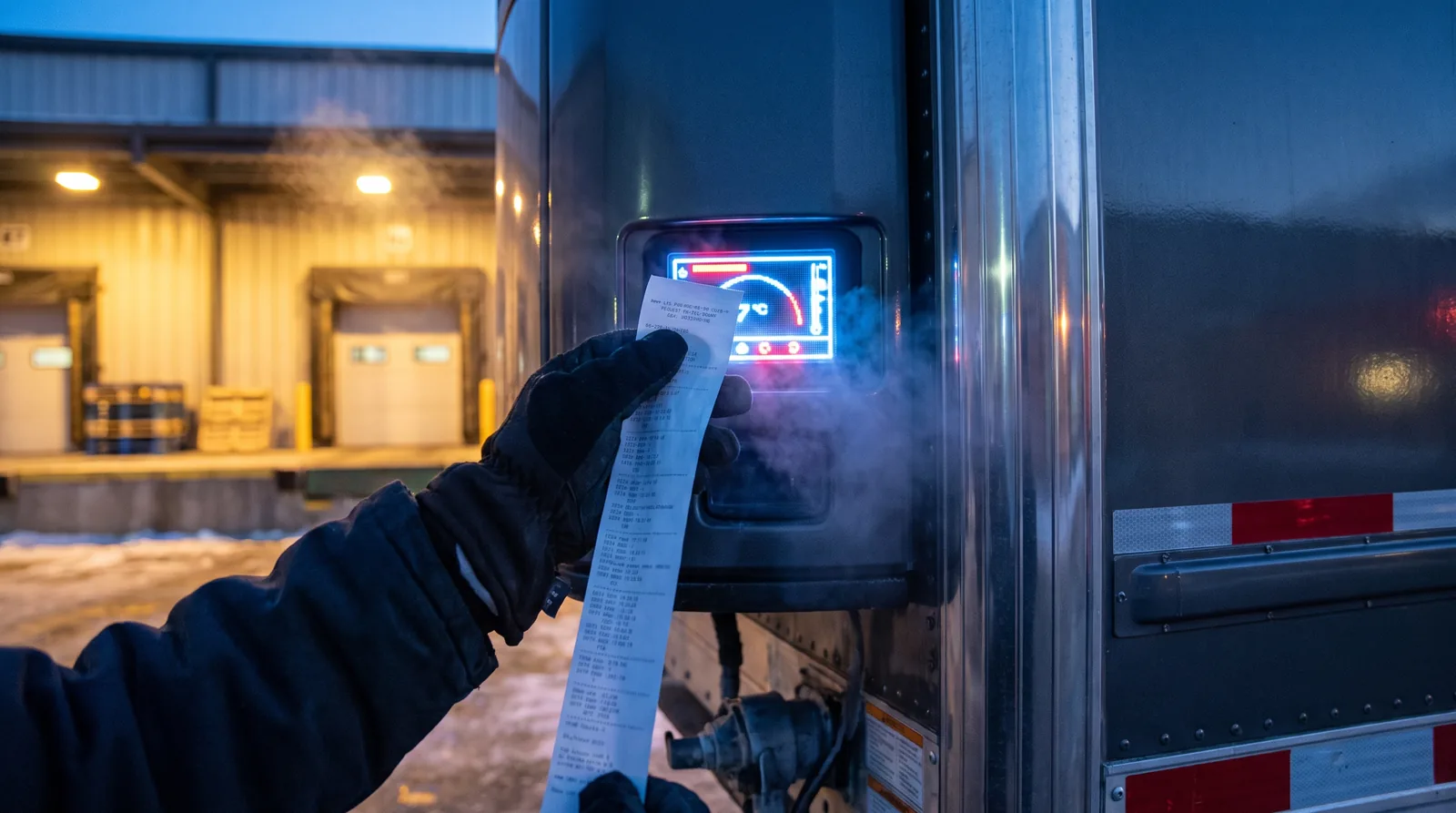
Typical spikes have technical explanations. A defrost cycle raises the air temperature for ten to twenty minutes without touching the product. Doors opened for a groupage stop produce a similar short jump. A unit running in start-stop mode holds temperature within a band by design, so the curve oscillates while the goods stay safe. A surveyor can tell these patterns from a genuine failure, which is why you should secure the complete trip record with set points, not a single torn-off page.
Evidence in a temperature dispute
In practice the dispute is won by the party with the better documented segment of the chain. The main types of evidence differ in weight:
| Evidence | What it shows | Weight in the dispute |
|---|---|---|
| Thermograph printout from the unit | Air temperature in the box and the set point for the whole trip | High for judging the unit, says nothing about product core temperature |
| Independent data logger in the load | Temperature next to the goods from loading to unloading | Very high and hard to challenge, because it depends on neither party |
| Core reading at loading | Product temperature at handover to the carrier | Decisive for the shipper: proves the goods left the ramp chilled |
| Joint measurement at unloading | Product temperature at delivery | Decisive together with a reservation entered on the CMR note |
What the law says: ATP, the CMR Convention and frozen food rules
ATP requires perishable foodstuffs in international carriage to travel in equipment that meets its standards and carries a valid certificate. Body classes describe capability: FRC, for example, means a reinforced insulated body with a unit able to hold any chosen temperature between +12°C and -20°C. Booking frozen goods onto a trailer without the right class is a mistake that counts against the transport organiser before the unit even starts.
The CMR Convention settles the burden of proof. Article 17(4)(d) lets the carrier escape liability where the damage arises from the nature of goods particularly exposed to decay. For carriage in a vehicle with refrigeration equipment, Article 18(4) adds a condition: the carrier can only rely on that defence if it proves that all steps incumbent on it in respect of the choice, maintenance and use of the equipment were taken, and that it complied with any special instructions given to it. Without a complete temperature record and a unit service history, that defence collapses. Equally, a shipper who never documented the product temperature at loading cannot show that the goods left chilled. This is why the set point belongs in the transport order and on the CMR note as a special instruction, not in a phone call.
Quick-frozen food adds an EU layer that still shapes loads arriving from Poland. Directive 89/108/EEC requires -18°C or colder, with brief upward fluctuations of no more than 3°C tolerated in transport. Regulation (EC) No 37/2005 requires air temperature in frozen food transport to be recorded with instruments conforming to EN 12830, EN 13485 and EN 13486, and the records to be kept for at least one year. A carrier that cannot produce such a record walks into the dispute already limping.
Reservations at unloading: how to secure the claim
The unloading dock decides the fate of the claim. Article 30 CMR requires reservations about the apparent condition of the goods at the latest on delivery, and for damage that is not apparent, written notice within 7 days of delivery, Sundays and public holidays excluded. Taking delivery without reservations creates the presumption that the goods arrived as described in the consignment note. The practical sequence:
- Enter a specific reservation on the CMR note before signing: measured temperature, probe location, number of pallets, time. A vague "goods warm" is easy to knock down.
- Measure jointly with the driver using a calibrated thermometer and have the driver countersign the reading. A joint measurement closes the argument about method.
- Secure the temperature records: the full-trip thermograph printout, the logger file from the load, photos of the controller display and the set point.
- Photograph seals, stowage and air chutes before anything is moved off the trailer.
- Do not dispose of or return the goods without the consent of the carrier and its insurer: destroying the evidence can sink an otherwise solid claim.
- Send a written claim to the carrier and watch the time limits: we cover them in CMR damage claims and time limits, and the step-by-step at the dock in damage report and CMR reservations.
If the batch genuinely lost its commercial value, what may be done with it and who pays for disposal is a separate question. We unpack it in broken cold chain and unsellable goods, and the wider emergency playbook lives in our transport risks hub.
The OTSL role
We arrange temperature-controlled transport between Poland, the United Kingdom, Switzerland and the rest of Europe. The transport order states the set point, the ATP class and the duty to hand over a complete temperature record, and for disputed deliveries we carry out cargo inspections and help assemble the claim file. Our warehouses in Kielce, Legnica and Milton Keynes can hold a disputed batch until the insurer decides. Contact us through the form before a temperature dispute grows into a dispute about everything.
Does a reefer trailer unit cool down warm cargo during transport?
No, a trailer refrigeration unit is designed only to maintain the pre-existing temperature of the goods, which means the shipper must ensure cargo is fully chilled before loading.
Step by step
- Core temperature measurement at loading. The shipper measures and logs the internal cargo temperature prior to loading.
- Set point confirmation. The driver checks that the refrigeration unit is running at the requested temperature setting.
- Continuous temperature recording. The thermograph records conditions inside the reefer trailer along the entire route.
- Inspection on arrival. The consignee verifies the cargo temperature in the presence of the driver before offloading.
- CMR reservation entry. Any identified temperature discrepancy is recorded directly onto the consignment note.
Definitions
- ATP (Agreement on the International Carriage of Perishable Foodstuffs and on the Special Equipment to be Used for Such Carriage): An international treaty establishing technical standards for equipment used in transporting perishable goods.
- FRC (Mechanically refrigerated equipment with heavy insulation class C): A trailer standard equipped with heavy insulation capable of maintaining temperatures between minus twenty and plus twelve degrees Celsius.
- CMR (Convention on the Contract for the International Carriage of Goods by Road): The official consignment note documenting the international carriage agreement and the condition of goods upon pickup.
- Thermograph: An automated logging instrument that records internal cargo hold temperature throughout transit.