 AI image
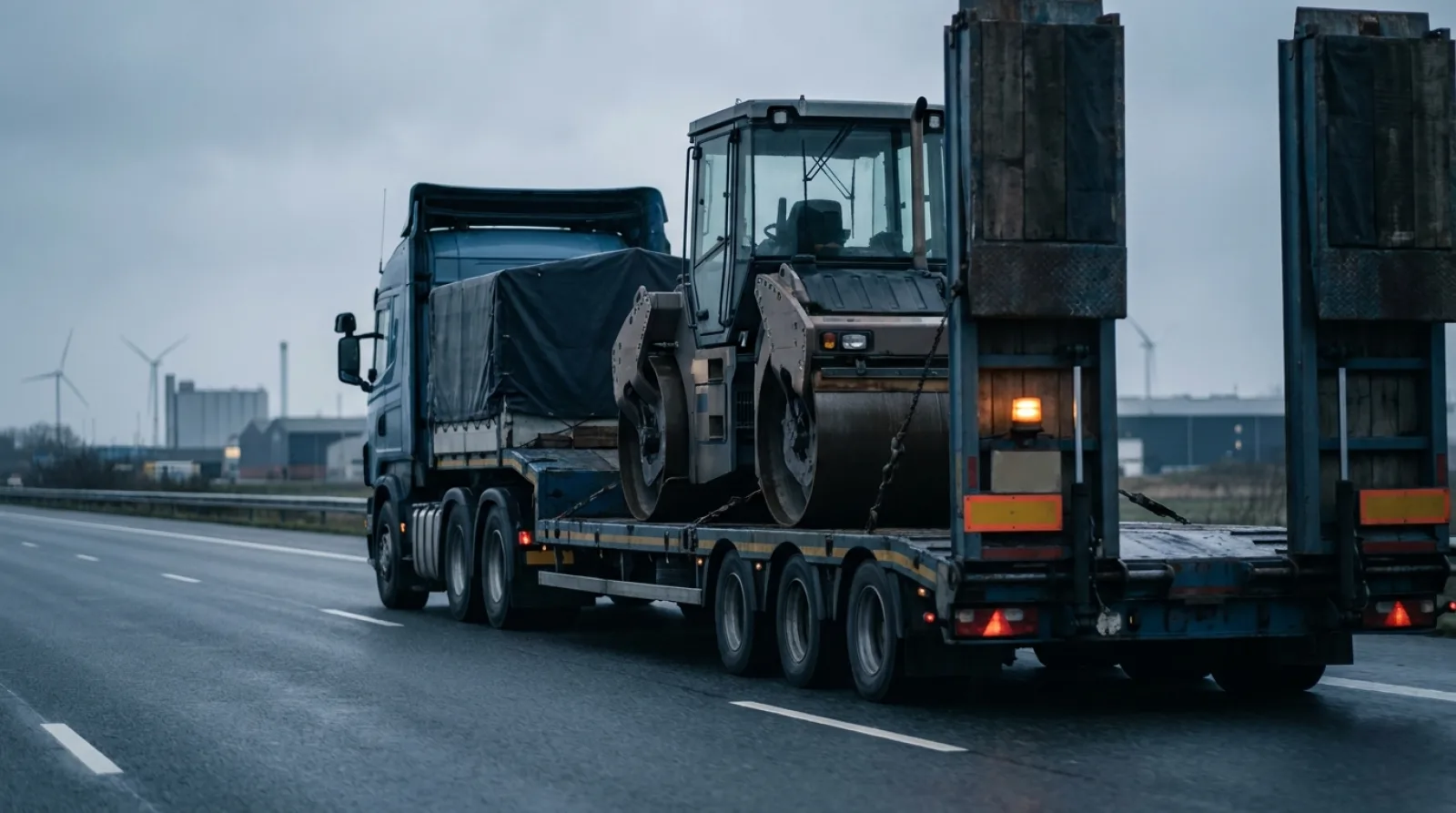
Transporting a road roller from the United Kingdom to the European Union requires selecting a suitable trailer for the weight of the machine, which typically ranges from 1 to 20 tonnes. The equipment usually does not require disassembly prior to carriage, but due to its short body, high overall weight, and narrow wheel track, properly distributing axle loads on the trailer is essential. Machinery purchased at UK auctions enters the EU following clearance under CN code 8429 40.
What technical demands does transporting a road roller involve?
The primary transport characteristic of a road roller is its compact construction. Although a road roller occupies a relatively short length on a trailer deck, its mass—typically falling between 1 and 20 tonnes—is concentrated over a small surface area. A narrow track or drum width creates high point loading on the trailer deck. Failing to balance this mass correctly can result in exceeding maximum permitted axle weights on the tractor unit or semi-trailer, leading to safety hazards and statutory fines during roadside inspections.
When planning movement, you must confirm that the haulage provider utilises a low-loader or platform trailer equipped with adequate floor loading capacity and lashing points. Because a road roller usually does not require disassembly, the key operational steps involve driving the machine onto the trailer bed or using a winch, followed by immobilising the drums or wheels with chocks and heavy-duty dunnage or lashings.
How do you manage customs clearance for a road roller bought at auction?
Construction machinery acquired at auction in the UK must complete official customs entry before entering the EU. Correct classification is required for the customs declaration. For a road roller, the applicable Combined Nomenclature heading is CN 8429 40. Prior to submitting entry documentation, you need to collect the commercial invoice from the auction house, specification sheets, and relevant origin documentation.
Moving goods across the UK-EU border requires an export declaration filed on the UK side and an import declaration submitted at the first EU entry port or inland destination customs office. Depending on the chosen tax arrangement, import VAT may be settled at the border or deferred via simplified customs mechanisms, provided the importer holds the necessary authorisations.
Importing a road roller step by step
- Document verification. Obtain the purchase invoice and collection note from the auction organiser, checking that chassis numbers match all paperwork.
- Vehicle selection. Match the roller weight (1–20 t) to a low-loader trailer capable of accommodating heavy concentrated axle loads.
- Loading and securing. Load the road roller onto the trailer deck, position wheel chocks, and apply high-tensile lashing chains or straps to balance weight across axles.
- Customs declaration setup. Compile the trade documents, assign CN code 8429 40, and lodge the transit or import entry filings.
- Border clearance and delivery. Present the vehicle and documents at the customs border post before proceeding to the final delivery destination.
Definitions
- CN: Combined Nomenclature, the goods classification scheme used within the European Union for international trade.
- EORI: Economic Operators Registration and Identification number, mandatory for undertaking customs activities in the UK and EU.
- SAD: Single Administrative Document, the standard official form used for manual customs declarations.
- NCTS: New Computerised Transit System, a system for managing electronic transit declarations such as T1 documents.
Checklist for road roller transport preparation
- Verify the operational weight and drum width against technical data sheets.
- Confirm whether the machine starts and can climb loading ramps independently.
- Ensure you have an active EORI number and submit documents to the customs broker.
- Check that the haulier carries load restraints rated for heavy machinery.
- Cross-check invoice details against the manufacturer serial plate on the unit.
When do these transport and clearance rules not apply?
The rules outlined above do not apply to equipment moved under temporary admission procedures using an ATA (Admission Temporaire, the temporary admission document) Carnet or to intra-EU transport that does not cross a third-country border. Tax exemption eligibility depends on the origin documentation provided by the seller, and collection timelines at the yard depend on the specific auction house terms.
The OTSL role
OTSL Sp. z o.o., headquartered in Kielce with a facility in Poland and a warehouse in Milton Keynes, UK, handles machinery haulage between Great Britain and mainland Europe. The company provides machinery transport services on low-loaders and coordinates customs paperwork. For auction shipments entering Europe, options such as Regime 42 can be used to streamline VAT processing.