 AI image
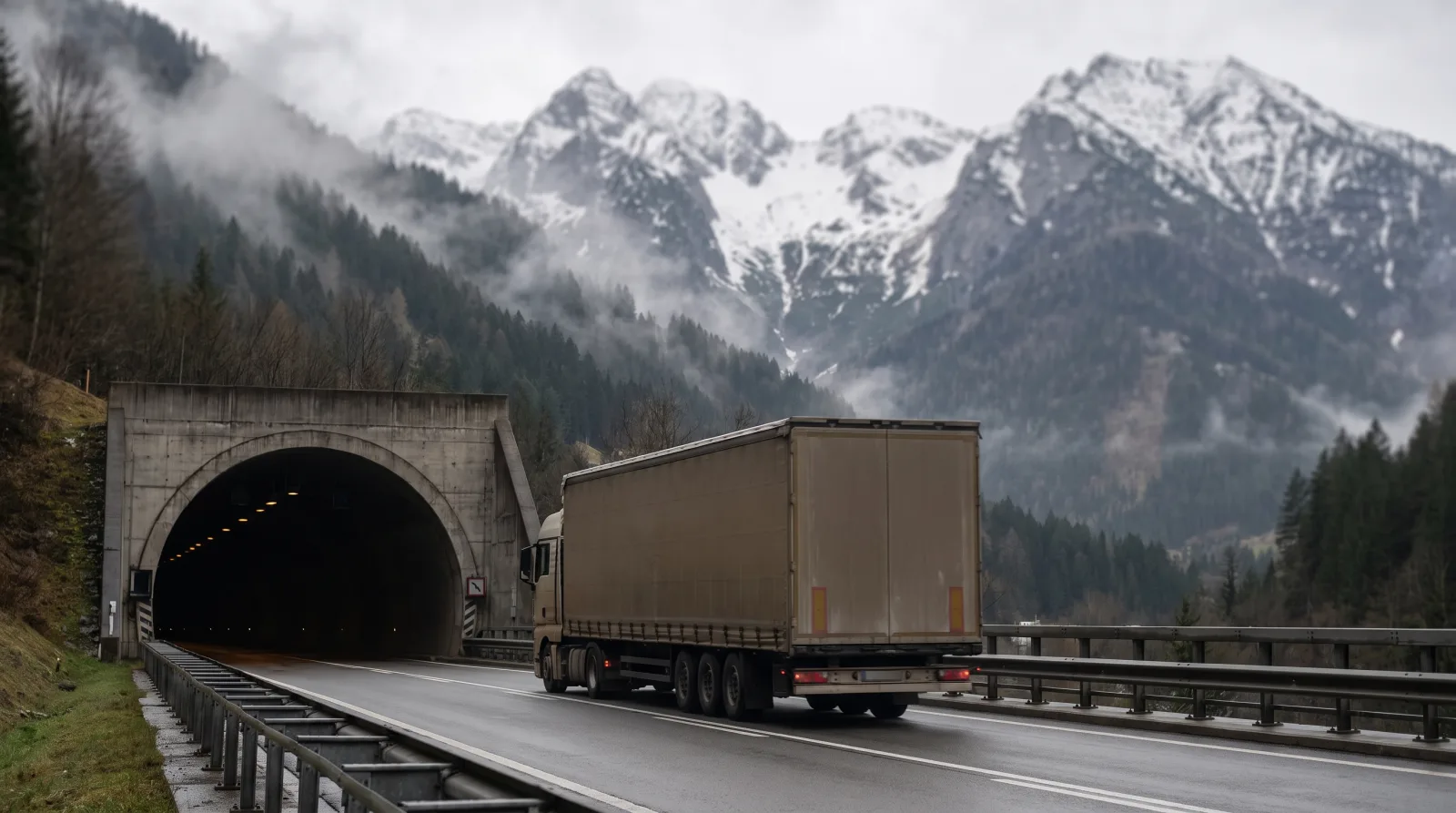
Austria is a close but distinctive lane, because it sits on the main Alpine transit corridor. Here cost and time are shaped less by the kilometres and more by the GO-Box toll with dearer mountain sections, driving bans in Tyrol, block clearance at the border, and winter requirements. All of these can stretch the run and lift the rate.
The GO-Box toll and the mountain road
In Austria trucks pay a toll based on distance, axle count and emission class, settled through the GO-Box on-board unit. The key point is that some Alpine routes carry a separate, higher tariff.
Austria charges trucks a distance-based toll via the GO-Box, and Alpine sections cost more: special routes such as the Brenner motorway (A13), Tauern or Arlberg have their own higher rates than ordinary motorways (source: ASFINAG). If the cargo transits south, over the Brenner to Italy, the toll cost rises on exactly these sections.
Tyrol: sectoral bans, night bans and block clearance
The Inn valley in Tyrol is the most regulated part of the route. A sectoral ban applies: on the A12 motorway certain goods groups, such as metals, stone, cement or fuels, may not be carried, with exceptions for local deliveries and the newest vehicles. On top of that come a night driving ban on the A12 and so-called block clearance (Blockabfertigung), the metering of how many trucks are let across the German border on peak days. A driver who hits such a queue waits, which shifts the delivery date. We collect Europe-wide limits in our note on truck driving bans.
Winter in the Alps
From autumn to spring Austria enforces winter requirements: suitable tyres, and chains on harder sections. This is not only a rule but a real delay risk when a pass is briefly closed in heavy snowfall. What to keep on board is covered in our note on winter truck equipment.
How long does delivery take and how do you order?
Austria is close, so with no disruption a full load runs quickly. The real time, though, depends on block clearance, night and weekend bans, and winter conditions on the route. For full loads choose road transport, for smaller batches groupage, and find lane details on the transport to Austria page. Send us the loading place, delivery address and goods type through the form, and we will prepare a quote.
How do you manage winter equipment rules and axle weight limits in Austria?
When planning haulage through Austria between 1 November and 15 April, you must account for strict winter equipment regulations for heavy goods vehicles over 3.5 tonnes GVW. This requires drive axle tires to have a minimum tread depth of 5 mm and at least 2 snow chains suitable for the wheel size to be carried on board. If traffic inspectors detect missing equipment during adverse weather, the articulated vehicle will be grounded, resulting in an immediate delay of 12 to 24 hours on the transit route.
Note the exact operational boundary of this rule: the mandatory use of winter tires does not apply when the road surface is completely dry and entirely clear of snow, slush, or ice. However, the obligation to physically carry snow chains in the vehicle applies continuously throughout the entire designated period, regardless of clear conditions at lower altitudes.
Furthermore, load distribution across axles requires active management during loading operations. When stowing 33 pallets with a total cargo weight exceeding 24 tonnes, you must monitor key mechanical factors:
- Drive axle weight limits, which increase dynamically during steep uphill climbs and must stay within statutory thresholds.
- Trailer stability on gradient descents exceeding 6 percent, where a shifted centre of gravity directly impacts braking distance.
Step by step
- Route planning. Check the planned itinerary for toll sections, special tariffs, and local transit restrictions.
- Vehicle preparation. Ensure the truck meets winter equipment regulations and required emission standards.
- GO-Box configuration. Install the on-board unit and set the correct axle count prior to entering toll roads.
- Schedule adjustment. Account for possible delays caused by border block clearances and driving bans.
- Document dispatch. Provide the driver with all necessary transport documentation for potential road checks.
Definitions
- GO-Box: An on-board unit used for electronic settlement of distance-based truck tolls in Austria.
- ASFINAG (Autobahnen- und Schnellstraßen-Finanzierungs- und Dienstleistungs-Aktiengesellschaft): The Austrian federal agency managing motorways and distance-based toll collection.
- Block clearance: A traffic management system at border checkpoints that admits heavy goods vehicles in controlled batches.
- Tyrolean driving bans: Regional transit restrictions on trucks designed to control traffic flow and environmental impact in Alpine corridors.
The OTSL role
When planning goods transport to Austria, OTSL assists in navigating Alpine transit corridors and route planning. You can explore our road transport options to select suitable vehicles, or read about express vans and time-critical transport to manage tight delivery schedules across Europe effectively.