 AI image
Winter equipment for trucks is not uniform across Europe: every country has its own rules. The general pattern in most Alpine and Scandinavian countries is that winter road conditions trigger a requirement for winter or all-season tyres on the driven axles, and snow chains on signposted sections. Missing equipment means a driving ban, a fine and liability for blocking the road. Always check the official national source before departure.
Why winter on the road costs more than fuel
Winter does not stop freight; it raises its price when nobody prepared the vehicle. A driver without winter tyres on the driven axle stalls on an icy climb toward a pass, blocks the lane, and a queue grows behind. A truck without chains is turned back from a signposted section to the nearest lay-by and waits until conditions improve or someone brings the equipment. Each of these is not just a fine but a lost delivery slot, downtime and a possible claim from the consignee.
The cost is tangible. Exhibition cargo due on the stand on Monday morning gets stuck on a closed pass on Sunday evening. A component for a production line waits in a lay-by because the tractor is not allowed onto a section with a chains-mandatory sign. Whoever plans a winter route without checking local rules is planning a delay. That is why equipment and a contingency plan are settled before loading, not at the border of an Alpine country.
Three layers of winter equipment
- Tyres. The foundation. Some countries require winter or all-season tyres only on the driven axles, some on all tractor axles, and a few also on the steering axle. The 3PMSF symbol is increasingly required instead of plain M+S. The tyre type and where it is fitted are the first thing a roadside check verifies.
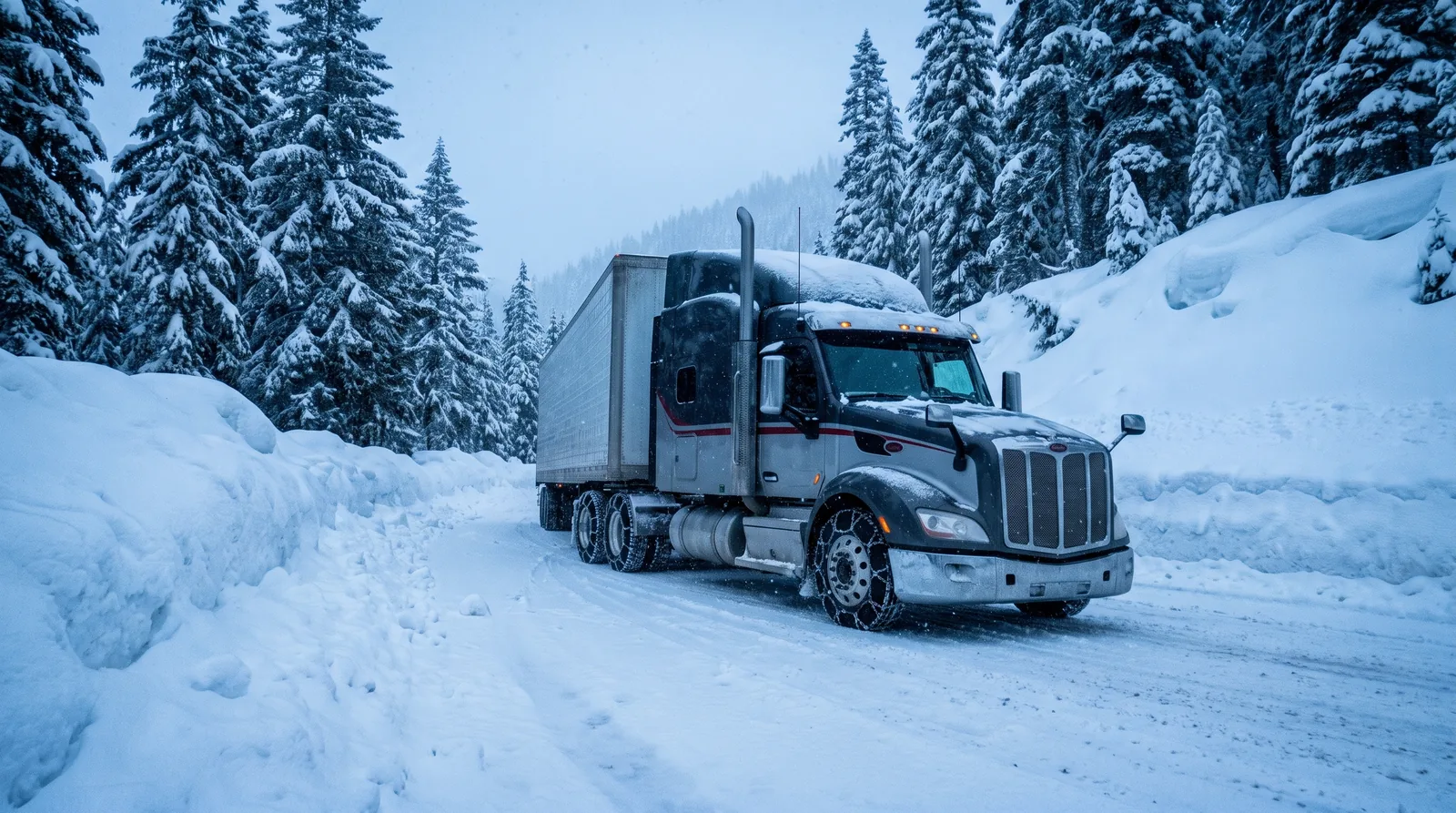
- Snow chains. Carried in the vehicle as mandatory equipment in some mountain countries and fitted on signposted sections where the sign mandates their use. No chains at such a sign is a ban on entry, not a suggestion.
- Additional equipment. Scraper, winter washer fluid, working heating, and in some countries items such as a warning triangle or hi-vis vest required year-round. This does not replace tyres or chains, but it feeds into how the vehicle is assessed during a check.
Differences between countries: a cross-section, not a fines table
Winter requirements differ across Europe strongly enough that no single rule applies everywhere. Below is a cross-section of the general principles. Exact conditions, dates and penalty amounts change and depend on current national law, so for every route check the official source of that country rather than rules from memory.
- Germany. The road traffic code StVO sets a situational winter obligation: in winter road conditions, meaning snow, black ice or slush, the vehicle must be fitted with tyres suited to winter. The obligation is tied not to a fixed calendar date but to actual conditions. The official legal service gives the exact wording.
- Austria. During the winter period, in the relevant road conditions, trucks must meet winter-tyre requirements, and on designated sections carrying and using chains is mandatory. Rules for trucks tend to be stricter than for cars. The winter period and conditions are set out by the official Austrian service.
- Alpine countries. Switzerland, mountain regions of Italy and Alpine sections of France use signs mandating winter tyres or chains on specific routes and passes. Pass closures during snowfall are a seasonal norm there. We cover Switzerland separately in the article on transport to Switzerland in winter.
- Scandinavia. Norway, Sweden and Finland have some of the strictest requirements, with a minimum tread depth in winter, winter tyres on trucks and a frequent duty to carry chains. This is a regime built for a long, hard winter, and enforcement is real.
Impact on route planning
Equipment gaps hit not the moment of the check but the whole schedule. Three typical scenarios:
| Situation | Immediate effect | Effect on delivery |
|---|---|---|
| Missing required winter tyres at a check | ban on further driving, fine, vehicle immobilised | delay, lost unloading slot, downtime cost |
| No chains on a signposted section | vehicle turned back, no right to enter the route | detour or wait for conditions to change, deadline shift |
| Pass closed due to snowfall | route unavailable regardless of equipment | longer detour, risk of exceeding driver hours |
Pass closures and seasonal bans fit into the wider picture of traffic restrictions we gather in the article on HGV driving bans in Europe. When a road is closed by authorities or by weather, it also helps to know when a delay falls within force majeure and when it is plain negligence: we cover that in force majeure under CMR. A closed pass alone does not automatically excuse liability if the vehicle lacked the required equipment anyway.
What to check before a winter departure
- Countries on the route, not just the destination. Transit through Austria or the Alps imposes its own rules even when the delivery is in Germany.
- Tyre marking. Check whether the route requires the 3PMSF symbol or whether M+S is enough, and on which axles.
- Chains in the vehicle. Even with no snow at loading, a signposted mountain section may demand them.
- Current conditions and closures. Passes get closed at short notice; the detour contingency is arranged in advance.
- Official source, not a forum. Conditions and penalties change each season; only the national source is binding.
The OTSL role
As an international freight forwarder we plan winter routes ahead: we select carriers with vehicles equipped to the rules of the countries on the route, we factor seasonal pass closures and traffic bans into the delivery date, and we keep a contingency plan for weather. We run traffic between Poland, the United Kingdom, Switzerland and the rest of Europe, with warehouses in Kielce, Legnica and Milton Keynes. Country lanes sit in our destinations section, more scenarios in transport risks, and you can discuss a specific winter route through the contact form.
Why are 3PMSF markings preferred over M+S on winter routes?
More European countries mandate the 3PMSF symbol because it certifies a standardized snow-grip test, whereas M+S is merely a manufacturer declaration without mandatory physical testing.
Step by step
- Check your route. Verify the exact winter equipment requirements for every country along your planned journey.
- Inspect tyre markings. Ensure that the tyres fitted to driven axles carry the required 3PMSF symbol.
- Pack correct snow chains. Confirm that you carry undamaged snow chains matching the exact wheel sizes of the vehicle.
- Prepare winter accessories. Stock the cab with a snow shovel, ice scrapers, and freeze-resistant operating fluids.
- Conduct a pre-trip fitting test. Practice fitting the snow chains at a depot to ensure swift installation during severe weather.
Definitions
- M+S (Mud and Snow): A manufacturer declaration stating that the tyre is suitable for driving in mud and snow conditions.
- 3PMSF (Three-Peak Mountain Snowflake): A symbol depicting a snowflake inside a mountain with three peaks, certifying that the tyre passed an official snow-grip test.
- Driven axles: The vehicle axles that transfer power from the engine to the road surface, where winter tyres are primarily required.
- Snow chains: Metal devices fitted onto tyres to increase vehicle traction on icy or heavily snow-covered road sections.
- All-season tyres: Tyres designed to handle varying weather conditions throughout the year while meeting specific winter performance standards.
When does this rule not apply?
The requirement to use winter tyres or snow chains does not apply when dry weather conditions prevail and no specific mountain signs are active on the route, unless local national regulations enforce strict seasonal date mandates regardless of weather.