 AI image
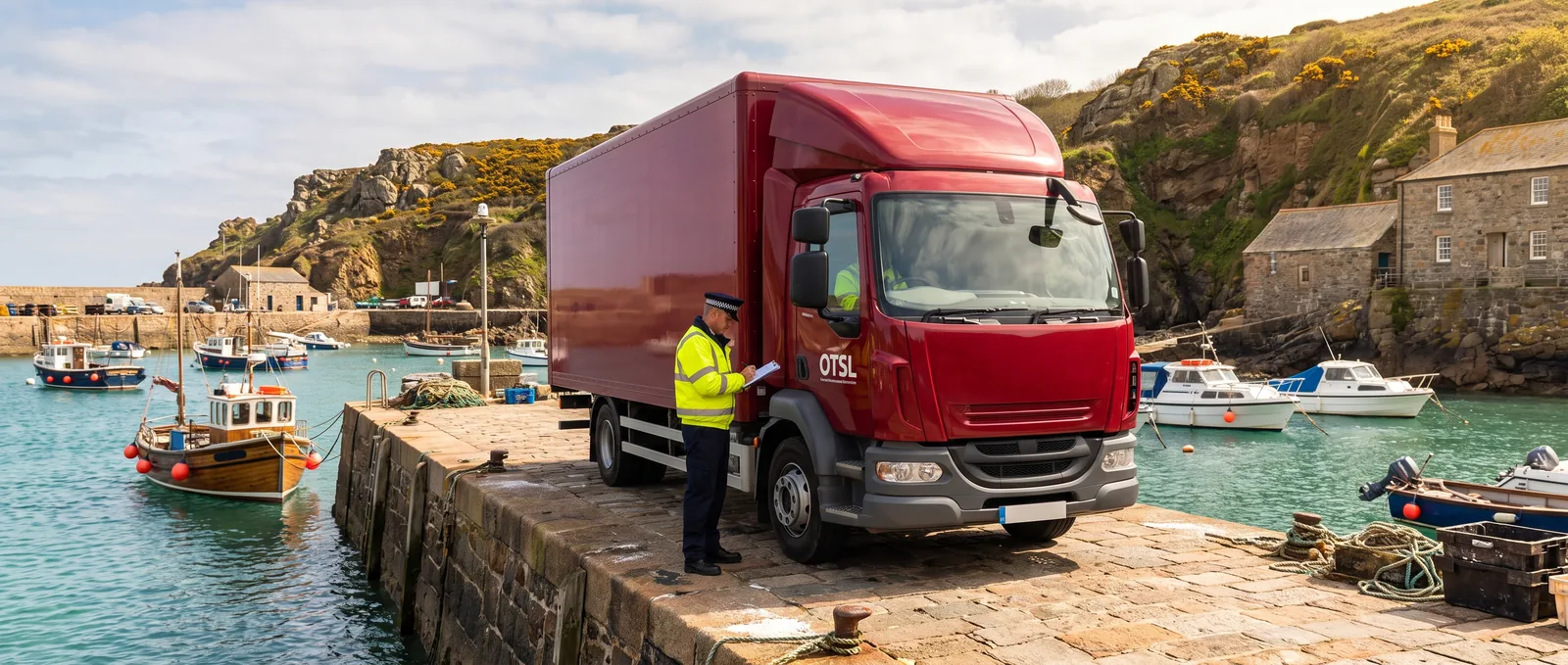
The Channel Islands, that is Jersey, Guernsey and the smaller Alderney and Sark, are Crown Dependencies lying outside the European Union and outside the UK VAT area. For tax and customs purposes they are treated as a separate territory, so clearance is needed even for a delivery from Great Britain, and all the more so from Poland. OTSL runs the transport with clearance and a ferry crossing.
Why does this differ from the Isle of Man?
Unlike the Isle of Man, which shares a customs and VAT area with Great Britain, the Channel Islands are separated from it. This means a separate clearance on entry to the islands and careful preparation of documents. It is a destination where the Incoterms rules and the split of duties between seller and buyer matter in particular, because they decide who is responsible for clearance on the island side.
The route and the crossing
- Road and port: the goods travel across the continent and reach the islands by ferry from ports such as Portsmouth and Poole in England, as well as from Saint-Malo in France.
- Clearance: a full customs declaration on entry to the islands, handled within the customs clearance in our order.
- Documents: a set as for export outside the EU, described in the text on export documents.
Planning a delivery to Jersey or Guernsey? Describe the consignment in the contact form and we will set the route, the crossing and the clearance. The context of the other destinations is in the guide to the islands of Britain and Ireland.
What dimensional and operational limits must you consider for ferry customs clearance?
When shipping to Jersey or Guernsey, you must account for the physical constraints of the islands' road networks. Vehicles exceeding 12 metres in length or with a gross vehicle weight over 32 tonnes require advance road permits from local island authorities. A standard 13.6-metre articulated lorry cannot navigate narrow island roads without prior clearance. Furthermore, ferry manifest data and customs pre-lodgement details must be submitted at least 24 hours prior to vessel departure from Portsmouth or Saint-Malo.
Regarding local taxation, Jersey applies a 5% Goods and Services Tax (GST) based on the CIF value of the shipment. For palletised freight, local island distribution vehicles restrict tail-lift deliveries to a maximum weight of 1000 kg per pallet. The standard customs clearance window at the destination port ranges between 12 to 48 hours depending on document verification efficiency.
Please note the boundary of application: these specific road permit requirements and ferry manifest procedures do NOT apply if you ship parcels weighing under 30 kg via air freight. Air cargo bypasses maritime road permits and follows direct airport customs procedures instead.
Step by step
- Document preparation. You prepare the commercial invoice and packing list without applying UK VAT.
- Export clearance. You declare the consignment for export clearance in the country of departure.
- Ferry booking. You arrange space on the cargo ferry connecting to the islands.
- Local customs entry. You submit the customs declaration to the authorities on Jersey or Guernsey.
- Final delivery. You transport the goods to the final destination on the island.
Definitions
- Channel Islands: A group of islands in the English Channel, including Jersey and Guernsey, forming a separate customs and tax territory.
- Crown Dependencies: Self-governing possessions of the British Crown that are not part of the United Kingdom or the European Union.
- UK VAT area: The tax territory of the United Kingdom, which excludes the Channel Islands.
- Customs declaration: An official document submitted to customs authorities to clear goods for import or export.
When does this rule not apply?
This rule of separate customs clearance does not apply to shipments moved to the Isle of Man, which shares a common customs and VAT area with Great Britain.
The OTSL role
OTSL manages end-to-end transport to the Channel Islands, coordinating road haulage with sea transit. We provide reliable road transport (FTL) and explain requirements outlined in our guide on express vans and time-critical transport in Europe.