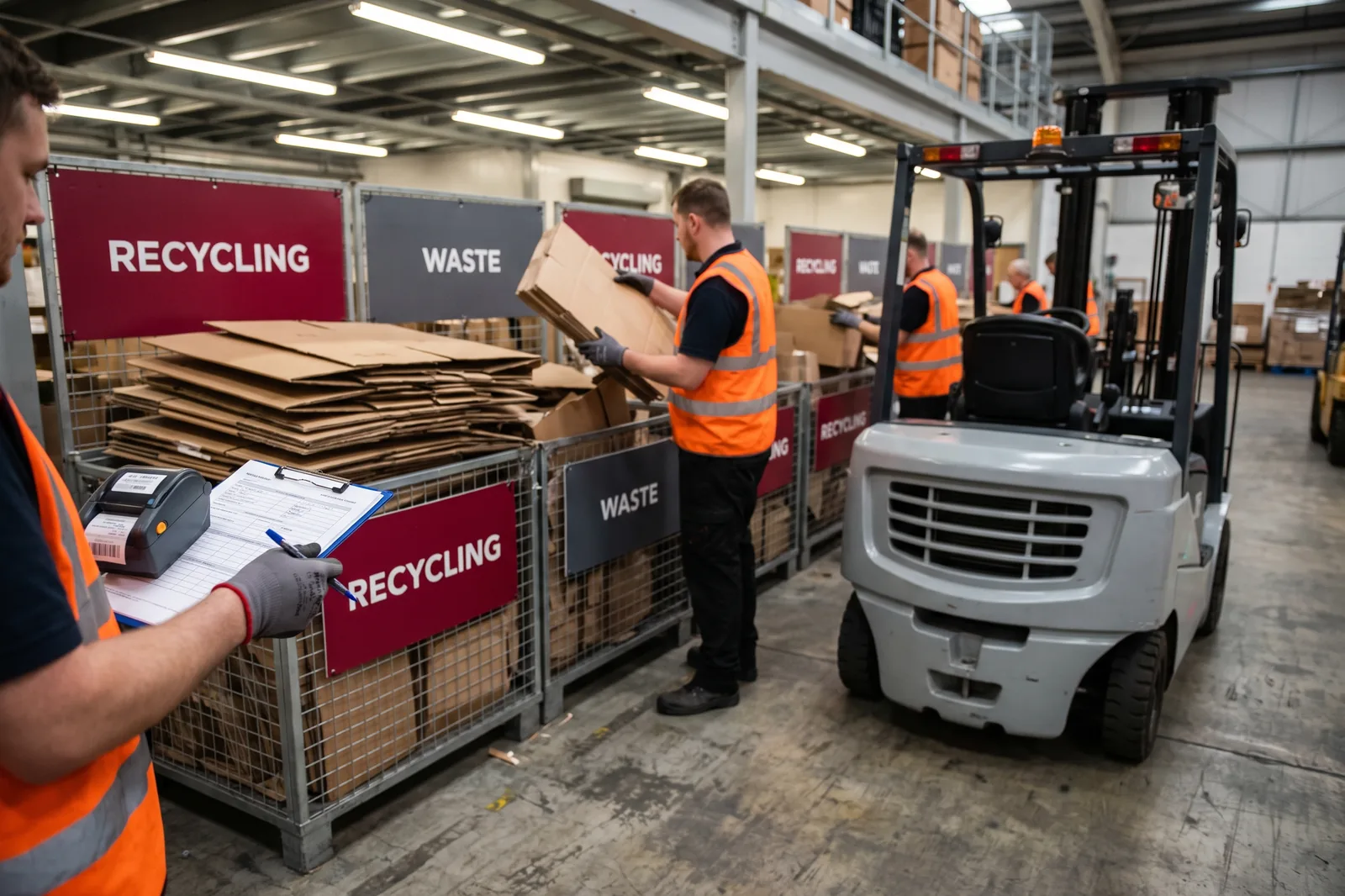
 AI image
Certified disposal is the lawful, documented destruction of goods that cannot be sold: rejected, damaged, contaminated or expired stock. From our Milton Keynes warehouse we arrange it through licensed, registered waste carriers and permitted disposal sites, and we issue a waste transfer note for every consignment. We organise the disposal through licensed operators, we are not a waste facility ourselves, and the documentation proves the goods left lawfully.
The English-language version of this article is the reference one for the UK cluster.
Why disposal is a compliance question, not just a skip
Throwing away unsellable stock is not as simple as putting it in a bin. Under UK waste rules a business keeps a duty of care over its waste until it is handed to someone authorised to take it, and it has to keep records proving that happened. Do it wrong and the liability follows the goods back to whoever owned them. For food and FMCG the stakes are higher again, because unsellable food that leaks back into the supply chain, or branded stock that reappears on a grey market, is a food-safety and brand-protection failure as much as a waste one. Certified disposal exists precisely so that when stock is destroyed, there is proof it was destroyed properly and it cannot come back to haunt the owner.
How do we handle disposal from Milton Keynes?
The disposal is the last step of a recovery, and it runs from the same site that did the inspection, so nothing is lost between hands.
1. Segregate the unfit stock
After the fit or unfit decision, described in the article on distressed load management, the unfit stock is separated and held apart from anything still in play, so there is no risk of rejected goods being mixed back into a good delivery.
2. Classify the waste correctly
Waste has to be described accurately, because a registered carrier can only take what it is authorised to take. General packaging, food waste and any hazardous fraction are separated and classified so each stream goes to a site permitted to receive it. Getting this wrong is one of the commonest ways a disposal turns into a compliance problem.
3. Arrange collection by a registered carrier
We arrange collection through a licensed, registered waste carrier. This is the honest heart of the service: we do not run our own disposal plant, incinerator or landfill, and we do not claim to. We organise the disposal through operators who hold the correct registrations and permits, which is the compliant way to do it.
4. Issue the waste transfer note and records
Every consignment leaves with a waste transfer note describing the waste, its quantity and its destination, and we keep the records the duty of care requires. The owner of the goods gets a clean paper trail showing exactly what was disposed of, when, by whom and to where, which is what an auditor, an insurer or a brand-protection team will ask for.
5. Certificate of destruction where required
Where a brand needs to be sure its stock cannot reappear, for example seconds, recalled product or counterfeit-sensitive lines, we arrange a certificate of destruction from the disposal operator. That gives the owner documented assurance the goods were destroyed and not diverted.
Food and FMCG: why it is stricter
Food waste carries its own rules. Unsellable food must be kept out of the human food chain, handled so it does not contaminate anything around it, and in many cases routed to specific treatment rather than general waste. Chilled and frozen stock that has lost temperature, product past its date, and goods contaminated in a trailer breach all fall here. Because our Milton Keynes site handles food-grade storage and inspection, the disposal decision is made against the same food-safety standard as the rest of the work, in line with FSA and HACCP principles. Sound food-safe handling of the stock that stays in play is covered in the article on food-safe storage and handling.
The environmental side
Compliant disposal is also the environmentally responsible one. Segregating waste properly means packaging can be recycled rather than landfilled, food waste can go to the right treatment, and only the genuine residue is destroyed. Doing disposal by the book is not just about avoiding liability, it is what keeps recoverable material out of landfill. We do not overstate this: we arrange disposal through the operators best placed to handle each stream, and the routing follows what the waste actually is.
Where do we do it?
We arrange certified disposal from our Milton Keynes warehouse, running 24/7 between London and Birmingham, within our warehousing and cargo handling services. Disposal is the closing step of the recovery chain and part of the full Milton Keynes value-added service.
Step by step
- Stock assessment. You identify damaged or expired stock and designate it for destruction.
- Notification. You provide us with the specification of the rejected stock.
- Collection arrangement. We engage a licensed waste carrier to collect the items from our Milton Keynes warehouse.
- Documentation issuing. A waste transfer note is created to document the consignment details.
- Certificate receipt. You receive official documentation proving that the goods were lawfully destroyed.
Definitions
- Certified disposal: The lawful and documented destruction of goods that cannot be sold.
- Duty of care: The legal responsibility of a business for its waste until it is received by an authorised person.
- Waste transfer note: A document recording the handover of waste to a registered carrier, detailing its quantity and type.
- Licensed waste carrier: An authorised operator legally permitted to collect and transport waste materials.
When does this rule not apply?
This requirement does not apply to items that can still be salvaged or resold, unless you decide to decommission them permanently for regulatory or quality reasons.
The OTSL role
At OTSL, we organise the disposal of rejected stock from our Milton Keynes facility through licensed waste operators. For hazardous goods requiring carriage, we offer ADR transport, while issues regarding damaged stock assessment are detailed in our guide on UK warehouse cargo recovery. See also: Certified disposal of rejected goods UK: cost breakdown and documents.
Sources
- GOV.UK: managing your business waste, duty of care and waste transfer notes
- GOV.UK: registered waste carriers and the Environment Agency
- Food Standards Agency: HACCP and food safety for businesses
Have rejected, damaged or expired stock that needs disposing of with a proper paper trail, or a brand that needs a certificate of destruction? Describe it in the contact form and we will arrange compliant, documented disposal through licensed carriers.
Disposal is often the last step of e-commerce returns handling. The whole process, from parcel intake to the routing decision, is described in UK returns address (ReturnHub).