 AI image
Importing a plate compactor or rammer (German: Rüttelplatte) from the United Kingdom to the European Union involves standard customs clearance and road freight arrangements. Equipment in the 50–800 kg weight range usually does not require disassembly for transport. As small machinery frequently sold in lots at UK auctions, it is a natural candidate for consolidated transport alongside larger construction equipment under CN code 8429 40.
How is a plate compactor transported from a UK auction?
When you purchase a plate compactor at an auction in the UK, the machine is typically ready for loading without needing any disassembly. With a mass ranging between 50 kg and 800 kg, these units occupy minimal space inside a trailer. Buyers often purchase small plant machinery in lots or combine them with larger items such as excavators or loaders, making consolidated transport the most practical approach from the auction site to destination.
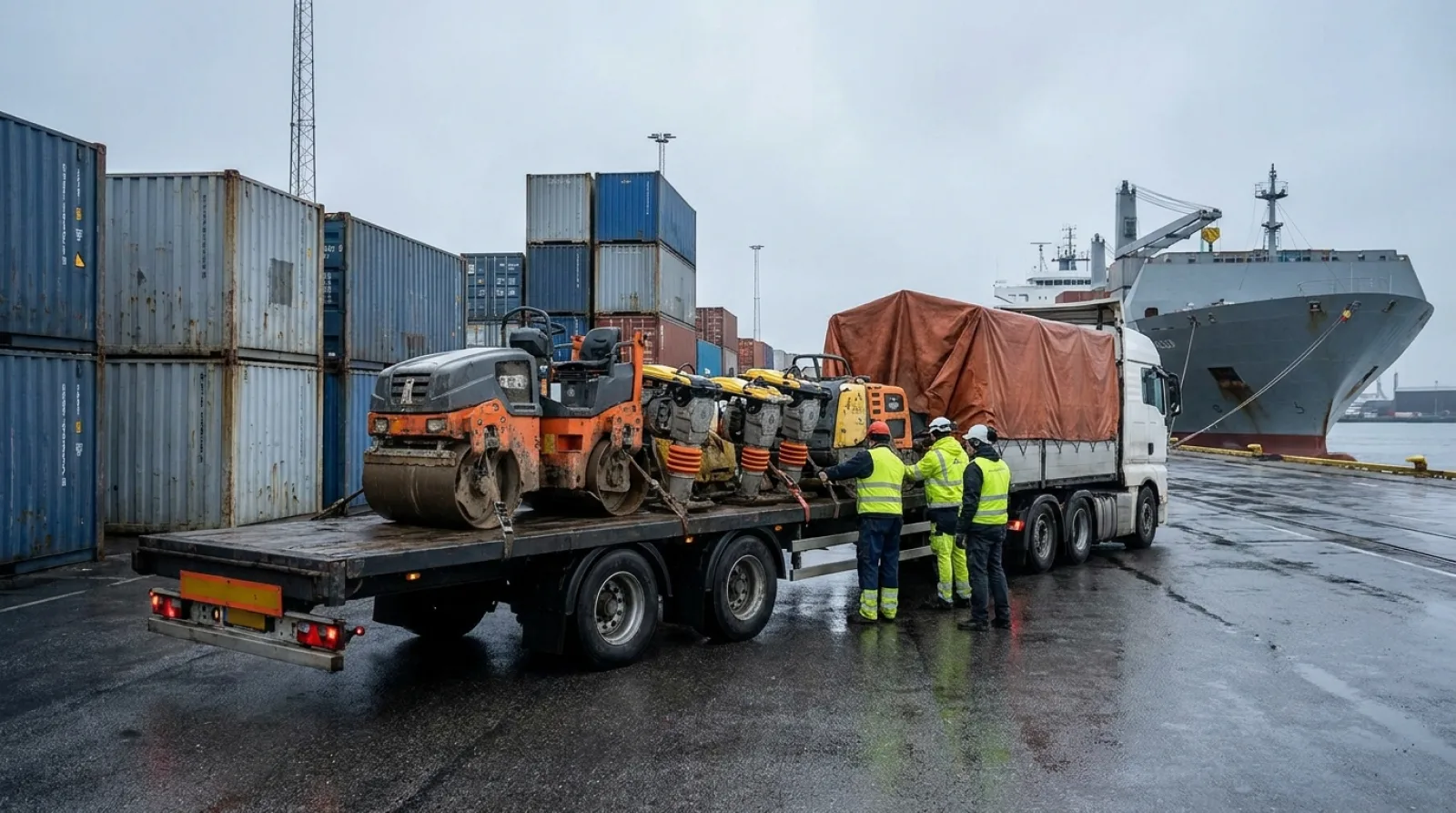
Securing the equipment properly inside the vehicle is essential. Plate compactors must be lashed using rated lashing straps directly to the trailer bed or anchored onto heavy-duty pallets. Collection arrangements and waiting limits depend on the specific auction site rules and the terms published in the buyer manual provided by the auctioneer.
Why combine plate compactors with heavier machinery loads?
A plate compactor is a compact item that rarely justifies an individual vehicle shipment over long international routes unless urgent delivery is necessary. Combining small units with larger machinery optimizes cargo capacity and reduces overall freight expenditure when moving goods across the UK and EU borders.
From a customs perspective, every line item on the invoice requires its own classification code. Plate compactors fall under tariff heading CN 8429 40. Accurately declaring each category ensures smooth customs clearance at the border and prevents unexpected holds or delays during import handling.
How to arrange the import step by step?
- Collection of commercial documentation. Obtain the official auction invoice and payment confirmation, ensuring the document lists equipment serial numbers and unit weight.
- Review of pickup requirements. Check the auction house release requirements, noting that pickup windows and loading protocols depend on auction terms.
- UK export declaration filing. Submit the UK export customs declaration using tariff code CN 8429 40 based on your purchasing documents.
- Freight consolidation and transport. Arrange road and ferry transport, consolidating the small machinery with larger equipment or routing via a transit facility.
- EU import clearance. Present the shipment for EU customs release or transit procedures at the entry port.
- Final site delivery. Unload the machinery at your designated warehouse or job site once customs formalities are complete.
Definitions
- CN (Combined Nomenclature): The common goods classification system used within the European Union for international trade statistics and customs tariffs.
- EORI (Economic Operators Registration and Identification): A unique reference number required by businesses conducting customs activities across the European Union and the United Kingdom.
- HS Code (Harmonized System Code): An international standardized numerical method of classifying traded products used worldwide by customs authorities.
- MRN (Movement Reference Number): A unique customs registration code generated upon declaration submission to track movement across international borders.
Checklist for preparing plate compactors for transport
- Verify that the total machine weight is within the standard 50–800 kg range.
- Confirm that the equipment requires no disassembly prior to trailer loading.
- Inspect engine fluids and ensure there are no fuel or oil leaks during transit.
- Gather purchasing documentation specifying CN tariff code 8429 40.
- Identify rated tie-down points on the machine frame for secure lashing.
- Ensure valid EORI numbers and customs authorisations are in place for both parties.
When do these transport rules not apply?
The standard import process described here does not apply if the plate compactor is being moved temporarily for exhibition or demonstration purposes without a change of ownership. In such cases, temporary admission procedures like the ATA (Admission Temporaire, the temporary admission document) Carnet are required. Furthermore, standard road freight rules do not apply if the equipment contains hazardous residue or exceeds standard dimensions, which depends on the exact model specifications.
The OTSL role
At OTSL, we handle the transport and customs clearance of machinery between the UK and the EU, utilising our hub in Kielce and our warehouse facility in Milton Keynes. We assist importers by combining small auction lots with larger freight movements. Learn more about our solutions on the groupage LTL and machinery transport service pages. You can also read our guide on Poland as a sourcing base for importers to explore efficient consolidation options.