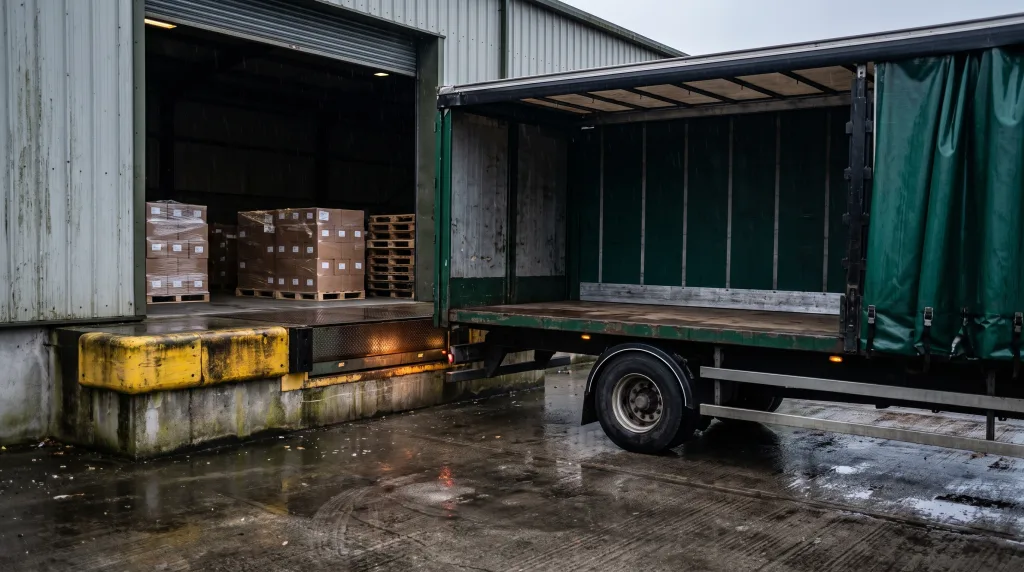
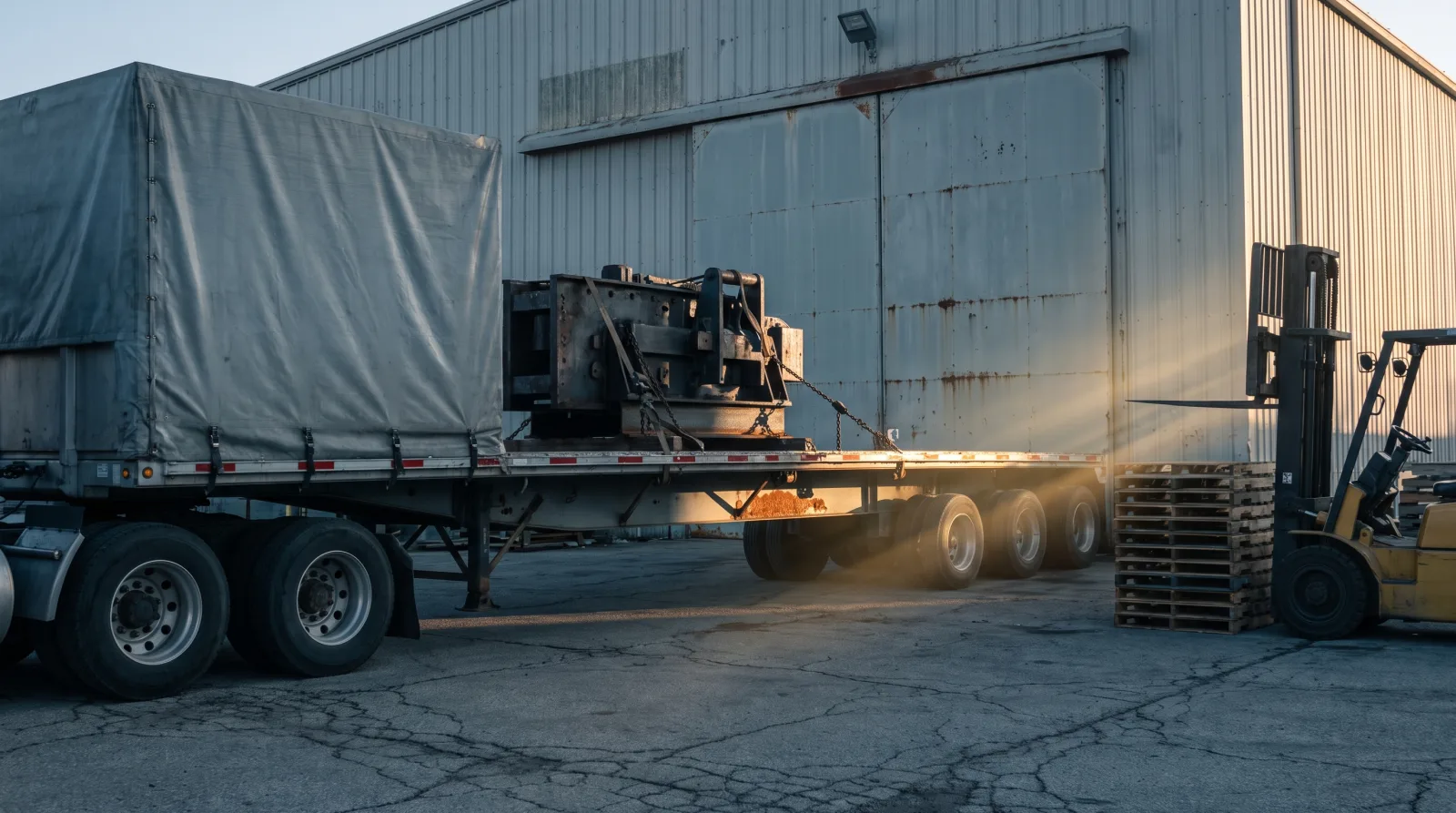
 AI image
A machine tool or a foundry line heading for an industrial fair in Kielce is an over-size or over-weight load, not "a pallet with an exhibit". Planning starts with data: mass, dimensions, support points and lashing options. On that basis OTSL selects the trailer (flatbed, mega) and checks the approach to the hall. Handling work on the venue grounds is done by the contractor appointed by the organiser at the organiser's rates; OTSL is responsible up to the side of the truck. Dates: METAL and CONTROL-TECH 22–24.09.2026, STOM-TOOL 6–9.04.2027 (as of 4.09.2026 — check the organiser's calendar).
Why is a machine for a fair a different transport job from a stand?
Stand construction is light and repeatable. A machine has one specific mass, often concentrated in one spot, and precisely defined places where it may be supported or hooked. Wrong information on any of these means the wrong trailer, no suitable unloading equipment, or damaged guideways and covers during lashing. That is why OTSL requires mass and support-point data before quoting, not at loading.
The second difference is the route. A flatbed or mega trailer with a tall machine will not fit everywhere a curtainsider with pallets will. Checking the approach to the venue gate, road restrictions and manoeuvring space at the hall is part of the order, not a task for the driver at the gate.
Who unloads the machine at the hall, and where does the forwarder's responsibility end?
On the exhibition grounds handling work is carried out by the contractor appointed by the organiser, at its rates and under its rules. The exhibitor's forwarder — OTSL included — is responsible up to the side of the truck: it delivers the machine in the build-up window, in line with the entry regulations, and hands it over for unloading. The unloading conditions (which equipment, what time, whether the exhibitor must supply spreader beams or slings) are agreed before departure, not at the hall.
Outside the venue OTSL has its own facilities: the Kielce depot has a lorry-mounted crane and forklifts up to 5 t. That allows a machine to be transferred to another vehicle or held when the build-up window falls later than the factory delivery. Machines heavier than that equipment can lift stay on the trailer until entry to the venue.
Moving a heavy machine to METAL or STOM step by step
- Load sheet. Provide mass, dimensions, centre of gravity, support points and lashing points, plus photographs of the machine; without these there is no reliable quote.
- Trailer and route selection. OTSL chooses a flatbed or mega, checks whether the load is out of gauge and plans the approach to the venue gate.
- Customs documents if the machine comes from outside the EU. ATA carnet or temporary admission for machines from the UK, Switzerland or Norway; if the machine is sold at the fair, the procedure changes to permanent import.
- Securing at the shipper's. The shipper is responsible for securing, the carrier for checking it; the driver inspects straps, chains and edge protectors before departure.
- Unloading agreement. Entry time from the organiser's materials, the venue contractor's equipment, slings needed — all confirmed before the truck leaves.
- Buffer when dates diverge. A factory delivery earlier than the build-up window goes to the OTSL depot in Kielce and leaves for the hall at the allotted hour.
Definitions
- Out-of-gauge (abnormal) load: a load exceeding the permitted mass or dimensions of a vehicle combination; it needs a suitable trailer and often permits and escort.
- Flatbed trailer: an open trailer without sides or tarpaulin, for machines loaded by crane or driven on; allows chain lashing to floor points.
- Mega trailer: a low-chassis trailer giving extra loading height inside a curtainside body; for tall machines that must travel under cover.
- Support points: the places on a machine's structure designated by the manufacturer for lifting and supporting; elsewhere the casing may not bear the load.
- Lorry-mounted crane (HDS): a crane on a vehicle; at the OTSL depot in Kielce it handles heavy pieces together with forklifts up to 5 t.
- ATA carnet (Admission Temporaire / Temporary Admission): a customs document for the temporary import of a non-EU machine to a fair without duty and VAT, with an obligation to re-export.
Checklist before shipping a machine to a Kielce fair
- Mass, dimensions, centre of gravity, support and lashing points sent to the forwarder with photographs.
- Edition date and build-up hours confirmed in the organiser's calendar and materials.
- Unloading at the hall agreed with the contractor appointed by the organiser: equipment, time, slings.
- Securing done by the shipper per the machine manufacturer's instructions; the driver's check documented.
- For a non-EU machine: ATA carnet or temporary admission ready; the sale-at-the-fair scenario discussed with the customs agency.
- Buffer in Kielce decided if the factory delivery and the build-up window do not coincide.
Does every machine for a fair need out-of-gauge transport?
No. Out-of-gauge rules do not apply to a machine that fits within the permitted dimensions and mass of the combination — then the right trailer and proper securing are enough. A load becomes abnormal when it exceeds height, width, length or mass limits, and that depends on the specific machine and trailer, not on the fact that it is going to a fair. The rule "OTSL is responsible up to the side of the truck" holds regardless of machine size, unless the exhibitor orders unloading outside the venue, for example at the OTSL depot in Kielce.
The OTSL role
OTSL serves exhibitors at Targi Kielce and handles out-of-gauge and special loads: it selects the trailer, checks the route, supervises securing and delivers the machine to the hall in the build-up window. The Kielce depot with its crane and 5 t forklifts acts as a buffer, and the OTSL customs agency processes ATA carnets and temporary admission for non-EU machines. OTSL is not the venue's official forwarder — who unloads the stand and under what rules is explained in the article on who unloads your stand at a trade show. A similar case with plastics machinery is described in Plastpol in Kielce. Services: machinery transport and out-of-gauge loads.