 AI image
On closing night every exhibitor dismantles at the same time, so a truck ordered "for whenever" waits in the queue at the hall. Dismantling hours, the order of entry for exhibits and limits on waiting time are set by the organiser in the exhibitor materials — the forwarder plans the vehicle for a specific hour against them, not "for the evening". When collection to the company cannot happen the same day, exhibits and stand can be taken from the hall in the evening, received at the OTSL depot in Kielce overnight (24/7) and dispatched to the client or the next show the following day.
What really happens at the hall on closing night?
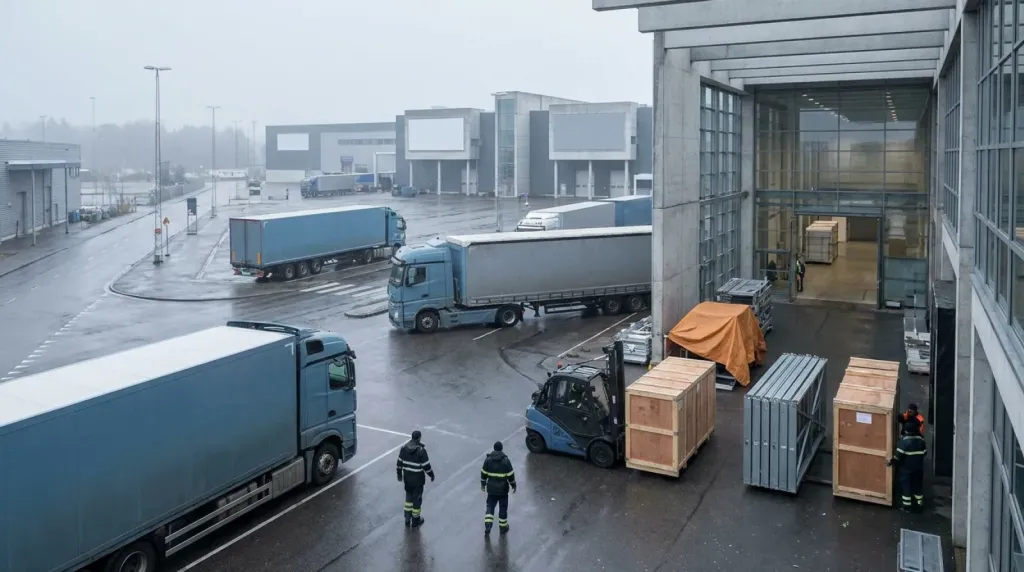
On the last day of a show the hall closes to visitors at a set hour, and dismantling begins shortly after. Hundreds of exhibitors pack their stands at the same time, and their forwarders' vehicles line up at the goods gates. The organiser regulates this traffic: it publishes dismantling hours, the order of entry for exhibits and limits on waiting time at the hall, and often uses a marshalling area from which vehicles are called in.
In these conditions a truck booked without a specific hour is in the worst position: it sits in the queue, the driver burns working time, and the crew at the stand waits for the crates. A truck planned for the hour given in the organiser's materials, dispatched from the Kielce depot a few minutes' drive away, enters when it is called.
What if the goods cannot go back to the company the same day?
It is a common case: the consignee's warehouse is closed at night, the driver has no working time left for the run home, or the same exhibits are going to another show in two weeks. The OTSL depot at ul. Batalionów Chłopskich 71 runs 24/7, so goods collected from the hall in the evening reach the warehouse overnight and leave for the client in the morning or stay in storage until the next show.
Receipt at the warehouse doubles as an inspection: items are counted and their condition documented with photographs. A fault caused during dismantling — a cracked panel, a bent profile — is thus recorded in Kielce rather than discovered at the company a week later with no way of telling when it happened.
Dismantling and collection from Targi Kielce step by step
- Get the dismantling hours. In the exhibitor materials for the edition, check when dismantling may start, the order of entry and the waiting limit at the hall.
- Book the truck for an hour. Give the forwarder a realistic packing time; the truck from the OTSL depot in Kielce enters when called, rather than queuing from the afternoon.
- Bring in the empty cases. Crates stored in the OTSL buffer return to the hall for the dismantling hour, so the crew packs straight into the original packaging.
- Pack and label. Every crate and pallet with the exhibitor's name and destination: company, OTSL warehouse or the next show.
- Loading and receipt at the buffer. The truck takes the goods from the hall; at the OTSL warehouse overnight they are counted and their condition photographed.
- Dispatch the next day. To the client, to the next show or — for a non-EU exhibitor — on the return leg with the ATA carnet, which OTSL presents to customs on leaving the customs union.
Definitions
- Dismantling window: the hours after the show closes in which exhibitors may take down stands and their forwarders may enter for exhibits; set by the organiser.
- Marshalling area: a designated area where vehicles wait to be called to the hall; used to thin the queue on closing night.
- Buffer warehouse: a warehouse next to the venue where goods go after dismantling when they cannot return to the company at once; in Kielce OTSL runs it 24/7.
- Inbound check: counting items and documenting their condition with photographs on receipt at the warehouse; the basis for distinguishing dismantling damage from transport damage.
- ATA carnet (Admission Temporaire / Temporary Admission): a customs document for temporary import of non-EU exhibits; on re-export it must be presented to customs when leaving the customs union.
- Post-show logistics: collection after dismantling, condition check, return to the company or carriage to the next show — the second half of a trade fair order.
Checklist for closing night in Kielce
- Dismantling hours, order of entry and waiting limit from the organiser's materials passed to the forwarder.
- Truck booked for a specific hour, with a margin for packing the stand.
- Empty cases ordered from the buffer for the dismantling hour.
- Destination of every pallet fixed: company, OTSL warehouse or the next show.
- A crew member responsible for signing the transport documents and noting reservations if anything is damaged.
- For a non-EU exhibitor: ATA carnet ready to present on re-export, exhibit list compared with what remains after the show.
Does every exhibitor have to use the buffer after dismantling?
No. The buffer does not apply to an exhibitor whose truck can take the goods from the hall and reach the company the same evening — a well-planned entry hour is enough there. The buffer makes sense when the consignee is closed at night, when the driver lacks working time for the run home, when the exhibits are going to another show, or when the exhibitor wants the condition of the goods documented right after dismantling. The rules for entering and leaving on closing night are set by the organiser; OTSL is not the official forwarder of Targi Kielce and fits the arrival time to the regulations of each edition. See also: The Targi Kielce calendar from a logistics angle: how to plan ahead and Small exhibitor at Targi Kielce: 1–3 pallets by groupage, tail lift and METAL and STOM in Kielce: getting a machine tool to an industrial fair.
The OTSL role
OTSL serves exhibitors at Targi Kielce in both directions: delivery for build-up and collection after dismantling. The depot at ul. Batalionów Chłopskich 71 runs 24/7, so a truck from the hall can unload overnight and the goods leave in the morning for the client or the next show. On receipt OTSL counts items and photographs their condition, brings empty cases from the buffer to the hall for the dismantling hour and, for non-EU exhibitors, looks after the ATA carnet voucher on the return leg. Handling work on the venue grounds is done by the contractor appointed by the organiser — OTSL is responsible up to the side of the truck. The second half of a trade fair order is described in the article on post-show logistics; how vehicle queuing works in the trade fair marshalling area; the depot itself in the warehouse next to the Kielce fairground. Services: secure transloading and storage, ATA carnets; the venue: Targi Kielce at OTSL.