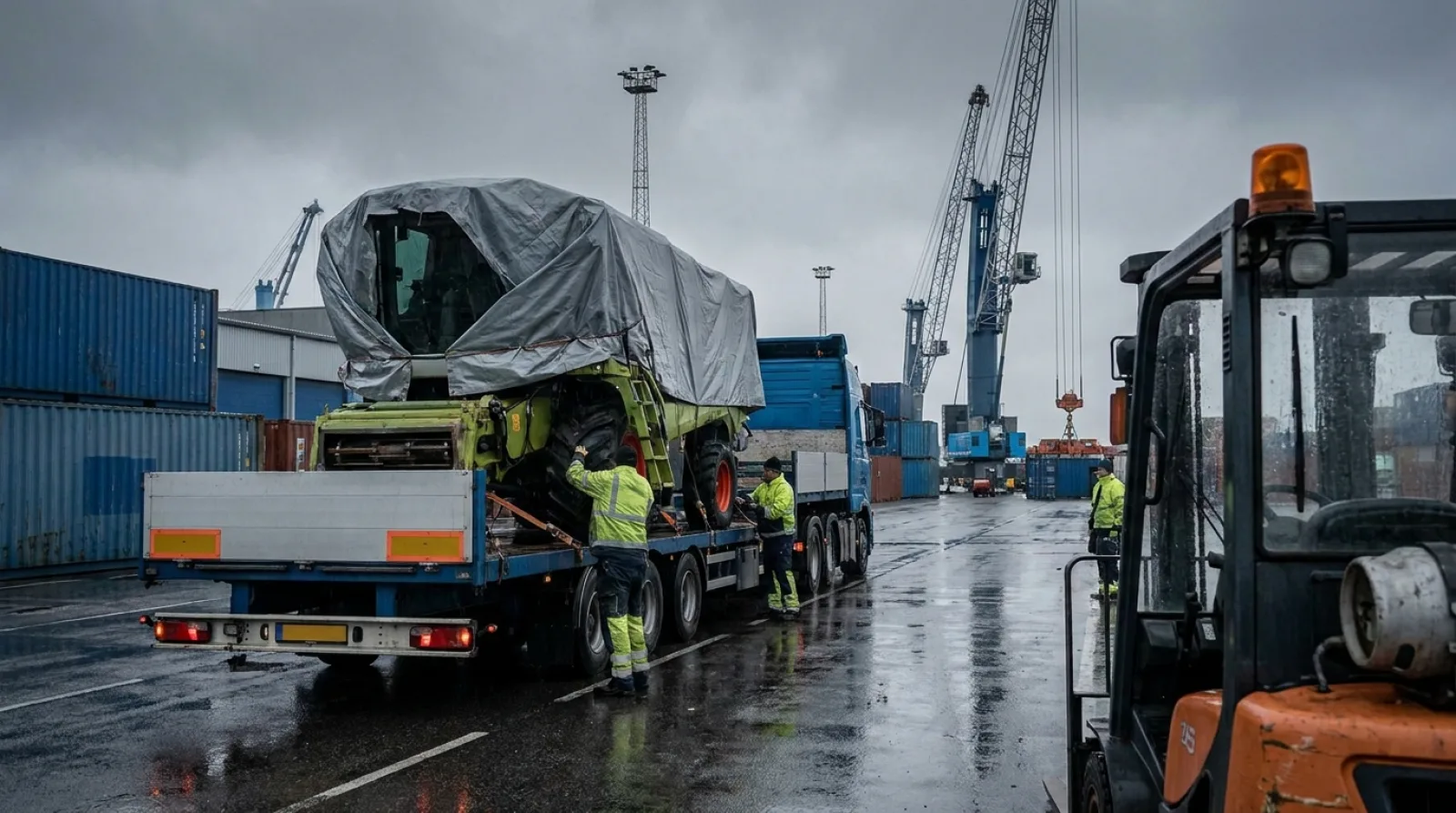
 AI image
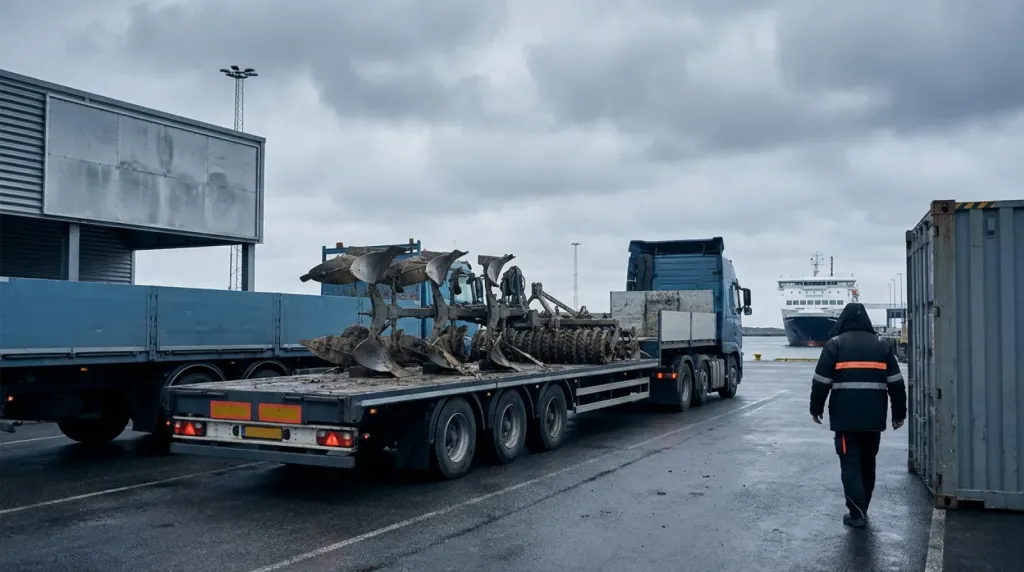
Transporting and importing a seed drill (German: Sämaschine, Polish: siewnik) from the United Kingdom into the European Union requires completing customs formalities under CN code 8432 31 and ensuring proper vehicle allocation. Seed drills typically range in weight from 0.5 t to 8 t. As the working width is often twice as large as the transport width, folding or partial disassembly is crucial prior to road haulage.
What are the technical requirements for transporting seed drills from UK auctions?
The main challenge when transporting a seed drill purchased at UK auctions is managing the difference between its field dimensions and statutory road transport limits. Agricultural seed drills are constructed so that their working width can be twice as large as their transport width. Prior to loading onto a trailer, operators must ensure that marker arms, coulter bars, and side extensions are fully folded and secured using mechanical locking pins.
A seed drill usually requires disassembly for transport if rigid structural parts exceed standard loading width limits. The weight range for these machines spans between 0.5 t and 8 t, which determines whether a standard flatbed, step-frame, or low-loader trailer is needed. Collecting machinery from UK auction sites involves checking physical dimensions and secure points before starting transit.
Why is CN code 8432 31 critical for customs clearance?
Following the exit of the United Kingdom from the European Union single market, all agricultural machinery moving between the UK and the EU requires customs declarations. Under the Combined Nomenclature tariff, seed drills fall under CN code 8432 31. Applying the correct commodity code ensures accurate calculation of duties, national VAT, and smooth border processing.
Machines bought at auctions in the United Kingdom enter the EU through formal customs clearance. Successful clearance relies on commercial auction invoices, technical data stating machine weight, and valid EORI numbers for both exporting and importing entities. An export declaration (EX1) must be filed with UK customs (HMRC) before the shipment departs the port.
Importing and transporting a seed drill step by step
- Document collection and verification. Gather the commercial auction invoice, payment receipt, and technical specification showing the mass within the 0.5–8 t range.
- Transport dimension assessment. Measure the machine in its folded state to verify if working width components have been reduced to transport limits.
- Component folding and disassembly. Remove or fold protruding markers and accessories if the machinery exceeds standard vehicle width limits.
- UK customs export filing. Submit the export declaration in the UK customs system to generate the Movement Reference Number.
- Haulage and EU import clearance. Execute road haulage from the UK site through port customs clearance to the final delivery destination.
Definitions
- CN (Combined Nomenclature): The European Union eight-digit coding system used for classifying goods, where seed drills fall under CN code 8432 31.
- EORI (Economic Operators Registration and Identification): A unique identification number required by business entities handling customs declarations within the UK and EU.
- Seed drill (Sämaschine / siewnik): An agricultural machine used for sowing seeds in rows, typically weighing between 0.5 t and 8 t.
- MRN (Movement Reference Number): A unique tracking number issued by customs authorities upon validating an export or import declaration.
Checklist for seed drill transport
- Verify that the working width is fully folded to match permissible road transport limits.
- Confirm that total machine mass falls within the 0.5–8 t range for correct trailer selection.
- Check that all movable parts and markers are locked with mechanical safety pins.
- Obtain the UK export declaration (EX1) from the auctioneer or customs agent.
- Ensure active EORI registrations for both exporter and importer.
- Confirm accurate assignment of tariff code CN 8432 31 on all paperwork.
When do these transport rules not apply?
The customs and transport procedures outlined here do not apply to equipment movements entirely within the European Union internal market. The requirement for export clearance under CN code 8432 31 does not apply when moving equipment under temporary admission or ATA (Admission Temporaire, the temporary admission document) Carnet procedures, unless ownership of the machine was transferred at auction. Requirements depend on individual auction house terms and specific seller collection conditions in the UK.
The OTSL role
OTSL Sp. z o.o., headquartered in Kielce, Poland, with operational facilities in Milton Keynes, England, manages international transport and customs coordination. We handle road haulage of farm machinery from UK auctions, ensuring correct vehicle routing and border clearance. Explore our machinery transport service and learn about event logistics in Agrotech in Kielce: moving farm machinery. See also: Agricultural Trailer Transport from the UK: Customs & Logistics and Tipper Truck Transport and Import from the UK: Customs Guide.