 AI image
Transporting and importing a backhoe loader from Great Britain to the European Union requires completing customs procedures and verifying cargo dimensions. A machine in the typical weight range of 7–9 t is classified under CN tariff heading 8429 59 and usually does not require disassembly for transport. Checking the backhoe arm height before loading onto a trailer is essential.
How does the transport of a backhoe loader purchased at a UK auction work?
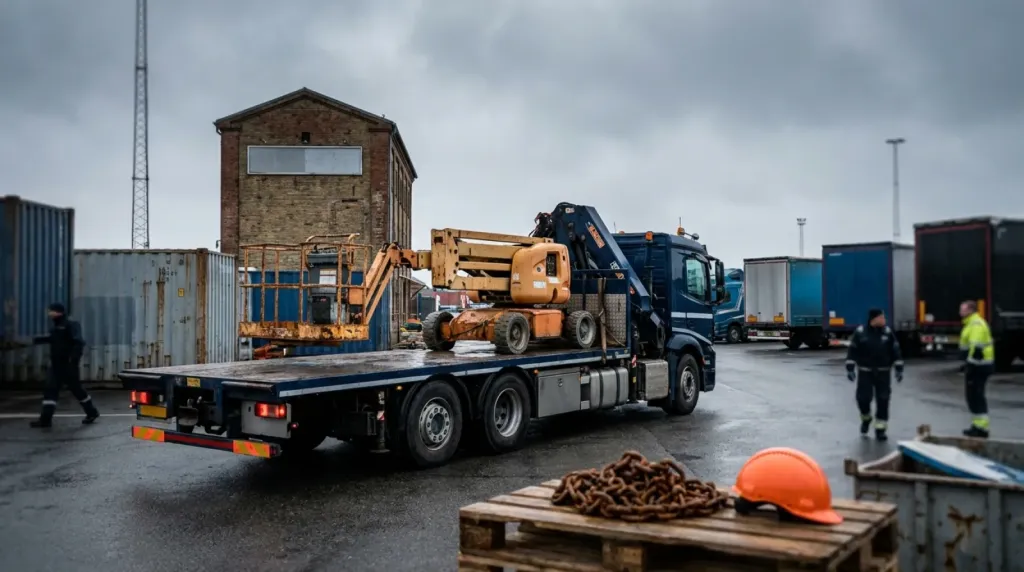
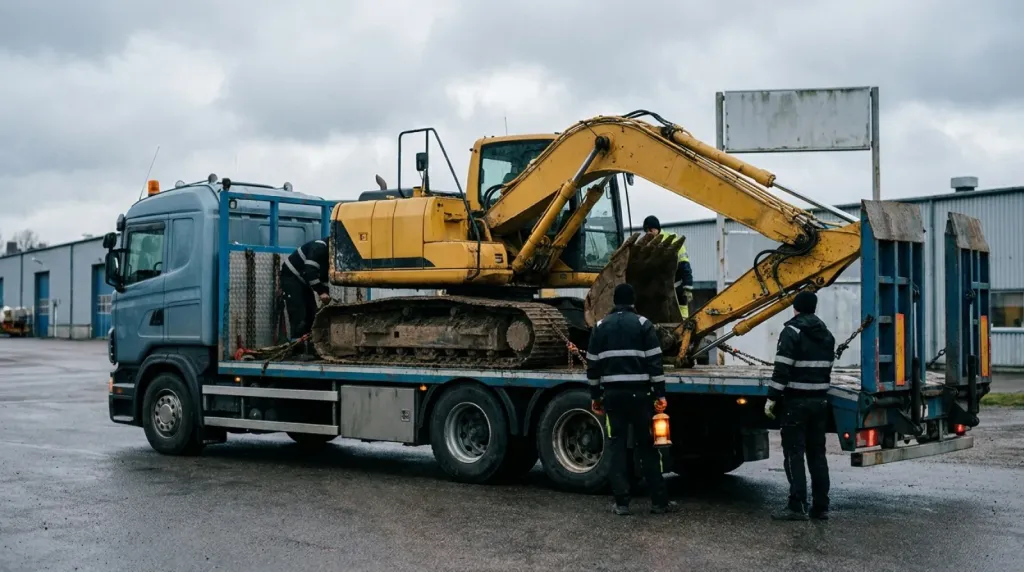
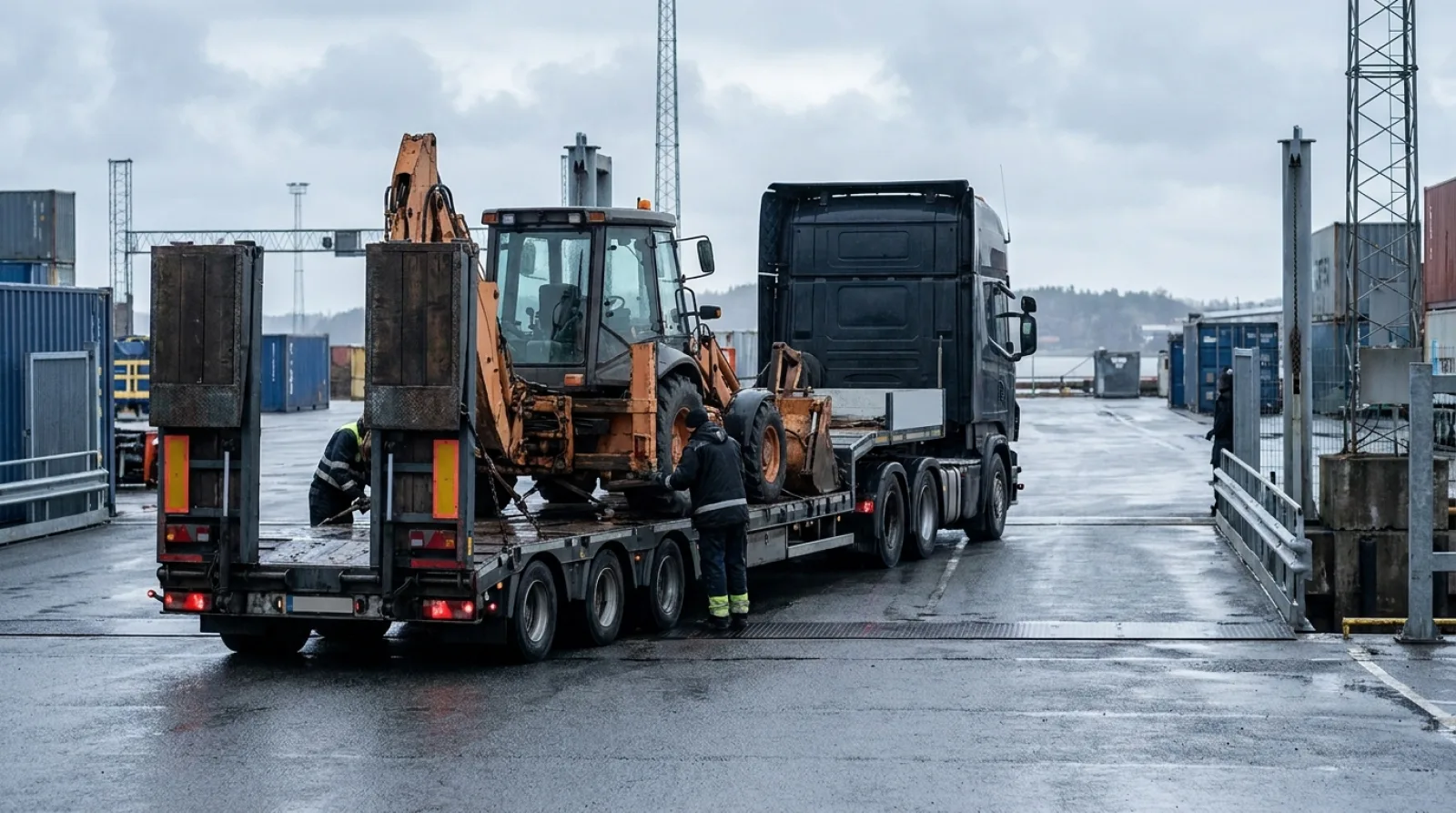
The backhoe loader is a classic of British auctions and a frequent acquisition for European Union contractors. Equipment with a typical weight range of 7–9 t is usually transported intact on a standard low-loader trailer. The machine does not require disassembly of its working attachments, which significantly speeds up the loading process at the collection site in Great Britain.
Before leaving the auction yard, the equipment must undergo validation of its commercial and technical documentation. Moving machinery from the UK involves third-country status, requiring full customs entries in the HMRC export system and import filings at the EU border. Proper alignment of purchase invoices and machine identification numbers prevents unnecessary holds at ferry terminals or clearance points.
Why is the backhoe arm height critical prior to loading onto a trailer?
Although the width and length of a backhoe loader generally remain within standard transport limits, the total vertical clearance can be challenging. The rear excavating arm, when folded into its travel position, directly affects the overall combination height once placed on a trailer bed. Measuring the top point of the arm before pulling onto the road is therefore a compulsory step.
If the measured height exceeds road envelope limits along transit routes, rerouting or special movement permits may be required. Incorrect positioning of the arm or unengaged hydraulic locks can lead to arm displacement during transit. Careful physical checks at the UK yard or Milton Keynes facility safeguard the transport against enforcement stops by transport authorities.
Importing a backhoe loader step by step
- Verification of technical parameters at the auction. Before picking up the machine, confirm its unladen weight within 7–9 t and measure the exact height of the stowed rear boom.
- UK export declaration processing. The customs broker submits the UK export declaration into the HMRC system using the auction invoice and serial number.
- Road haulage and ferry booking. The machinery is driven or winched onto the low-loader trailer and secured with certified chains and lashing straps.
- Border customs clearance in the EU. The transport enters the EU under appropriate customs manifest entry using tariff heading CN 8429 59.
- Inspection upon arrival at destination. Upon arrival at the recipient site in Poland or elsewhere in the EU, seals and machine condition are inspected prior to unloading.
Definitions
- CN (Combined Nomenclature): The European Union eight-digit goods classification system used for customs tariffs and foreign trade statistics.
- EORI (Economic Operators Registration and Identification): A unique identification number used by customs authorities when dealing with businesses across the EU and UK.
- MRN (Movement Reference Number): A unique reference number assigned to customs declarations within electronic declaration systems.
- Backhoe loader: A versatile construction vehicle weighing typically 7–9 t, combining a front loader bucket and rear excavator arm, which usually does not require disassembly for haulage.
Checklist for transport preparation
- Verify auction release documentation and serial chassis number.
- Measure the highest point of the folded rear backhoe arm.
- Confirm gross vehicle weight compliance with the 7–9 t machine payload.
- Ensure the UK export declaration MRN is generated before port arrival.
- Prepare heavy-duty lashing chains and wheel chocks for low-loader transport.
- Apply correct tariff heading CN 8429 59 on all customs paper work.
When does this transport rule not apply?
The rules described above do not apply to machines exceeding standard dimensional or weight limits, or when non-standard oversized attachments are fitted to the chassis. The principle of transport without disassembly does not apply if the total combination height on the low-loader exceeds statutory overhead limits in transit countries. Furthermore, customs clearance requirements depend on the chosen regime and final destination inside the EU. If the equipment has sustained structural boom damage or lacks self-propulsion, handling depends on event conditions and instructions set out in the exhibitor manual or auction terms.
The OTSL role
OTSL Sp. z o.o., based in Kielce with facility support in Milton Keynes, United Kingdom, manages transport and customs documentation for machinery imported from Britain. We offer reliable machinery transport on low-loader trailers connecting the UK, Poland, Switzerland, Norway, and the rest of Europe. Our customs specialists handle full customs clearance ensuring correct application of CN code 8429 59. Procedures are coordinated in line with mechanisms such as regime 42 EU import deferred VAT and transport guidelines outlined in machinery customs clearance Netherlands import. Operational bases in Milton Keynes and Kielce allow smooth execution at every step.