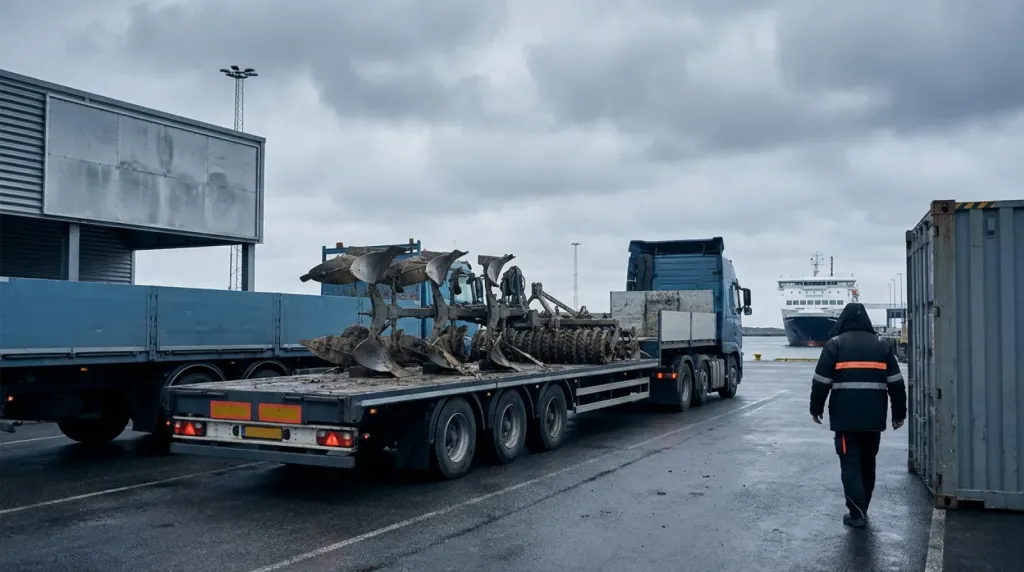
 AI image
Transporting and importing an agricultural baler from the United Kingdom to the European Union requires compliance with customs procedures and selecting suitable road transport equipment. These machines typically weigh between 2 and 12 t and fall under CN code 8433 40. They usually do not require disassembly, though round and square balers differ in size, with large units requiring out-of-gauge transport.
How does the import of agricultural balers from UK auctions work?
Agricultural balers purchased at UK auction sites or commercial dealerships enter the European Union through formal customs clearance. Buying at auction requires verification of purchase documentation and machine specifications. For the cargo to leave the UK and enter free circulation in the EU, importers must present commercial invoices, transport documentation, and formal customs declarations. Used machinery must also comply with biosecurity requirements regarding soil cleanliness, which means thorough cleaning is necessary prior to dispatch.
Transport coordination must account for the mechanical dimensions of the equipment. Agricultural balers generally fall within a weight range of 2 to 12 t. Owing to their compact frame, these machines usually do not require disassembly before road transit, which simplifies loading operations. However, collection conditions, loading hours, and crane or ramp requirements depend on the rules of the specific auction house or vendor site, requiring site-specific verification before dispatching a vehicle.
What is the difference between transporting round and square balers?
Round balers and square balers feature distinct physical dimensions and axle load distributions. Round balers are generally shorter in length but can be wide or high, which influences the choice between low-loader trailers and standard flatbeds. In contrast, large square balers frequently feature extended total lengths and heavy operational weights, often reaching the upper boundary of the 2 to 12 t range.
These dimensional variations dictate whether the move can proceed as standard freight or must be arranged as an out-of-gauge transport operation. If vehicle or cargo dimensions exceed statutory road limits, official movement permits and escort vehicles must be arranged. The choice of transport configuration depends on precise catalogue dimensions and measured total vehicle width upon loading.
Customs clearance and transport step-by-step
- Document and dimension verification. Obtain technical specifications from the seller, verify the mass within the 2–12 t range, and check whether the round or square baler fits standard road limits.
- Auction site preparation. Ensure the baler is washed free of soil residues and check specific collection guidelines provided by the auction organisers.
- Customs filing. Assign commodity code CN 8433 40, compile the commercial invoice, and lodge the export declaration via the UK Customs Declaration Service (CDS).
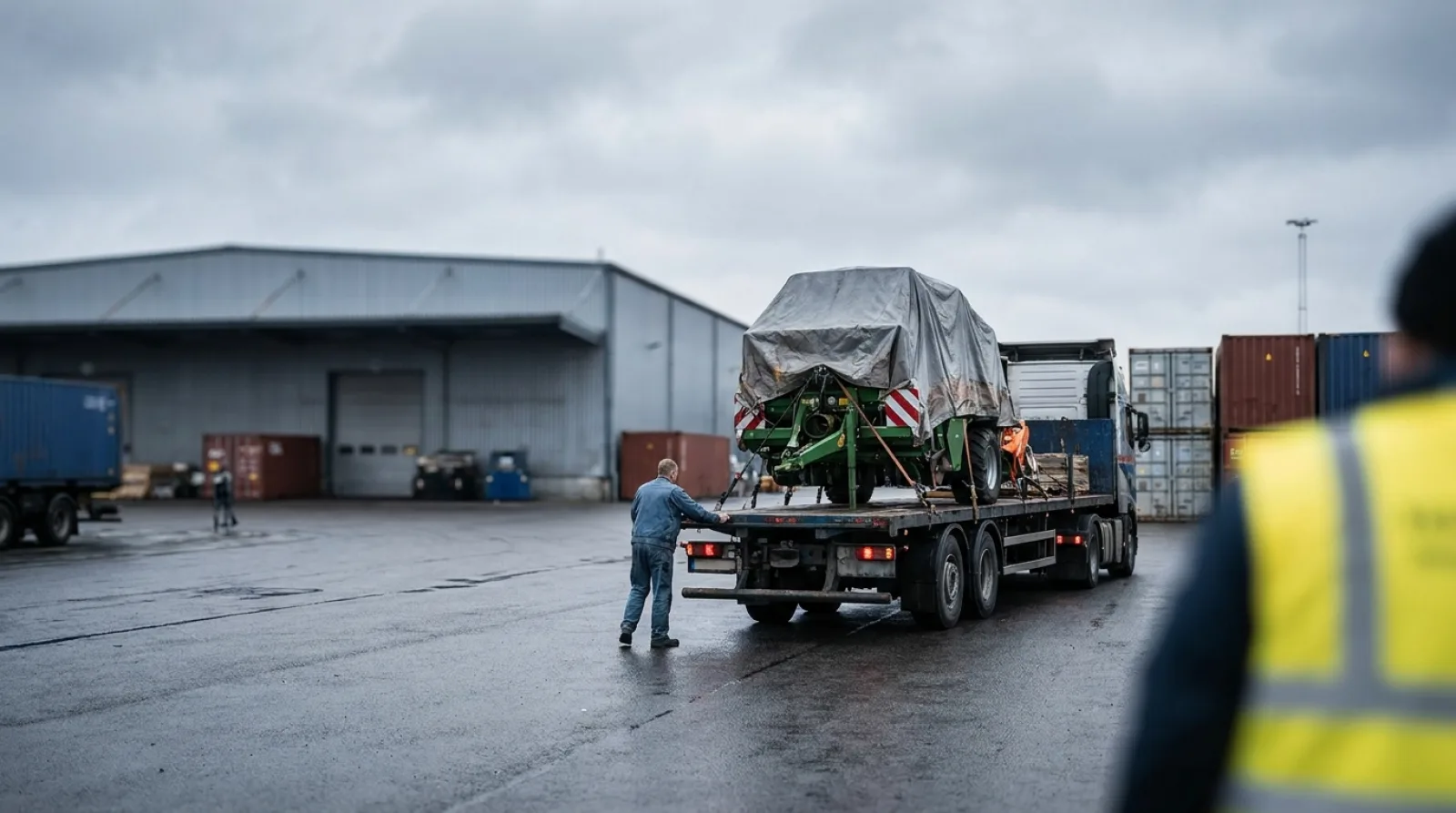
- Road transport deployment. Secure the machinery onto a low-loader or flatbed trailer using approved lashing chains and straps.
- EU import clearance. Complete final import clearance or open a transit procedure to the final destination within the European Union.
Definitions
- CN 8433 40: Combined Nomenclature code covering balers for straw or fodder, including pick-up balers.
- Baler: Agricultural machine designed to compress cut and raked crops into compact bales.
- CDS: Customs Declaration Service, the official electronic customs clearance portal used in the UK.
- EORI: Economic Operators Registration and Identification number required for customs declarations in the UK and EU.
Checklist before collecting a baler from an auction site
- Obtain verified external dimensions (length, width, height) and total weight.
- Confirm valid EORI numbers for both the exporter and importer.
- Verify correct classification under CN code 8433 40 in shipping invoices.
- Ensure the machine is thoroughly cleaned of mud and organic debris before export.
- Review auction site access rules and loading equipment availability.
- Select appropriate transport gear based on standard or oversize parameters.
When do these transport rules not apply?
The outlined transport and customs procedures do not apply to machine movements taking place entirely within member states of the European Union, where goods move freely without border customs declarations. These rules also do not apply when equipment is moved under temporary admission, unless the machinery enters permanent domestic use within the EU. Furthermore, standard road freight arrangements do not apply if the machine's dimensions exceed legal road profiles; in such cases, movement rules depend on national out-of-gauge regulations across transit countries.
The OTSL role
OTSL Sp. z o.o., headquartered in Kielce with operational facilities in Milton Keynes, England, handles international transport and customs coordination for agricultural machinery. The company manages machinery transport for equipment bought at UK auctions destined for the EU. For large units exceeding standard limits, OTSL arranges specialized out-of-gauge transport. The OTSL logistics team supports importers through every stage of border formalities to maintain efficient supply chains. See also: Transport and Import of Agricultural Tractors from the UK and Transport and import of a crop sprayer from the UK: rules.