 AI image
Transporting and importing an agricultural tractor (German: Traktor) from the United Kingdom to the European Union requires a customs declaration under CN tariff heading 8701. Machines with a typical weight range of 2–18 t usually do not require disassembly for transport, though front loaders and counterweights travel separately. Machines bought at UK auctions enter the EU via clearance.
How to prepare an agricultural tractor for transport from a UK auction?
When purchasing an agricultural tractor at an auction in the United Kingdom, technical parameters and cross-border formalities must be taken into account. An agricultural tractor is the most commonly imported farm machine from the UK, reflecting the active secondary machinery market. The typical weight range for these vehicles spans from 2 to 18 t. In most scenarios, the machine fits onto standard transport trailers without requiring disassembly of its main structural components prior to loading.
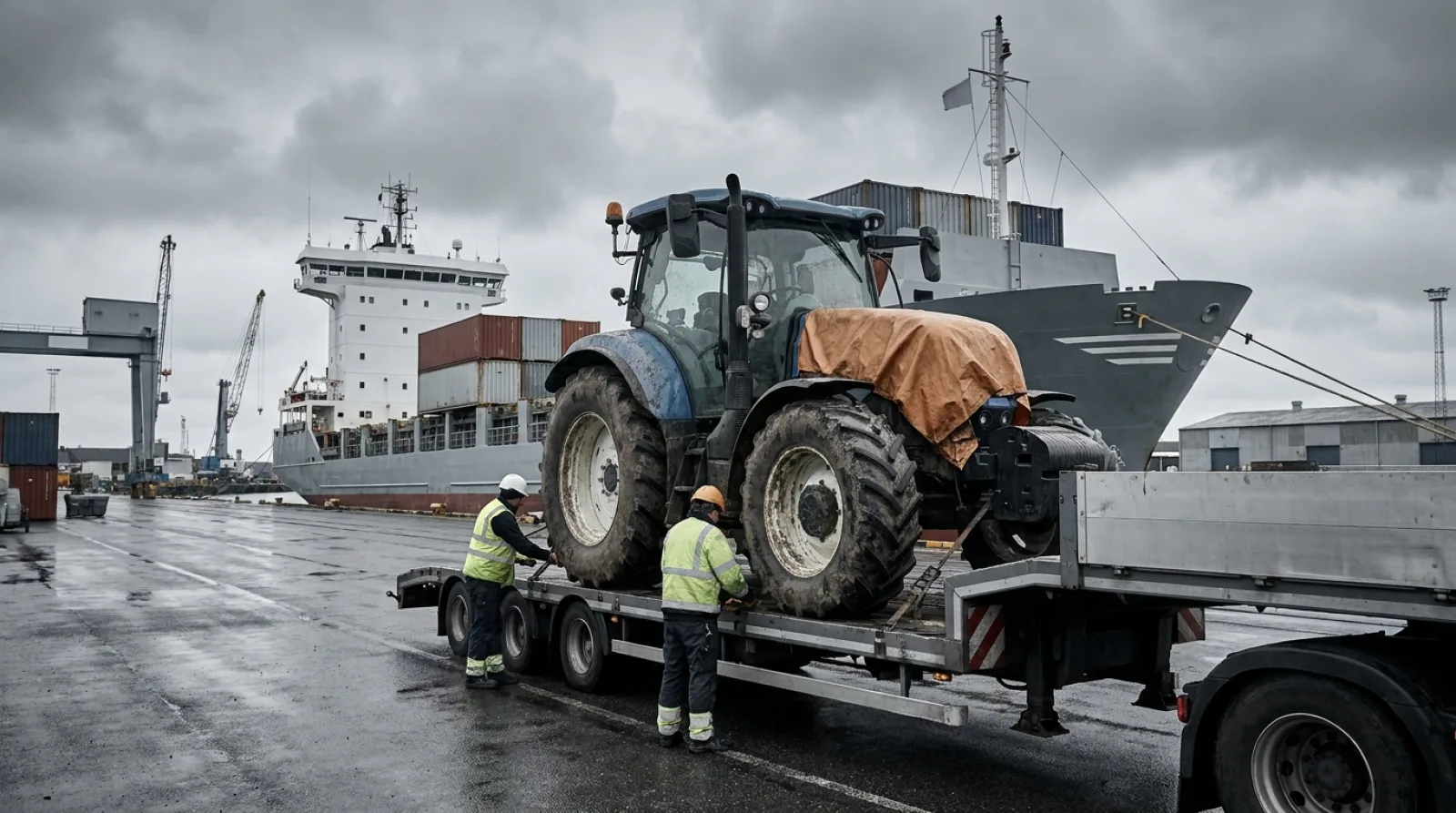
However, auxiliary attachments require specific handling. Practical experience shows that counterweights and front loaders usually travel separately on the trailer or on a secondary transport unit. Removing these components facilitates an optimal distribution of weight across the trailer axles and enhances security during road transport and sea crossings. Pickup schedules and site access terms depend on the specific auction house terms or exhibitor manual conditions.
Which customs requirements apply under CN heading 8701?
Every agricultural tractor entering the European Union customs territory from Great Britain must undergo import customs clearance. Under the Combined Nomenclature, the correct tariff heading for an agricultural tractor is 8701. Accurate classification under this code is necessary to process the import declaration and calculate applicable duties and taxes upon arrival.
Machines bought at auctions in the United Kingdom enter the EU via clearance, either at the border crossing point or at an inland customs office. Importers must present commercial documentation, such as the auction invoice or bill of sale. The exact set of documents required depends on the selected customs procedure and the terms of the sale.
Importing an agricultural tractor from the UK step by step
- Vehicle acquisition at auction. Securing the tractor bid at a UK auction and obtaining the official invoice and release documentation.
- Equipment and weight verification. Confirming the vehicle weight within the 2–18 t range and detaching weights and front loader for separate transport.
- Collection arrangement. Scheduling vehicle collection from the auction site in accordance with the auction house rules and exhibitor guide.
- Tariff classification. Assigning the machine to CN tariff heading 8701 within the customs filing system.
- Transport and customs clearance. Executing the road and ferry transport followed by import clearance upon entering the EU customs area.
Definitions
- CN tariff heading 8701: The official Combined Nomenclature code covering agricultural and forestry tractors used in customs declarations.
- Agricultural tractor: A motorized vehicle built for agricultural work, known in German as Traktor.
- Front loader: An interchangeable attachment fitted to the front of a tractor, usually transported separately during international haulage.
- Import customs clearance: The legal process required to release goods from a third country into free circulation within the EU.
Checklist for tractor transport from the UK
- Verify the tractor mass within the 2–18 t range using auction specifications.
- Ensure tariff heading CN 8701 is declared on all customs paperwork.
- Arrange separate cargo securing for counterweights and front loaders.
- Review collection conditions in the UK auction house terms.
- Compile all purchase invoices required for EU import clearance.
When do these rules not apply?
The import steps outlined above do not apply to agricultural machinery moved entirely within the European Union internal market, where customs borders do not exist and filings under CN 8701 are not required. Procedures depends on the customs status of the cargo and the route taken. Furthermore, these guidelines do not apply if the tractor exceeds the standard 2–18 t weight range or possesses dimensions requiring special abnormal load permits, which depends on national transport regulations across transit countries. See also: Transport and Import of Temporary Fencing and Barriers from the UK and Transport and Import from the UK: Dewatering Pump and Sets and Transport and Import of Agricultural Balers from the UK: Rules.
The OTSL role
OTSL Sp. z o.o., based in Kielce with a logistics facility in Milton Keynes, England, manages international transport and customs clearance for agricultural machinery moved between the UK and the EU. Explore our specialized services for machinery transport and customs clearance. For additional details on customs options, read about Regime 42 deferred VAT import clearance or consult our guide on Agrotech in Kielce farm machinery transport.