 AI image
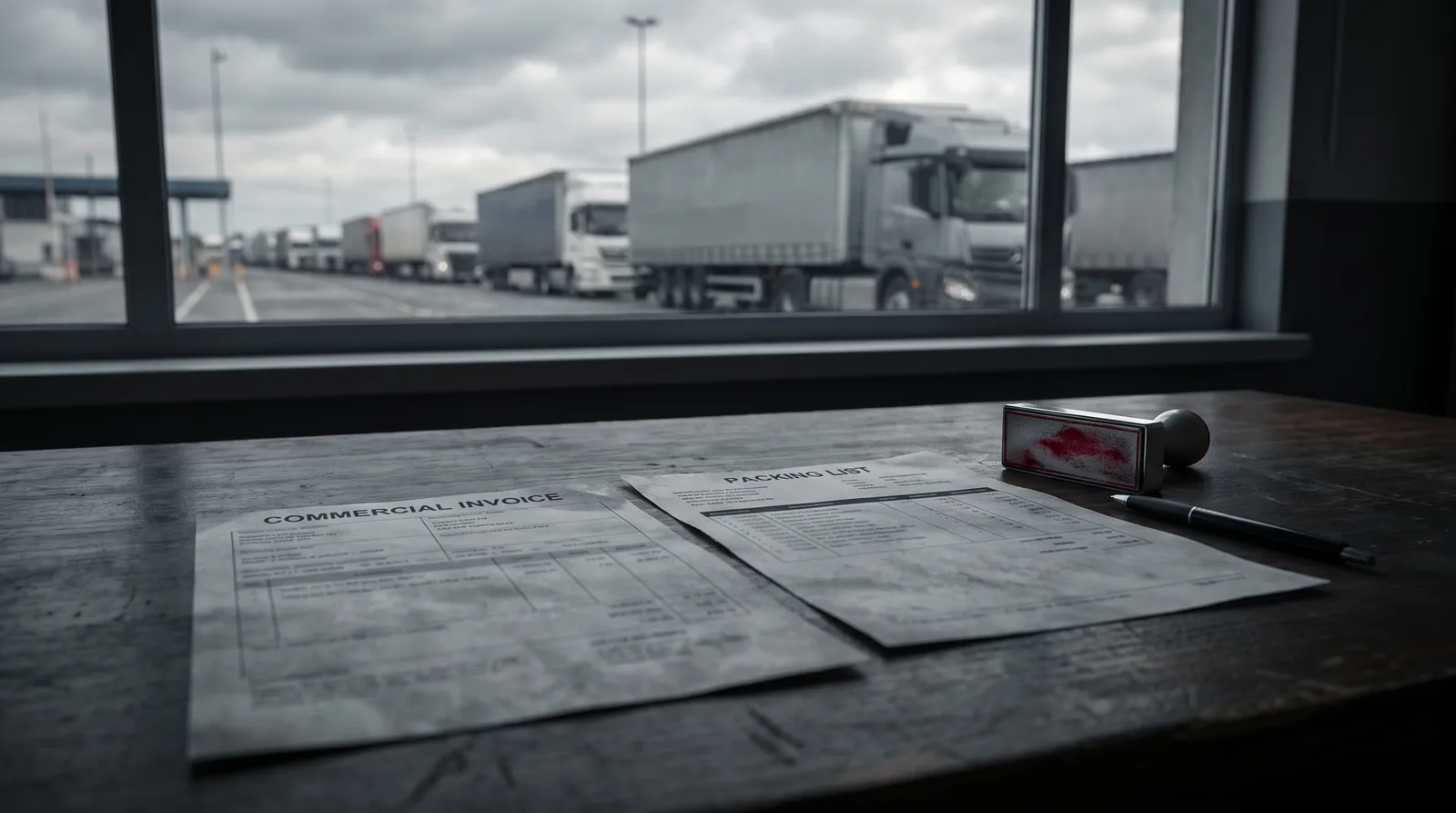
A commercial invoice used for customs clearance must identify the seller and the buyer with their EORI numbers, describe the goods in words a customs officer can understand, and state the HS code, value with currency, Incoterms with a named place, net and gross weight, country of origin and the number of packages. The packing list maps those goods to physical packages. Every gap means questions, and the truck waits while they are answered.
The officer will not guess what is on the trailer
A customs declaration is built from documents, not from looking at the load. The broker sees what the seller wrote on the invoice and nothing else, and from that alone must classify the goods, calculate the charges and check whether the shipment is subject to controls. A line reading „spare parts, 1 pallet" allows none of it. The broker emails the exporter, the exporter hunts for the one colleague who knows the answer, and the loaded trailer stands at the terminal or the border. The driver loses the delivery slot, detention charges start running, and the consignee starts asking where the goods are. For UK imports the entry goes into the Customs Declaration Service and needs, among other data, a full 10-digit commodity code and a GB EORI, so a thin invoice stops the process before it begins.
Then comes the broker's own bill: extra tariff lines, declaration amendments and inspection attendance appear on it exactly when the paperwork was incomplete. We break those charges down in what customs clearance really costs, and the full document set for the UK route, from the invoice to safety and security declarations, in export to the UK: required documents.
Field by field
| Field | What to enter | What happens without it |
|---|---|---|
| Seller and buyer | full names, addresses, EORI and VAT numbers of both parties; if the goods travel somewhere other than the buyer's address, also the delivery consignee | the declaration cannot be lodged; the broker chases data by email while the truck waits |
| Invoice number and date | a unique number and the issue date | the documents cannot be tied to a specific transport |
| Goods description | what it is, what it is made of, what it is used for, understandable to an outsider | no basis for classification, high inspection risk |
| Commodity code | at least the 6-digit HS code; 8-digit CN code for EU export declarations, 10 digits for UK import entries | the broker classifies at your risk or holds the declaration |
| Quantity and unit | pieces, pairs, litres or kilograms for every line | a mismatch with the packing list and the CMR (the Convention on the contract for international carriage of goods by road) note invites an examination |
| Value and currency | unit price, line value and invoice total in one currency | no basis for customs value, duty or import VAT |
| Incoterms with place | rule plus named place, e.g. FCA Kielce or DAP Manchester, marked Incoterms 2020 | unclear who clears the goods and which costs enter the customs value |
| Net and gross weight | per line and in total, consistent with the packing list and the CMR note | the declaration needs weights, and a weighbridge mismatch ends in a control |
| Country of origin | per line, not one entry for the whole invoice | no preferential rate, duty paid in full |
| Packages | number and kind, e.g. 12 cartons on 2 pallets, matching the CMR note | a package count different from the consignment note means questions and an examination |
The four fields most shipments fail on
Goods description. An internal stock code like „ART-8814-B" means something only to your ERP system. From the description alone the officer must work out what the goods are, what they are made of and what they are for, because classification and duty rate follow from it. The test is simple: would a stranger without your product catalogue understand what is on the trailer. „Worm gearboxes for belt conveyors, cast steel" passes; „machine parts" does not. Keep the part number as an addition, never as the only description.
Commodity code. The first six digits come from the World Customs Organization Harmonized System, shared by most trading nations. EU export declarations use the 8-digit Combined Nomenclature, while a UK import entry needs the full 10-digit code, which you can look up free of charge in the UK Trade Tariff on GOV.UK. A code on the invoice speeds the broker up, but responsibility for correct classification stays with the declarant. How to classify properly, and why a binding tariff ruling beats guessing, is covered in how to classify goods correctly.
Value, currency and Incoterms. Customs value rests as a rule on the transaction value, the price actually paid or payable, set out for the EU in Article 70 of the Union Customs Code, with the UK applying its own equivalent valuation rules. That is why „value 0" on samples and free-of-charge goods blocks clearance: goods always have a customs value, even when nobody pays for them. State a realistic value and mark the line free of charge. An Incoterms rule without a named place is empty: DAP always with the delivery place, FCA with the handover point, because that decides who arranges clearance and which transport costs enter the customs value.
Origin and EORI. Origin decides the rate. A preferential rate under a trade agreement, such as the one between the EU and the UK, requires documented preferential origin, usually a statement on origin on the invoice; a bare „PL" or „DE" in a column is not enough. Check the conditions for your agreement at official sources such as GOV.UK before promising your customer a zero rate. And without EORI numbers the declaration cannot be lodged at all; what the number is and how to get one is explained in EORI number: what it is.
The packing list: why a second document
The invoice says what was sold. The packing list says where it physically sits: package by package, with contents, net and gross weight, dimensions and markings. When customs selects the shipment for examination and wants to see line 7, a good packing list leads the officer to one carton on one pallet. Without it, an examination means opening everything in turn, on your transport's time and money. The packing list is also the first line of defence at the weighbridge: the documented gross weight must match what the scale shows. For groupage and exhibition loads, where one trailer carries a dozen consignments from different shippers, no serious clearance works without it.
The gaps that stop clearance most often
- Missing EORI number of the seller or the buyer, or a number inactive in the system.
- An unusable goods description: an internal code, a bare brand name or a collective „parts".
- Line values that do not add up to the invoice total, typically after a manual edit of one line.
- No currency stated, or two currencies on one document with no indication which applies.
- Zero value on samples, marketing material and replacement parts sent free of charge.
- Incoterms without a place, or a rule contradicting what the transport order says.
- Missing net and gross weights, or weights copied from a different dispatch.
- A packing list contradicting the invoice and the CMR note: a different pallet count, a different weight, a line the invoice does not show.
The OTSL role
As an international freight forwarder we arrange customs clearance on the UK, Swiss and EU routes, and we check documents before the truck moves, not at the border. We catch invoice and packing list gaps at order stage, keep the paperwork consistent with the CMR note and coordinate brokers on both sides. Warehouses in Kielce, Legnica and Milton Keynes let us consolidate and repack a load before it goes for clearance. The full service is described under customs clearance, more topics sit in the knowledge base, and you can discuss a specific transport through the contact form.
Why is a detailed packing list necessary if the invoice already lists all goods?
The packing list tells customs officers exactly which box or pallet contains which item, enabling physical checks without unloading the entire truck.
Step by step
- Check trader details. Verify full company names, addresses and active EORI numbers for both importer and exporter.
- Add commodity codes. Insert the correct HS code for every line item on the invoice to enable smooth classification.
- Set commercial terms and value. State the agreed Incoterms with a named location along with total values and currency.
- Prepare the packing list. Map invoice items to specific cartons or pallets while detailing net and gross weights.
- Send documents early. Submit the invoice and packing list to the customs broker before the vehicle departs.
Definitions
- EORI (Economic Operators Registration and Identification): A unique identification number used by businesses when dealing with customs authorities across the EU and the UK.
- HS Code (Harmonized System): An international standardized numerical classification for goods used to calculate duties and taxes.
- Incoterms (International Commercial Terms): A set of pre-defined commercial rules defining the allocation of costs, risks and responsibilities between seller and buyer.
- Commercial Invoice: The transaction document issued by the seller that forms the basis for the customs declaration and duty assessment.
- Packing List: A document breaking down invoice items into physical packages, detailing weights, dimensions and pallet allocation.
When does this rule not apply?
The requirement to issue a commercial invoice and packing list for customs clearance does not apply to movement of goods solely within the European Union, unless the shipment crosses non-EU territories such as the UK or Switzerland.