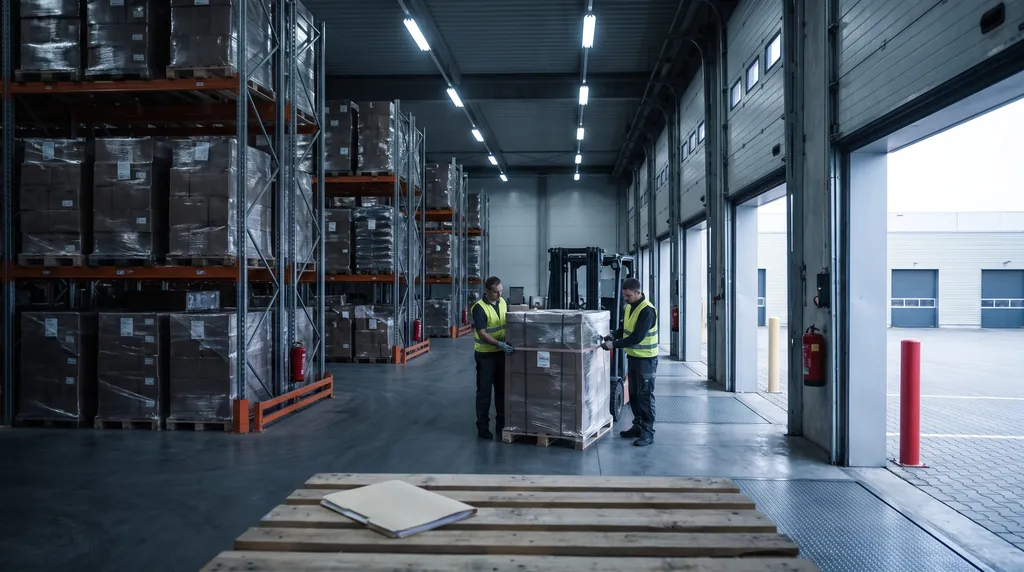
 AI image
A free zone is a fenced, designated area within the EU customs territory where non-Union goods are treated, for import duty and VAT, as if they had not yet entered the Union (Articles 243-249 of the Union Customs Code). You can store, transship and process goods there without paying duties until they enter the EU market. It pays off mainly for transit, re-export and duty deferral. Check availability and conditions with the customs authority.
How a free zone works in practice
The rule is simple to state and easy to get wrong on the ground. Non-Union goods physically sitting in a free zone have not yet been released for free circulation. No duty or VAT is charged, most trade-policy measures do not apply, yet the goods stay under customs supervision. The charges arise only when the goods leave the zone towards the Union market and are placed under release for free circulation. If instead they leave the EU under re-export, EU duty never becomes due at all.
This shifts the moment of payment and adds flexibility, but it is not a loophole. The zone boundary is a real customs boundary: on entry and exit you file declarations or notifications, keep stock records and answer for the match between physical stock and paperwork. The customs authority can inspect what comes in and out. So the zone rewards goods that genuinely travel onward or wait for a market decision, and penalises goods that will end up permanently in a Polish or German warehouse anyway.
What you can do in a free zone
- Storage without charging duties. Non-Union goods may sit in the zone without a time limit until they are placed under another procedure or re-exported. Duty and VAT wait rather than run.
- Transshipment and consolidation. Stripping a container, repacking, combining several consignments into one shipment for re-export. This is the natural home for logistics where the goods change transport mode, not customs owner.
- Usual handling and processing. The UCC allows usual forms of handling in the zone, and once the goods are placed under the relevant special procedure, inward processing of non-Union goods too. The scope and formalities are set by the customs authority, so confirm your exact scenario with them.
- Inspection and sorting before the decision. Quality checks, sampling, splitting a batch into a part for EU circulation and a part for re-export, before the costly release decision is taken.
Free zone versus customs warehouse: do not confuse them
This is the most common question and the most commonly mis-answered one. Both defer duties on non-Union goods, but they differ in nature. A customs warehouse is a special procedure under which goods are placed in customs warehousing on the basis of an authorisation, regardless of the building they sit in. A free zone is a designated territory: a place, not a procedure, and inside it a wider range of operations is allowed. Which option is cheaper and simpler depends on your volume, your location and whether you need processing. We cover warehousing mechanics in customs warehousing and temporary admission.
| Feature | Free zone | Customs warehouse |
|---|---|---|
| Nature | designated territory (a place) | special procedure under an authorisation |
| Basis in the UCC | Articles 243-249 | rules on special procedures and storage |
| Range of operations | broad: storage, transship, processing once placed under a procedure | mainly storage and usual handling |
| Duty and VAT | deferred until the goods enter EU circulation | deferred until the procedure is discharged |
| Availability | only where a State has designated a zone | depends on an authorisation, wider geography |
When does a free zone really pay off?
The benefit is not universal. The zone earns its keep in a few repeatable patterns, and outside them it is often an extra handling cost.
- Transit goods. A load that enters the EU only to move on, for example to the United Kingdom, Switzerland or Norway, can pass through the zone without triggering EU duty. On deferring the import VAT itself when goods do enter the EU market, see procedure 42.
- Re-export. If part of a batch leaves the EU again, no duty arises on that part. The zone lets you split goods into EU circulation and export without paying twice.
- Duty deferral under uncertain demand. When you do not yet know whether or when the goods will hit the market, the zone keeps the money in your business rather than in the budget until the decision is made.
- A buffer while waiting for documents or checks. Instead of paying to hold a container at the port, you move the goods to the zone and wait for permits or inspections. On the cost of waiting at the port, see demurrage and detention.
When it does not pay off. If the goods will end up permanently in EU circulation and go straight to your warehouse anyway, the zone adds formalities and handling cost without a real saving. For such loads a plain warehouse with fast transshipment, for example a cross-dock in Kielce, and standard clearance usually work better. Forwarders rarely spell this out, because a zone sounds impressive in a quote, yet not every load gains from it.
Before you choose a zone: what to check
- Availability. Free zones exist only where a given State has designated them. Check with the national customs authority whether there is a zone on your route at all and on what terms it accepts goods.
- Record-keeping duties. A zone requires stock records and notifications on entry and exit. That is real administrative work, not just a warehouse address.
- Scope of permitted operations. Processing, inward processing and other operations need the relevant procedure and the customs authority's acceptance. Do not assume everything is allowed; confirm the specific scenario.
- The full calculation. Compare the zone handling cost with the real benefit of deferral and re-export. Without transit or re-export the benefit often disappears.
Important: the above is a general description of the mechanism. The detailed conditions, the list of permitted operations and the formalities change and depend on the country, so before deciding, confirm them in an official source, that is the UCC text and the competent customs authority.
The OTSL role
As an international freight forwarder we build the chain so that the customs procedure fits the goods, not the other way round. We advise when a free zone or a customs warehouse genuinely defers duties and when it is only cost, and when a plain transshipment settles the matter more cheaply. We run traffic between Poland, the United Kingdom, Switzerland and the rest of Europe, with warehouses in Kielce, Legnica and Milton Keynes and customs clearance. More scenarios sit in our knowledge base, and you can discuss a specific load through the contact form.
Step by step
- Notification of entry. You inform the customs authorities about the planned arrival of non-Union goods at the designated zone.
- Transport to the zone. You move the freight into the free zone under appropriate supervision.
- Storage and handling. You store or perform permitted operations on the goods without paying import duties or taxes immediately.
- Selecting the next procedure. You decide whether to route the freight for re-export, transit, or release into free circulation.
- Discharging the procedure. You pay import duties upon entry into the local market or dispatch the goods outside the customs territory.
Definitions
- Free zone: A designated part of the customs territory where non-Union goods are treated as being outside the customs territory for import duty purposes.
- Union Customs Code: The set of legal rules governing trade with third countries and the application of procedures within the customs area.
- Non-Union goods: Freight produced outside the customs territory or goods that have not been released for free circulation in the European market.
- Import duties: Customs duties and other charges levied on goods introduced into the customs territory.
- Customs supervision: Action taken by customs authorities to ensure that customs rules and regulations are observed.