 AI image
Start with an EORI number (you cannot file a customs declaration without it). Then prepare a commercial invoice and packing list, agree an Incoterm with your buyer, lodge the export declaration at customs, and check whether the goods need proof of origin (EUR.1 or an invoice statement) and any licences. The same path applies to the UK, Switzerland or Norway.
Step 1. Get an EORI number
This is the first thing to sort out, because without an EORI the customs system will not accept a declaration. A Polish business applies for its EORI through the electronic customs platform (PUESC). Registration is free, the number is issued once, and it serves for every future export and import. If you want to understand how it works and how to obtain it, we cover it in detail in the EORI number: what it is and how to get one.
What is at stake: if you send goods without an EORI, no declaration can be created and the truck stops at the border. It is the most common reason a first export stalls.
Step 2. Prepare the commercial invoice and packing list
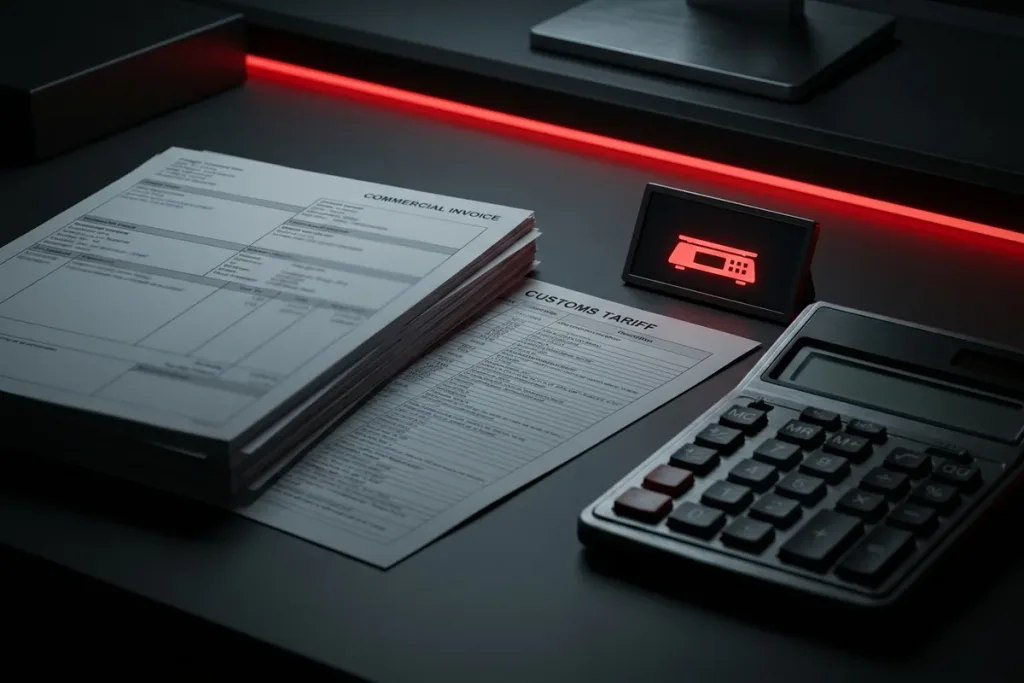
The commercial invoice is the backbone of clearance. It must state the seller and buyer, a description of the goods, quantity, value, currency, delivery terms (Incoterm) and, where possible, the customs tariff code (HS/CN). The packing list describes what is physically on the pallet: number of packages, gross and net weight, dimensions.
- The invoice value must match the real transaction. Under-declaring value risks penalties.
- Give the HS code of the goods. It drives the duty rate in the destination country and any restrictions.
- Gross weight matters especially for Switzerland, where duty is charged on gross mass per 100 kg.
Step 3. Agree an Incoterm with your buyer
An Incoterms rule defines who pays for transport, insurance and clearance, and the point at which risk passes to the buyer. For a first export this decision genuinely drives your costs and decides who handles import clearance on the other side of the border. The full breakdown is in our article on Incoterms 2020 explained.
| Rule | Export clearance by | Import clearance by | Good for |
|---|---|---|---|
| EXW | Buyer | Buyer | Minimum seller obligations (but risky on export) |
| FCA | Seller | Buyer | A safe standard for a first-time exporter |
| DAP | Seller | Buyer | Delivery to the address, no import duty on seller |
| DDP | Seller | Seller | Buyer wants a price with duty and everything included |
For a first shipment, FCA or DAP is often safest. EXW sounds convenient, but formally the buyer is responsible for export clearance in your own country, which tends to cause problems.
Step 4. Lodge the export customs declaration
Every consignment leaving the EU must be declared for the export procedure. In Poland this is done electronically in the AES system (via PUESC). You receive a confirmation that the goods have left the EU, which is your evidence for 0% VAT on export. The declaration can be filed by your own company or by a customs agent acting on your behalf. We run our own customs agencies in Poland and the UK, so the export declaration and import clearance on the far side can sit in a single order.
What is at stake: without confirmed exit of the goods, the tax office can challenge the 0% VAT rate. An export that was meant to be untaxed then costs you 23% of its value.
Step 5. Check the origin of the goods (EUR.1 or statement)
If a free trade agreement applies between the EU and the destination country, your customer may pay reduced or zero duty, but only if you prove the preferential origin of the goods. The instrument depends on the destination. For the United Kingdom the EU-UK agreement (TCA) does not use the EUR.1 certificate: origin is proven solely by a statement on origin on the invoice (exporter self-certification; any exporter up to EUR 6,000, above that a REX-registered exporter). For Switzerland you can use a EUR.1 movement certificate or a statement on the invoice (above EUR 6,000 a EUR.1 or approved-exporter status is required). Official sources confirm the rules: gov.uk (UK rules of origin) and BAZG (Switzerland).
- Without proof of origin, the customer pays the full duty rate even when the agreement provides for zero.
- Origin is not the same as the place of dispatch. What counts is where the goods were produced and whether they meet the origin rules of the relevant agreement.
Step 6. Licences, restrictions and sensitive goods
Some goods need extra documents regardless of direction: food and products of animal origin (sanitary and veterinary control), chemicals, dual-use items, excise goods. Before you dispatch, check the HS code of the goods and the destination country's requirements. Food entering the UK also faces border checks under the BTOM model, while Switzerland and Norway have their own procedures and systems.
Beyond the UK: Switzerland and Norway
The mechanics are the same (EORI, invoice, packing list, export declaration, origin), but the destination country adds its own rules. Switzerland charges duty on gross mass per 100 kg and handles clearance through the BAZG customs system (Passar has replaced the former e-dec). For distance selling into Switzerland, a VAT registration threshold of CHF 100,000 in annual turnover applies. Norway has its own TVINN system and an import VAT requirement. This matters for food: Norway is part of the EEA and shares a common veterinary regime, so goods from the EU generally do not undergo veterinary border checks as they would entering the UK (BTOM), although registrations and certificates may still apply. Duty and the customs declaration remain, because Norway is outside the customs union. It is worth confirming details in the official sources: BAZG (Switzerland) and Skatteetaten (Norway). For exporting to Britain, see our piece on the first UK export for a small business.
The path in summary
A first export outside the EU is not complicated if you keep the order: EORI, commercial documents, Incoterm, export declaration, origin, licences. Mistakes cost real time and money: a truck at the border, lost 0% VAT, full duty with no proof of origin. If you want it handled in a single order, with one point of contact and our own customs agency on both sides, write to us through the form. We will walk you through your first shipment and tell you plainly what is missing.
Is an EORI number mandatory for filing an export declaration?
Yes, any business exporting goods from the EU customs territory to third countries must have an EORI number to submit customs declarations.
Step by step
- Obtain an EORI number. Register your business with customs authorities before organising the shipment.
- Agree on Incoterms. Establish clear transport responsibilities and risk distribution with your buyer.
- Prepare commercial paperwork. Issue the commercial invoice and create a detailed packing list for the shipment.
- Check origin and licences. Determine if the goods require special export licences or proof of origin like an EUR.1.
- Lodge the customs declaration. Hand over documentation to your customs agent and carrier to clear the border.
Definitions
- EORI (Economic Operators Registration and Identification): A unique identification number assigned to businesses for customs operations within the European Union.
- Incoterms (International Commercial Terms): Standardised trade terms that define the division of costs, risks, and responsibilities between buyer and seller.
- EUR.1 (EUR.1 movement certificate): A document certifying the preferential origin of goods to qualify for reduced customs tariff rates.
- Export customs declaration: An official declaration submitted to customs authorities to place goods under the export procedure outside the EU.
The OTSL role
OTSL organises regular freight flows to third countries, offering reliable groupage (LTL) alongside full customs clearance. Read our comprehensive guide on export documents for Great Britain to streamline your international trade.