 AI image
Transporting and clearing a front loader (German: Frontlader, Polish: ładowacz czołowy) purchased at a UK auction requires complete customs documentation and equipment verification. Front loaders typically weigh between 0.3 and 1.5 t and fall under CN tariff heading 8430 69. Generally, the equipment does not require disassembly for transport. Crucially, buyers must check compatibility with the tractor model and confirm whether the mounting frame is included.
Why is checking the mounting frame vital before UK transport?
When purchasing a front loader at British agricultural auctions, you must keep in mind that these attachments are often sold separately from the tractor. The loader itself consists of the lifting arms, hydraulic system, and locking mechanisms. Before arranging haulage, carefully verify whether the attachment matches your target tractor model and make. The most important component is the mounting frame, which bolts directly onto the tractor chassis. If the seller at the UK auction does not include the mounting frame, installing the loader on your tractor later will require purchasing separate brackets or custom fabrication.
When reviewing auction listings, pay close attention to the condition of hydraulic hoses, control valves, and attachment pins. Ensure the front loader has been disconnected correctly at the auction site and that all moving parts are secured for transit. Retrieving items from UK auction yards requires presenting official collection notes, proof of purchase, and gate releases. Details regarding free storage periods and late collection fees depend on the specific auctioneer rules and site conditions.
How does customs clearance work for CN tariff code 8430 69?
Importing a front loader from Great Britain into the European Union involves standard border procedures following Brexit. Under the Combined Nomenclature, front loaders are declared under tariff code CN 8430 69, covering other moving, grading, scraping, or excavating machinery. Processing the export declaration in the UK and import entry in the EU requires an auction invoice, proof of origin documents, and active EORI numbers for both consignor and consignee.
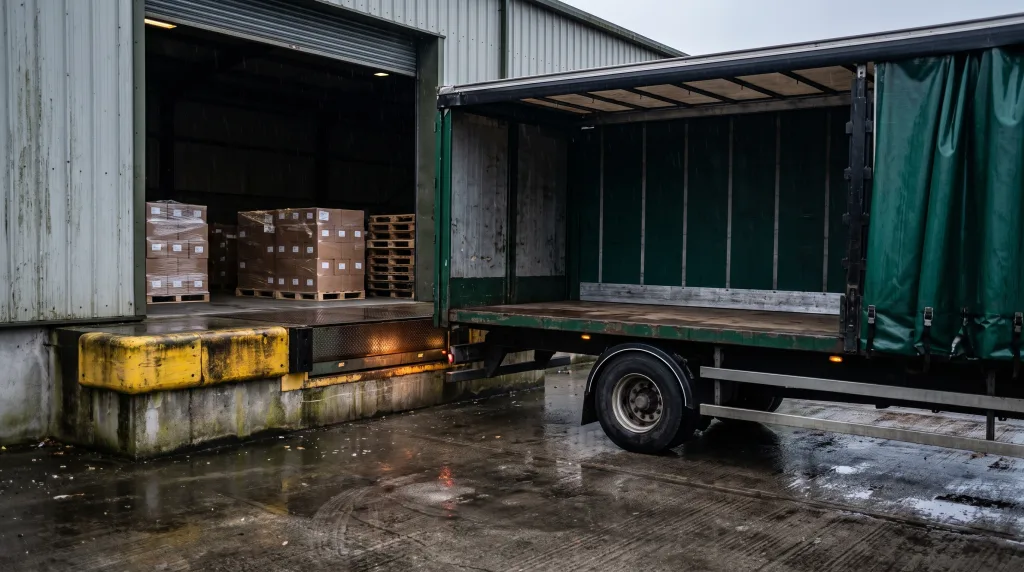
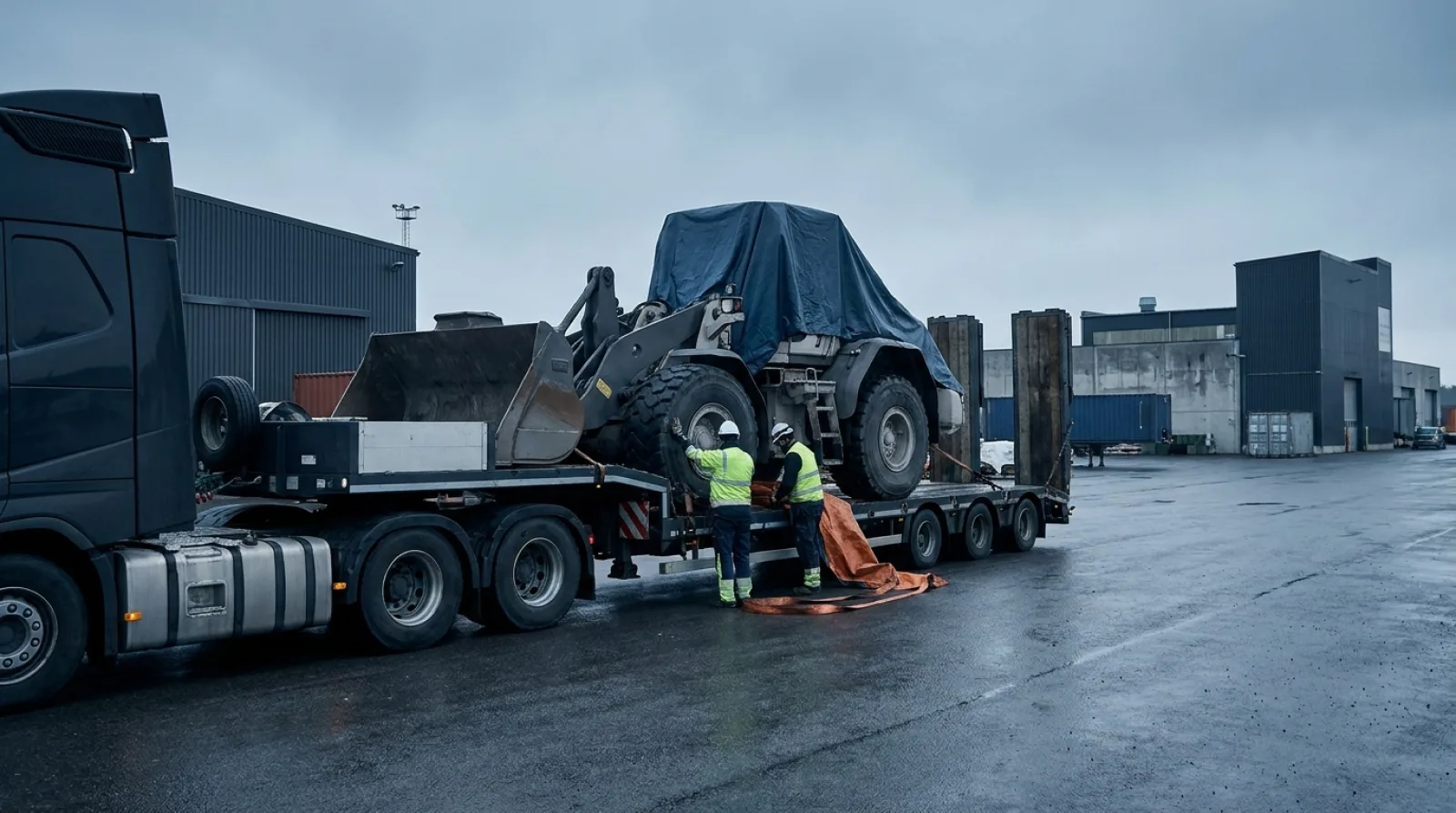
Given its typical weight range of 0.3 to 1.5 tonnes, a front loader can be carried as part-load or groupage freight on standard curtain-side trailers. Disassembly is usually not required, which simplifies transshipment and speeds up loading. However, the attachment must be placed securely on wooden skids or pallets and lashed firmly with heavy-duty straps to protect hydraulic cylinders from strain during transit.
Transporting a front loader from the UK step by step
- Verify technical specifications. Confirm through auction documents that the loader includes the mounting frame and fits your tractor.
- Collect purchase documentation. Obtain the commercial invoice, payment receipt, and release note from the auction house.
- Lodge UK export declaration. Submit export clearance details via UK customs systems under CN code 8430 69.
- Secure the load on trailer. Position the 0.3–1.5 t loader on solid timber timber blocking and secure it with lashing straps.
- Complete EU import clearance. Present import documentation at the destination border or use deferred VAT customs schemes.
Definitions
- Front loader: An agricultural or construction attachment mounted to the front of a tractor for lifting and moving materials.
- CN Code: Combined Nomenclature, the European Union coding system used for classifying goods in international trade.
- Mounting frame: A sub-frame bolted to the tractor chassis that allows the front loader to be attached safely.
- EORI: Economic Operators Registration and Identification number, mandatory for businesses handling customs in the UK and EU.
Checklist for UK auction front loader retrieval
- Checked loader compatibility and verified inclusion of the mounting frame.
- Confirmed valid EORI registration for EU and UK customs processing.
- Received auction invoice and official collection release from the seller.
- Verified loader weight within 0.3–1.5 t to select appropriate transport capacity.
- Protected hydraulic lines and cylinders against leaks and transit damage.
- Reviewed collection deadlines and yard access terms with the auction site.
When do these import procedures not apply?
The described transport and customs clearance rules do not apply to equipment moved solely within the European Union, unless the machinery moves under a customs transit procedure. These rules also do not apply if the front loader is transported under an ATA (Admission Temporaire, the temporary admission document) Carnet for temporary exhibition purposes. The exact customs requirements and storage fees depends on the customs status of the importer and the auction terms specified in the event catalogue.
The OTSL role
Organising logistics and customs formalities for agricultural equipment purchased at British auctions requires precise coordination. OTSL Sp. z o.o., based in Kielce with a logistics background and warehouse facility in Milton Keynes, arranges freight transport and customs clearances between the UK, Poland, Switzerland, Norway, and the rest of Europe. We handle services including customs clearance and machinery transport. For further context on moving agricultural machinery, read our guide on Agrotech in Kielce farm machinery transport or learn about VAT deferral options in Regime 42 EU import clearance. See also: Transport and import of hook loaders and skip loaders from the UK.