 AI image
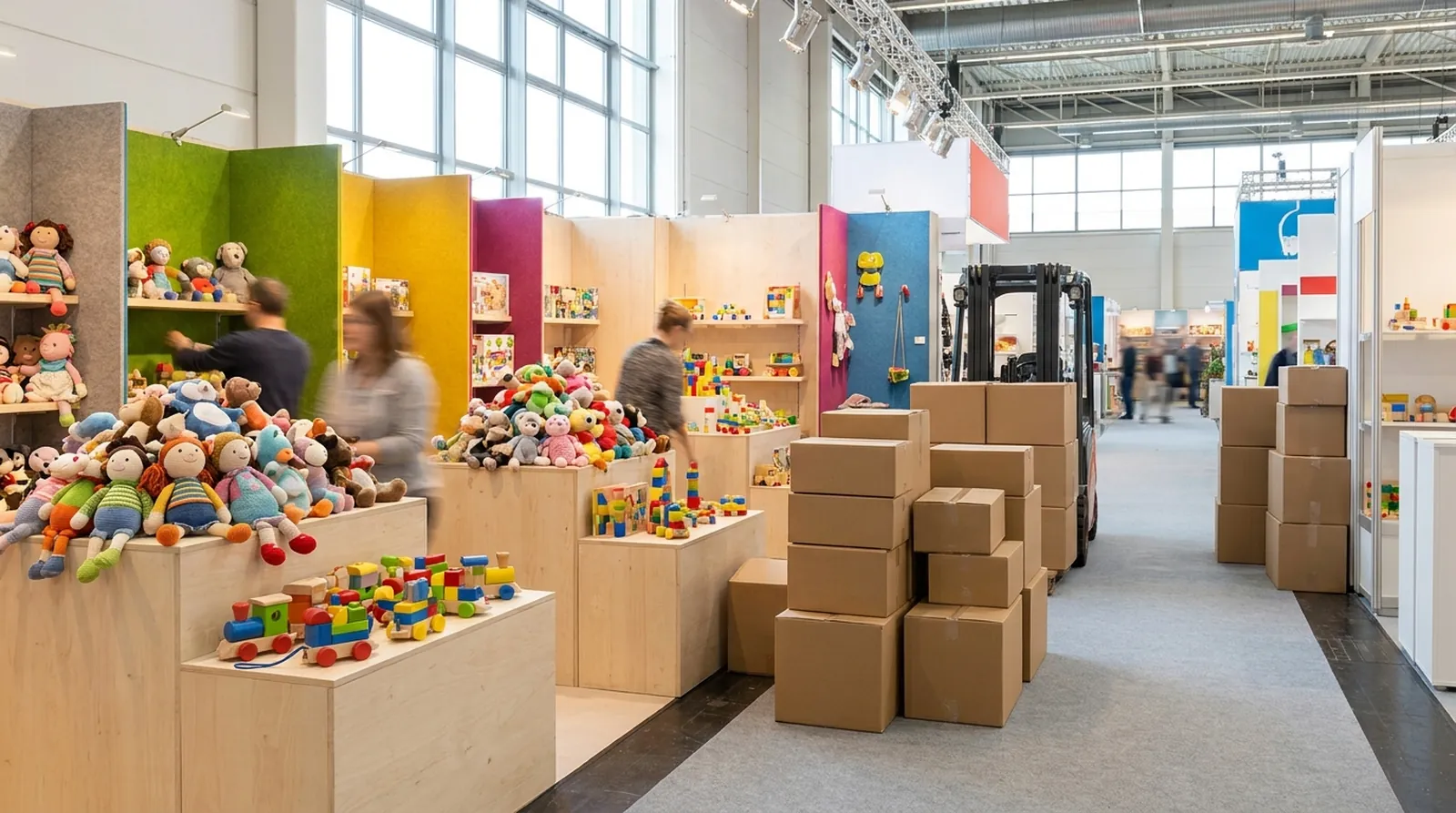
Spielwarenmesse in Nuremberg is the leading European toy industry fair and one of those trips where completeness matters more than speed. An exhibitor usually brings a large number of light cartons, oddly shaped display elements and POS materials. One missing sample carton hurts more than a delayed pallet, so we plan the delivery as a single countable whole, with scanning at loading and one transport owner running the job from collection through to the post-fair distribution.
Why does a toy fair follows its own rule?
Most industrial fairs move heavy, compact freight. This is the opposite: many low-weight items that shift around the trailer and are even easier to lose at cross-docks. Add glass cabinets, mock-ups and stands with odd shapes, plus an industry cycle where goods often leave the fair for distributors rather than returning to the producer. Each of these three points changes how we build the transport.
- Smalls and cartons (part-load freight moved together): many items, little weight, high risk of loss at every extra terminal. We keep cross-docks to a minimum and check the physical count against the scan.
- Odd-shaped displays: glass cabinets, illuminated stands, mock-ups and fragile exhibits need custom securing, layer separators and clear "this way up / do not stack" marking. This is not freight you can simply strap down hard.
- Industry seasonality: next year order book closes at the fair, so part of the goods leaves the event straight for receivers across Europe.
Fragile exhibits and POS material
Sample toys, prototypes and promotional material cannot be recreated quickly if they arrive damaged or fail to arrive at all. We treat them separately: rigid outer packing, separators between layers, no heavy pallets stacked on sample cartons, and clear marking on the load list. For the most sensitive items we agree the securing method when the order is placed, rather than assuming it will somehow make it.
Deadlines, bookings and assembly windows
Fair deadlines are not set by the carrier but by the organiser and the venue rules: they define delivery windows, site access and the order in which halls are built. We do not guess those rules. We ask the exhibitor for the organiser material or confirm the details directly when the order is placed, then plan the transport around them. The practical takeaway is simple: the earlier we know the date and the assembly window, the more reliably the delivery hits its slot, with no waiting outside the hall and no risk of the crew standing idle while the stand sits in the car park.
The back end: warehousing and consolidation
Not every stand element is ready at the same moment. Our warehouses in Kielce and Legnica let us gather cartons, stands and samples arriving from different places into one counted shipment, instead of sending several independent parcels that then have to be synchronised at the hall. For routes from the United Kingdom the same is done from our Milton Keynes warehouse. Consolidation cuts the number of cross-docks, simplifies the booking and gives one load list instead of several.
How do we handle a Spielwarenmesse trip?
- Consolidating all stand elements into one transport with a load list and scanning at loading.
- Securing and separators matched to fragile exhibits, cabinets and stands.
- Delivery booked to the organiser rules and assembly windows, confirmed at order stage.
- One transport owner running the case from collection to return.
- After the event: sample distribution to receivers across Europe or the trip home, and storage in our warehouse if the goods wait for a next step.
Related topics
More on the direction: transport to trade fairs in Germany. The full stand seen from the logistics side: trade fair stand logistics from A to Z. Freight and customs on the German lane: transport to Germany. All events: the European guide.
Step by step
- Inventory and labelling. Count every single carton and assign a unique identifier before the vehicle arrives.
- Scanning at loading. Verify the full packing list as items are loaded onto the trailer.
- Securing light freight. Fasten small boxes and custom-shaped display pieces so they do not shift in transit.
- Delivery to the booth. Hand over all packages directly to the person managing your stand in Nuremberg.
- Post-fair distribution. Move the exhibition stock straight to regional distributors or back to your warehouse.
Definitions
- POS (Point of Sale) materials: Advertising items and displays designed to promote products directly at the exhibition stand.
- Sample carton: A lightweight box containing product samples meant for presentation to trade visitors.
- Cross-docking: A logistics process where incoming shipments are transferred directly to outbound transport without intermediate storage.
- Display elements: Display cabinets, mock-ups and stands forming the visual structure of the booth.
When does this rule not apply?
This rule does not apply when sending small top-up supplies via express parcel services during the event or when exhibition materials are dispatched directly from multiple independent suppliers.
The OTSL role
At OTSL, we manage the transport of trade fair displays and commercial goods across Europe. For your shipment to Nuremberg, you can rely on our groupage (LTL) solutions, keeping in mind that poor exhibition logistics costs more than the transport itself.