 AI image
Switzerland does not collect import tax (VAT) when the calculated amount is CHF 5 or less per customs declaration. At the standard 8.1% rate that maps to roughly CHF 62 of goods value, at the reduced 2.6% rate (food, books) to about CHF 190. A separate threshold covers minor duty amounts, which the administration also waives. Source: BAZG.
How the CHF 5 tax rule works
The Swiss system has no flat "up to X francs, no formalities" figure. The logic runs the other way. The administration calculates the tax due on the consignment value, and if the result does not exceed CHF 5, it waives collection. The threshold sits on the tax due, so the goods value follows from a simple division by the rate.
Up to what value is import VAT free
Because the threshold sits on the tax amount (CHF 5), the goods value at which you pay nothing depends on the rate. Below is an indicative calculation. Treat it as the mechanism, not a fixed official table, because transport and insurance costs also enter the taxable base.
| Import tax rate | Goods type (example) | Value where tax ≤ CHF 5 |
|---|---|---|
| 8.1% (standard rate) | most industrial goods | approx. CHF 62 |
| 2.6% (reduced rate) | food, books, medicine | approx. CHF 190 |
This is why one single "tax free up to" number misleads. For books the ceiling is three times higher than for electronics. Confirm current rates and values with BAZG, the only binding source.
Minimum duty amount. When duty is not collected
Swiss duty is assessed on gross weight, usually per 100 kg, under the tariff for the specific goods. Here too a minor-amount threshold applies. If the calculated duty is very low, the administration does not collect it. This is a separate mechanism from the tax threshold, so a small parcel can be exempt from one but not the other. There is no magic weight limit. What counts is the amount the tariff produces. Note that since 1 January 2024 Switzerland has unilaterally removed customs duty on industrial products (HS chapters 25-97, with few exceptions), so duty on gross weight now concerns mainly agricultural and food goods. Import VAT applies regardless of duty. Confirm the detail with BAZG.
In practice the decision chain looks like this:
- establish the tax and duty rate for the commodity code,
- compute tax on value and duty on gross weight,
- if either charge falls below the collection threshold, it is dropped.
What does the de minimi threshold does NOT cover?
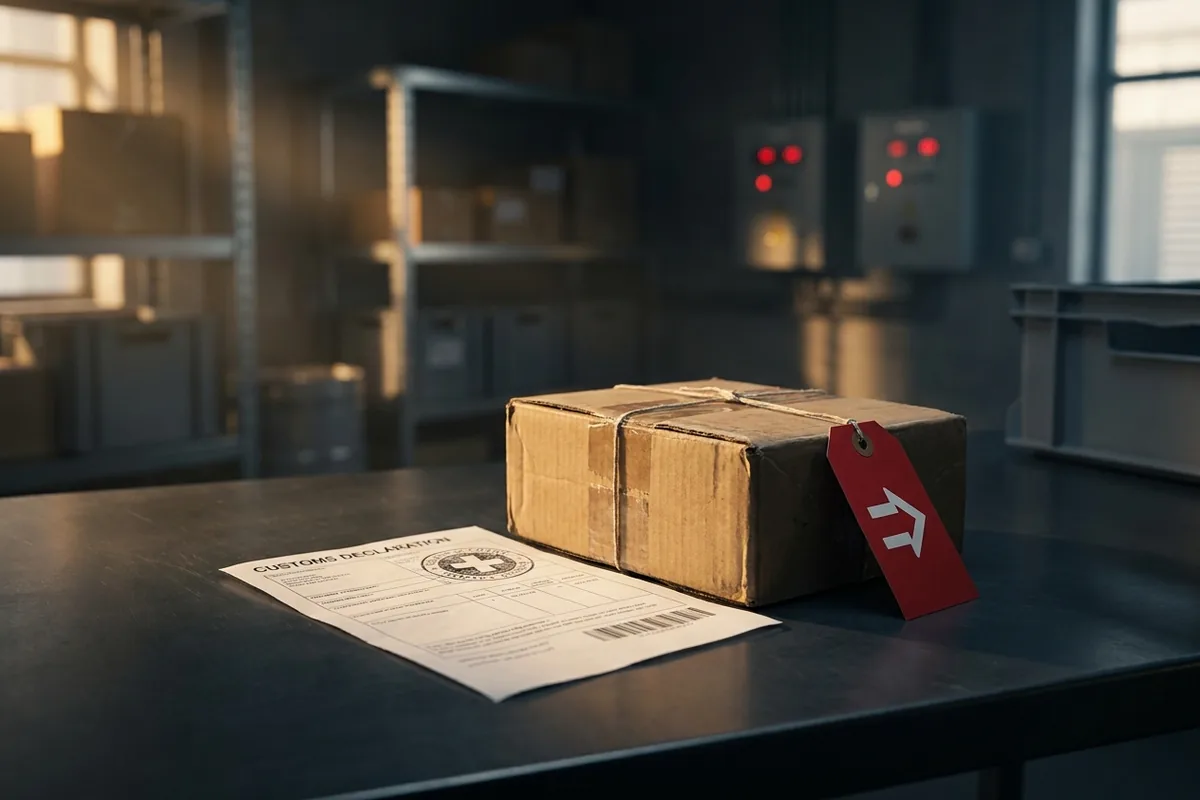
This is the most common misunderstanding. A waiver of the charge does not remove the clearance obligation or the cost of handling it. Every consignment entering Switzerland needs a declaration. Operator and agency fees are billed separately, as set out in our article on deliveries to Switzerland and clearance charges. Outside the threshold also sit excise, restricted and licence-bound goods, and shipments deliberately split to slip under the limit.
In short, de minimis covers only the collection of duty and tax. It does not cover:
- the customs declaration obligation and documents,
- clearance and handling fees,
- excise and controlled goods,
- consignments artificially split into smaller ones.
How a shipment is declared. Passar replaces e-dec
The Swiss customs administration (BAZG) has replaced the former e-dec system with the Passar platform. Import declarations pass through it, and it calculates the charges. Even when the tax comes out below CHF 5, the shipment data must reach the system. The waiver is a decision by the office based on the calculation, not a right to skip the declaration. We map the full formal route in our article on export to Switzerland and customs procedures.
Distance selling and de minimis
If you ship to customers in Switzerland regularly, a second, entirely different threshold applies. A company whose small, exempt consignments add up to at least CHF 100,000 turnover per year must register for Swiss VAT and charge tax to its customers. At that point the CHF 5 rule stops working in your favour, because taxpayer status changes how the transaction is settled. We break this scenario down in Swiss e-commerce customs and VAT and the CHF 100,000 threshold.
Common mistakes that cost money
The most expensive errors usually trace back to misreading the threshold. The exemption can vanish at the first inspection, and then a correction, a border delay and a customer waiting on goods land on the bill.
- Confusing the tax threshold with the goods value, so the parcel generates a charge at the border after all.
- Leaving transport and insurance out of the base, which pushes the real value over the threshold.
- Splitting one delivery into several "small" ones, which the administration treats as circumvention.
- Assuming that no tax means no clearance and no operator fees.
We clear goods through our own customs agencies in Poland and the UK, and we handle shipments to Switzerland with one dedicated contact per order. We will check whether your consignment really fits the threshold and price the cost before the goods move. Reach us through the contact form, describe the lane and the goods, and we will send a concrete answer.
Step by step
- Verify the tax rate. Determine whether your goods fall under the standard or reduced Swiss tax rate.
- Calculate shipment value. Convert the value of the goods into Swiss francs using the appropriate exchange rate.
- Assess calculated tax. Check if the calculated import tax exceeds the minimum waiver threshold.
- Prepare customs paperwork. Complete the required customs declaration regardless of whether tax collection is waived.
- Hand over for transport. Pass the consignment to the carrier for formal clearance at the Swiss border.
Definitions
- De minimis threshold: The limit below which a public charge is too small for customs to collect.
- Kleinsendung: A low-value consignment whose calculated import tax falls below the threshold for collection.
- BAZG (Federal Office for Customs and Border Security): The Swiss authority responsible for customs duties and import taxes.
- VAT (Value Added Tax): The Swiss tax applied to imported goods upon entering the customs territory.
- Customs declaration: The legal document required for importing goods into Switzerland regardless of their value.
The OTSL role
When organising shipments to Switzerland, OTSL assists with border paperwork and customs declarations. You can book our groupage (LTL) services, while our team ensures your documentation complies with Swiss regulations. For further details on border processes, see the article on transport to Switzerland, customs clearance and documents.