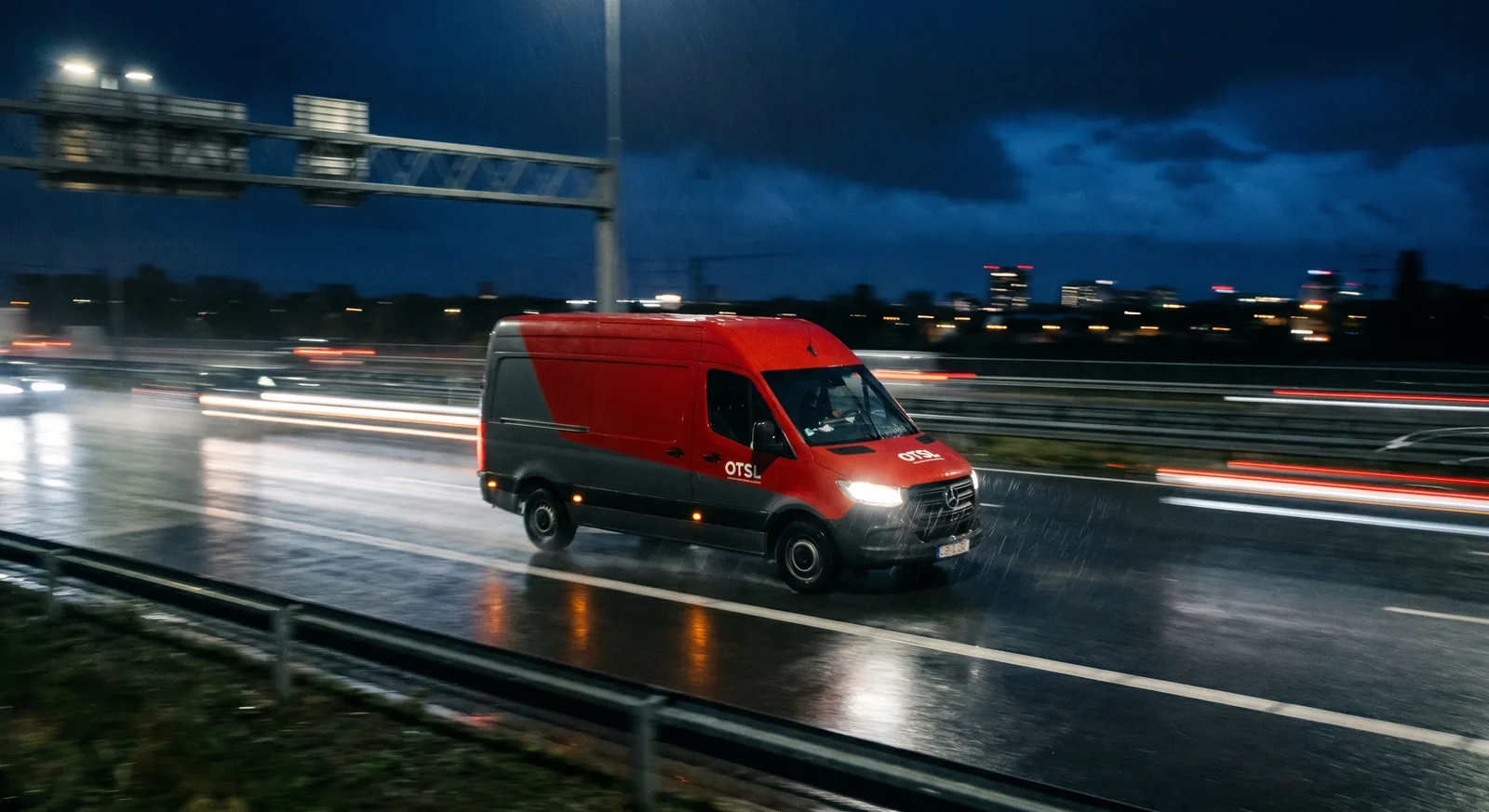
 AI image
A time-critical delivery is one where being late costs many times more than the transport itself. A call at 7 pm, a small parcel, almost a thousand kilometres and a hard morning deadline. We pick a reliable vehicle, two drivers, and run without stopping, because a whole production line is waiting at the other end.
An example from our work
The client called at seven in the evening. By morning, almost a thousand kilometres from Kielce, a small parcel of just a few kilograms had to arrive. Without it the production line would stop at six, and the cost of that stoppage ran close to half a million euros. Every minute counted.
What did we do?
- We picked a vehicle suited to the route, with a margin for the risk of a breakdown.
- We sent two drivers so the van could run without a rest break. With a multi-manned crew, Regulation (EC) No 561/2006 allows the drivers to take turns at the wheel, and the new daily rest must fall within 30 hours of the end of the previous one (Article 8(5)).
- We tracked the vehicle live and confirmed every stage: departure, borders, the final kilometres.
The parcel arrived ahead of time and production started without disruption. That is what dedicated transport looks like when a whole line is at stake.
A time-critical delivery, step by step
- The call: what is moving, from where, to where and by when. Weight, dimensions and the hard deadline hour are enough.
- The vehicle decision: a van up to 3.5 t leaves sooner, an articulated truck takes more; we compare the options in express to the line: van or dedicated truck.
- The crew: one driver, or two when the route exceeds the daily driving limit; how far you can realistically get in 24 and 48 hours is calculated in driver hours versus the delivery deadline.
- The run and the monitoring: live position, status reports at agreed points, contact with the receiver before unloading.
- Proof of delivery and documents, including remarks on the CMR consignment note if anything deviates from the plan.
Why compensation will not replace an on-time delivery
The CMR Convention makes the carrier liable for delay (Article 17), but the compensation is capped at the amount of the carriage charge (Article 23(5)). With a line stoppage running into hundreds of thousands of euros, a refunded freight bill saves nothing. Declaring a special interest in delivery in the CMR note, against an agreed surcharge, raises that ceiling (Article 26), but the cheapest protection is a transport planned so the delay never happens. Before you count claims, count the cost of the stoppage: what a production line stoppage costs helps with the numbers.
Checklist: calling with an urgent transport
- Weight and dimensions of the consignment and how it will be loaded.
- Exact collection and delivery addresses, a contact on site.
- The hard unloading deadline and what happens once it passes.
- Goods documents: invoice, packing list, the UN number for ADR (the Accord governing international carriage of dangerous goods by road) cargo.
- A decision maker reachable while the vehicle is on the road.
The OTSL role
OTSL organises time-critical transport across Europe: from a van for a few kilograms to a dedicated articulated truck, with a two-driver crew, tracking and a fallback plan. Day to day this is the job of our express vans; when another carrier has failed, emergency transport takeover steps in. Describe the situation through the contact form; on urgent cases we answer with specifics: vehicle, route, hour.
Definitions
- Time-critical delivery: Transport of goods where any delay generates costs significantly higher than the transport service itself.
- Multi-manned crew: A working arrangement with two drivers in one vehicle enabling alternate driving to reduce transit time.
- EU driving time regulation: Legislation specifying rules for driving limits, required breaks, and rest periods for drivers.
- Production stoppage: A situation in a manufacturing plant where missing components force the halting of assembly lines.
When does this rule not apply?
The rule regarding continuous multi-manned transit does not apply when border controls or weather-related road closures force a vehicle to stop.