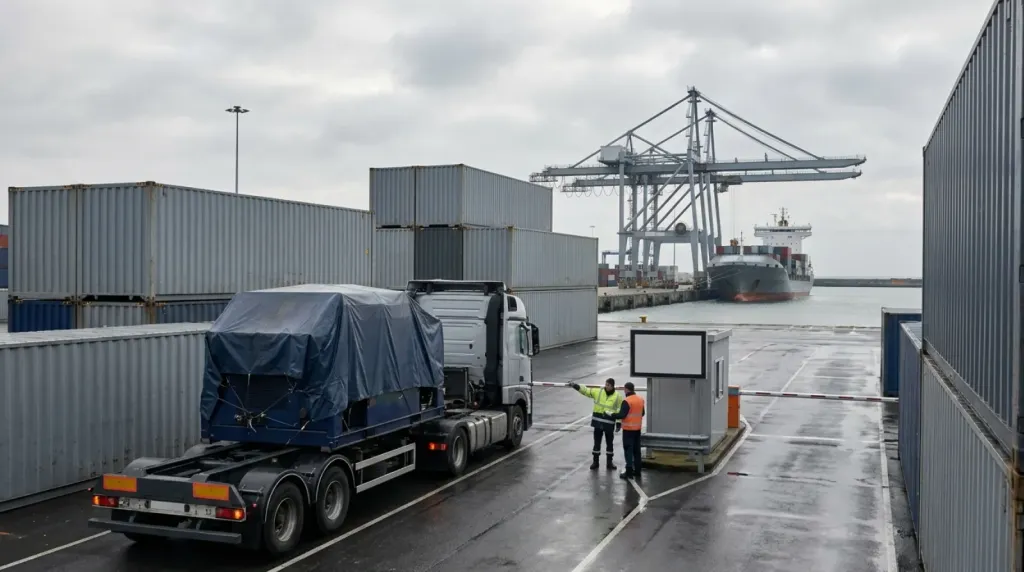
 AI image
Yes, a company can lodge its own customs declaration if it holds an EORI number, has access to the customs system and can complete the declaration correctly. No special licence is required. In practice most importers and exporters use a customs broker, because a single mistake in the HS code, the value or the procedure costs more than the broker's fee.
Does the law let you clear customs yourself
The Union Customs Code does not reserve the lodging of declarations for brokers only. Any person who can present the goods and the required documents may lodge a declaration, provided they are established in the EU customs territory and hold an EORI number. There is no state licence you must buy to clear your own goods. The myth of a mandatory intermediary comes from the fact that, day to day, companies rarely have the time or the system to do it smoothly.
It is different outside the EU. When shipping to Great Britain, the UK importer needs a UK EORI and either its own access to the CDS system or an intermediary. Before you decide, check which side of the border the obligation arises on and who has customs standing there. If you are just starting, read our guide on what an EORI number is and how to get one.
What you need to self-clear
Before declaring goods without an agent, you must have every element in place. Gaps stall the truck at the border and rack up detention charges.
- An active EORI number (a separate one in the EU and in the UK if you clear on both sides).
- Access to the declaration system (the national customs environment in the EU, the CDS system in the UK).
- The correct tariff code (HS/commodity code) for each item.
- A documented customs value, the right Incoterms and proof of origin if you want a preference.
- Knowledge of the right procedure (release for free circulation, transit, customs warehousing, inward processing) and of import VAT.
System access alone is not enough. A declaration is a statement made under your liability, so what you enter matters far more than the fact that you can click send.
Direct or indirect representation
If you choose an agent, you also choose the type of representation. This is not a formality, because it splits liability for the customs debt differently. The table sums up the differences, and we cover them in depth in our article on direct versus indirect customs representation.
| Criterion | Direct representation | Indirect representation |
|---|---|---|
| Whose name the agent acts in | The client's name | Their own name |
| Who carries the declaration risk | The client (declarant) | Client and agent jointly |
| Typical use | Firm established in the EU | Party from outside the customs territory |
| Requirement | Written authorisation | Written authorisation |
Where a non-specialist loses most
Self-clearance most often fails on three fronts. Each turns the saved fee into a real loss.
- HS code. The wrong code means the wrong duty rate and the wrong restrictions. Overstate it and you overpay, understate it and you face a correction with interest and a held shipment.
- Customs value. Leaving out freight, insurance or licence fees understates the base and triggers a check. Overstating it means overpaid import VAT.
- Procedure. Choosing release for free circulation instead of transit or warehousing can needlessly tie up cash in duty and VAT.
These slips rarely show at once. They surface at a post-clearance audit, when interest is added. That is why it pays to know the common traps in our guide on how to avoid customs mistakes.
When self-clearing really makes sense
The in-house model holds up when clearances are repetitive and predictable. If you move the same product line, under one stable HS code, on one route and at high volume, it pays to invest in the knowledge and the system and keep an agent as backup for the odd case.
When a broker is the better call
A broker wins with a changing product mix, new routes, special procedures, phytosanitary and veterinary checks, and anywhere the driver's time at the border counts. For non-EU routes such as export to Great Britain or Switzerland, having your own agent on the other side cuts waiting and keeps both clearances consistent. For Switzerland specifically, customs duty now applies mainly to agricultural and food goods and is charged on gross weight per 100 kg, since industrial goods have been duty-free since 2024, though import VAT still applies. Declarations run through the Passar system at the BAZG authority.
How do we handle it at OTSL?
We have run the Poland to Great Britain route since 2011 and operate our own customs agencies in Poland and the UK, so export and import clearance sit with one provider. One dedicated contact runs your job from declaration to delivery, so you are not juggling two intermediaries. If you are unsure whether to self-clear or use an agent, get in touch. We will review your supply setup and advise what is cheaper and safer in your case. See the full scope on our customs clearance page.
Step by step
- Obtain an EORI number. Register your business with the relevant customs authority to receive a valid identifier.
- Classify your goods. Assign the correct commodity codes to your items to determine duty rates and documentation needs.
- Prepare shipping documents. Gather the commercial invoice, packing list, and any mandatory certificates or licences.
- Select submission method. Decide whether to submit the declaration independently via customs software or hire a customs representative.
- Submit entry and pay duties. Transmit the electronic entry to customs authorities and pay the required duties and import VAT.
Definitions
- EORI (Economic Operators Registration and Identification): a unique reference number used by customs authorities to identify business entities across the European Union and the UK.
- Customs clearance: the official act of declaring goods to customs authorities when crossing a border to permit their movement into or out of a territory.
- Direct representation: a customs agreement where the agent acts in the name and on behalf of the client, who retains full liability for any customs debt.
- Indirect representation: a customs arrangement where the agent acts in their own name but on behalf of the client, sharing liability for customs obligations.
- HS code (Harmonised System): a standardized numerical classification code used worldwide to determine applicable customs duties and import controls.
When does this rule not apply?
This rule does not apply to goods subject to specific restrictions, such as excise merchandise, dangerous cargo, or controlled agricultural products requiring mandatory phytosanitary inspections.
The OTSL role
If you move goods across UK and EU borders, OTSL coordinates international road transport while aligning shipments with customs requirements. You can also read our guide on upoważnienie dla agencji celnej to learn about direct and indirect representation models.