 AI image
Under Article 18 of the Union Customs Code, customs representation takes one of two forms. A direct representative acts in your name and on your behalf: the customs debt stays with you. An indirect representative acts in its own name on your behalf and is jointly and severally liable with you. One tick box decides who receives the post-clearance demand.
One tick box, two very different risk maps
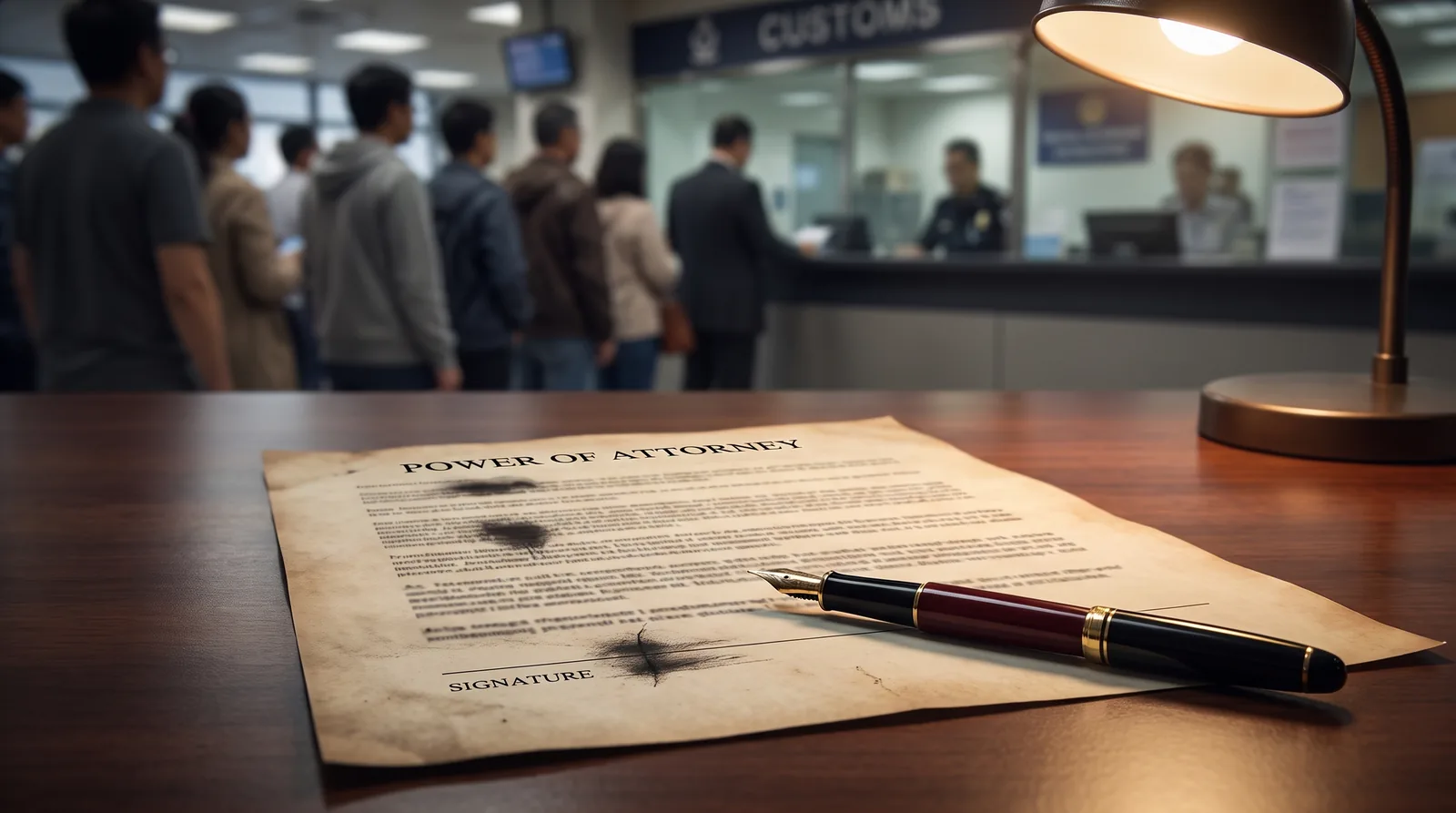
This continues our series on what freight forwarders keep quiet about when documents get signed. After the piece on who is legally liable for what among forwarder, carrier and broker, we turn to the document most importers sign in five minutes before their first clearance: the empowerment, the power of attorney for a customs agent. The form looks harmless, and the representation box often arrives pre-ticked by the agency. Few people ask what was ticked, or why.
The stake surfaces long after the truck has left. Customs authorities may notify a customs debt for up to three years from the date it was incurred (Article 103(1) UCC). A post-clearance audit, a challenged tariff classification or an understated customs value ends in a demand for duty and import VAT on goods you sold months ago. Only then do you learn who the debtor is: you alone, or you and the agent jointly. And why the agency insisted so firmly on the direct box.
Direct representation: the customs debt stays with you
Under direct representation, you are the declarant. The agent acts like an attorney: it lodges the declaration in your name and on your behalf, and the legal effects land squarely on you. The debtor is the declarant (Article 77(3) UCC), so the post-audit demand arrives at your company, not at the agency. Against the agent you keep only contractual claims, and only where you can show the error arose on its side rather than in the data you supplied.
That split has a hard legal anchor: the person providing information in a declaration is responsible for its accuracy and for the authenticity of the supporting documents (Article 15(2) UCC). The agent declares what you gave it: the invoice, the goods description, the commodity code you agreed. A good agency questions doubtful data before filing; a weak one copies every mistake into the declaration. We showed the difference, one stopped truck at a time, in choosing a customs agency matters.
There is also a formal trap. Anyone who fails to state that they act as a representative, or who acts without an empowerment, is deemed to act in their own name and on their own behalf (Article 19(1), second subparagraph, UCC). That is why no serious agency touches a declaration without a signed empowerment: without it, the agency itself would become the debtor for the full duty. When the agent insists on paperwork before the first clearance, that is the regulation talking, not bureaucracy.
Indirect representation: joint and several liability
Under indirect representation the agent is the declarant: it files in its own name, though on your behalf. The declarant is the debtor, but the person on whose behalf the declaration is made is a debtor as well (Article 77(3), second sentence, UCC). Where several persons owe the same debt, they are jointly and severally liable (Article 84 UCC): customs may claim the full amount from either of you, and in practice goes wherever enforcement is easiest.
From the trader's side this can look like extra protection, and sometimes it is: another company stands next to you for the debt. From the agent's side it is pure exposure: a signature under someone else's duty, VAT and classification. That is why the market looks the way it does: direct representation is the default across the EU, and indirect representation appears only where it is unavoidable, at a price.
| Criterion | Direct representation | Indirect representation |
|---|---|---|
| In whose name the agent acts | in the client's name and on the client's behalf (Article 18(1) UCC) | in its own name, on the client's behalf (Article 18(1) UCC) |
| Who is the declarant | the client | the customs agent |
| Who owes the customs debt | the client (Article 77(3) UCC) | agent and client jointly and severally (Articles 77(3) and 84 UCC) |
| Typical use | standard service for EU-established businesses | importers without EU establishment (Article 170(2) UCC), special cases |
| Agency attitude | offered by default | refusal, or security plus a higher fee |
What do you sign in the empowerment and what to demand?
- The form of representation named explicitly. Wording such as "empowered to act as a direct representative" rather than a vague "authorised to represent". If the form offers both boxes, check which one is ticked before you sign.
- Scope of acts and procedures. One-off clearance or ongoing service, release for free circulation, export, transit, special procedures. An empowerment without a scope is a blank cheque.
- Substitution under control. A sub-delegation clause lets the agency pass your clearance to another agency, for example at a border crossing. Convenient, but you are entitled to know who physically lodges your declarations.
- Division of duties around data. Who supplies which documents, by when, and who answers for their content. Article 15 UCC puts the responsibility for supplied information on you anyway, so demand a verification routine, not an invoice-copying machine.
- A valid EORI number before the first clearance. Without EORI registration the agent cannot file in your name. What blocks a clearance and how to prevent it is covered in missing EORI or wrong VAT.
- Duration and revocation. Start date, how the empowerment is revoked and what happens to declarations in progress. Switching agencies is a formality in the customs systems too, not just an email.
When does the agency refuse indirect representation?
A new client with no track record, goods under anti-dumping duty, a disputed classification, a high-value entry: in these cases the agency declines the indirect form or demands security, a deposit or a guarantee. That is arithmetic, not malice: with joint and several liability, any underpayment found within three years can land on the agency, and recourse against the client is worth exactly as much as the client's solvency.
There is one case where the indirect form is the only road. The declarant must, as a rule, be established in the customs territory of the Union (Article 170(2) UCC). A business outside the EU, a UK company importing into Poland after Brexit without an EU subsidiary being the obvious example, cannot be the declarant itself and needs an indirect representative. On the UK side the split is mirrored: UK law distinguishes direct and indirect representation, and an indirect agent is jointly and severally liable for the debt; check the conditions in the official HMRC guidance on gov.uk before you appoint anyone. Switzerland runs its own declaration system outside the UCC; the federal customs office BAZG explains the rules.
Before you accept a higher fee for indirect representation, or start hunting for an agency willing to take it, price the alternatives: an EORI registration in the right country, different delivery terms with your counterparty, a different import structure. Those are questions for customs advisory before the empowerment reaches your desk, not after the demand arrives.
The OTSL role
As an international freight forwarder we organise customs clearances on routes between Poland, the United Kingdom, Switzerland and the rest of Europe and work with vetted customs agencies, so we know which empowerment to read twice. We help assemble the declaration data, keep EORI numbers and documents consistent with the cargo, and our warehouses in Kielce, Legnica and Milton Keynes let goods wait safely while a clearance is clarified. See the customs clearance section and the knowledge base for the wider picture, or describe your case through the contact form.
Step by step
- Assess representation form. Evaluate the trade requirements and your compliance profile before choosing the representation type.
- Complete authorisation form. Enter company details and tick the specific box designating direct or indirect representation.
- Verify EORI status. Ensure your economic operators registration and identification number is active and accurate on the form.
- Submit documentation. Send the signed authorisation form together with required corporate registration records to the agent.
- Archive clearance records. Retain official customs declarations and tax assessments for audit purposes.
Definitions
- Customs representative: Any person appointed to carry out acts required under customs legislation in dealings with customs authorities on behalf of another person.
- Direct representative: A party acting in the name of and on behalf of another person, meaning the main customs debt rests solely with the importer or exporter.
- Indirect representative: A party acting in its own name but on behalf of another person, resulting in joint and several liability for any customs debt.
- Customs debt: The obligation on a person to pay the amount of import or export duties applied to goods crossing the customs border.
- Union Customs Code (UCC): The framework of rules and procedures governing customs matters across the European Union.
When does this rule not apply?
The rule placing sole liability on the importer does not apply when a customs agent acts without proper authorization or exceeds the granted powers, or when customs authorities determine that false documentation was knowingly submitted by the broker.