 AI image
The carrier is liable for goods in transit, but Article 17(2) of the CMR Convention relieves it where loss, damage or delay resulted from circumstances the carrier could not avoid and consequences it was unable to prevent. A strike or blockade does not work automatically: the carrier must prove it, and until then it must protect the cargo and ask for instructions.
What the CMR Convention actually says
Article 17(1) sets the rule: the carrier is liable for total or partial loss of the goods and for damage from takeover to delivery, as well as for delay. Paragraph 2 lists the defences, among them circumstances the carrier could not avoid and consequences it was unable to prevent. The key provision is Article 18(1): the burden of proving that the loss arose from such a cause rests on the carrier. For the cargo owner this is good news: you do not have to prove the carrier's fault, the carrier has to show it did everything in its power.
What usually is NOT force majeure
- Vehicle breakdown: Article 17(3) expressly excludes reliance on the defective condition of the vehicle used.
- A strike or protest announced in advance, where a detour, another date or another route could have been planned.
- Ordinary congestion, roadworks and predictable seasonal disruption.
- Shortcomings on the carrier's side: no driver available, poor planning, no fuel.
- Theft on an unsecured car park when a secured one was within reach; each case is judged on its facts, but courts treat carriers strictly.
Courts ask one question: could a diligent professional carrier have avoided the event or limited its consequences? If yes, the Article 17(2) defence fails, even if tractors really were blocking the road.
Blockades, strikes and the duties of care and instructions
Where performance on the agreed terms becomes impossible, Article 14 CMR requires the carrier to ask the person entitled to dispose of the goods for instructions. Article 15 works the same way where delivery proves impossible after arrival. Until instructions arrive, the carrier keeps the goods in its care and acts in the interest of the person entitled: it moves to a safe parking area, protects the load from the weather and, if needed, arranges transhipment or warehousing. A blockade does not suspend these duties; it is precisely when they matter most.
Who pays for the detour and the standstill
Under Article 16(1) CMR the carrier is entitled to recover the costs caused by requesting and carrying out instructions, unless those costs arose through its own fault. Demurrage and rates for extra kilometres are in practice governed by the transport order or framework contract. Even where a blockade satisfies Article 17(2) and the carrier is not liable for the delay, settling the extra costs remains a contractual matter. That is why decisions such as wait, reroute or emergency unloading into a warehouse should be taken jointly and leave a written trace.
Communication is half the battle
- Immediate notice of the event, with the vehicle position and the condition of the load.
- Ongoing documentation: photos, announcements by authorities and road operators, confirmations that a crossing is closed.
- Instructions confirmed in writing; an e-mail is enough, as long as it exists.
- At delivery: entries on the CMR note and a report if anything suffered. We describe how in our articles on the damage report and reservations on delivery.
Force majeure disputes are rarely won in court and more often in the documents collected while the event unfolds. A carrier that stayed silent through three days of blockade is in a weaker position than one that reported every few hours and asked for instructions.
The same rule works the other way round: a shipper who issues instructions quickly and answers the phone limits the damage and the costs instead of multiplying them by silence.
Examples from practice
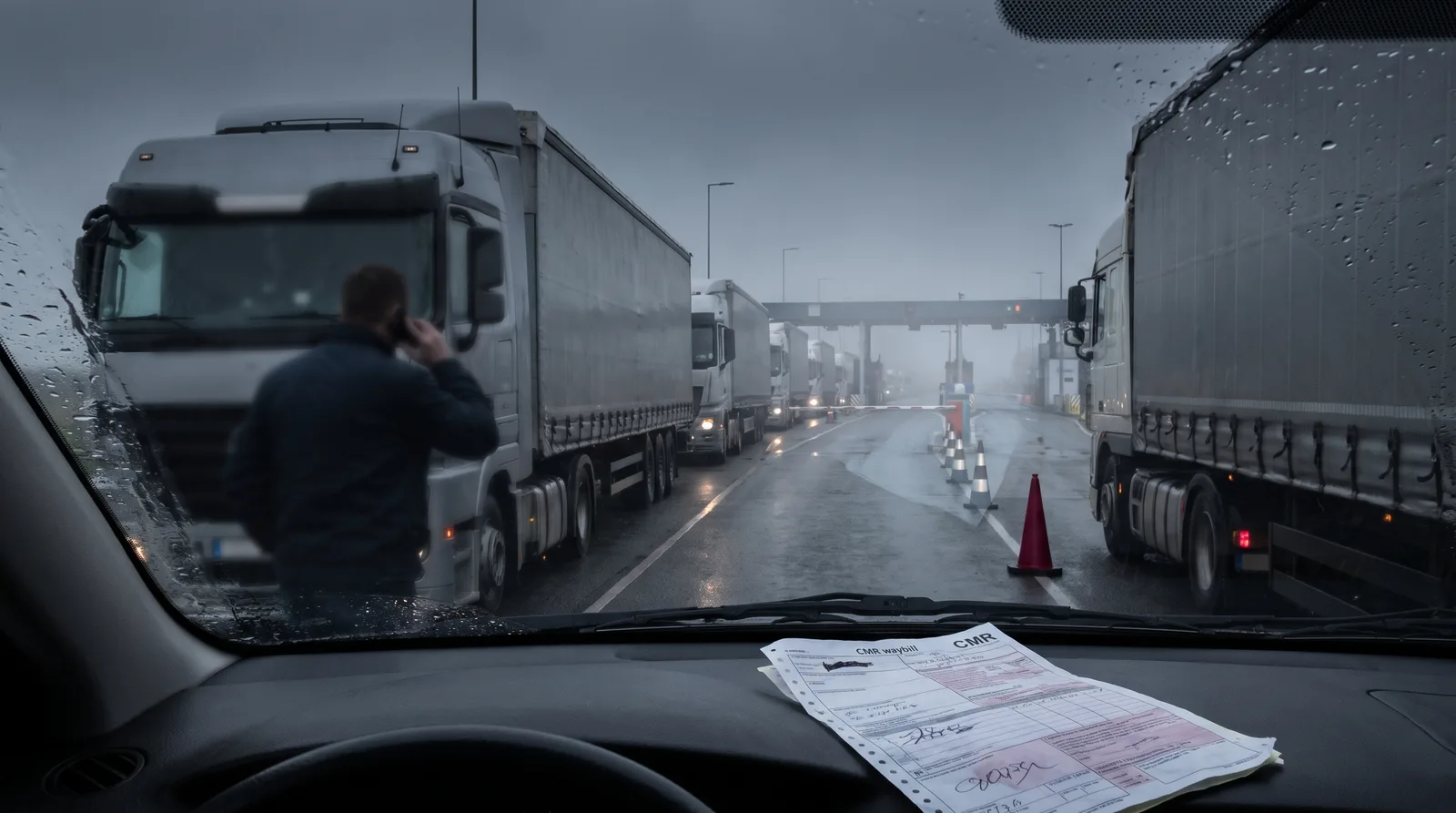
Farmer blockades at border crossings: a crossing closed from one hour to the next may be unavoidable, but when the protest has lasted for weeks, the choice of route on loading day will be questioned. Strikes in ports and ferry terminals: the carrier is not liable for the strike itself; what is judged is what it did after the announcement, such as switching the crossing, rebooking the ferry and informing the client. A sudden administrative border closure: a classic Article 17(2) candidate, provided it came without warning and there was no reasonable alternative. Extreme weather: a storm or blizzard after which the road operator closes the motorway usually defends itself, but even here a court will check whether weather warnings were published early enough to move the departure or pick another route.
The OTSL role
Our forwarders track the vehicle along the whole route: when a blockade or strike appears, you hear it from us, not from the news, you get options with costs and timings, and decisions are confirmed in writing. It also pays to know the carrier liability limit of 8.33 SDR per kg, because with high-value cargo that limit defines what the dispute is really worth. Contact us if your routes run through sensitive crossings, or browse our knowledge base.
Does a strike automatically relieve the carrier from liability?
A strike or blockade does not grant automatic exemption from liability. The carrier must prove that the disruption was unavoidable, that reasonable precautions were taken, and that proper steps were followed to safeguard the goods and obtain directions from the sender.
Step by step
- Secure the cargo. Ensure the safety of the goods immediately at the place of the stoppage.
- Document the disruption. Gather clear evidence confirming the presence of a blockade or strike on the route.
- Inform the customer. Notify the sender promptly about the delay and current status of the transport.
- Request instructions. Ask the sender for formal guidance on how to proceed with the shipment.
- Execute directives. Follow the received orders regarding route changes or temporary storage.
Definitions
- CMR (Convention on the Contract for the International Carriage of Goods by Road): An international treaty governing the rights, duties and liability in road freight transport.
- Force majeure: Exceptional circumstances whose occurrence and consequences could not be avoided despite professional diligence.
- Carrier liability: The legal obligation of the transport operator for cargo loss, damage or delay during transit.
- Burden of proof: The duty of the carrier to demonstrate that an impediment was unavoidable and beyond its control.
Sources
CMR Convention, official text (unece.org)
CMR Convention in the Polish journal of laws (isap.sejm.gov.pl)