 AI image
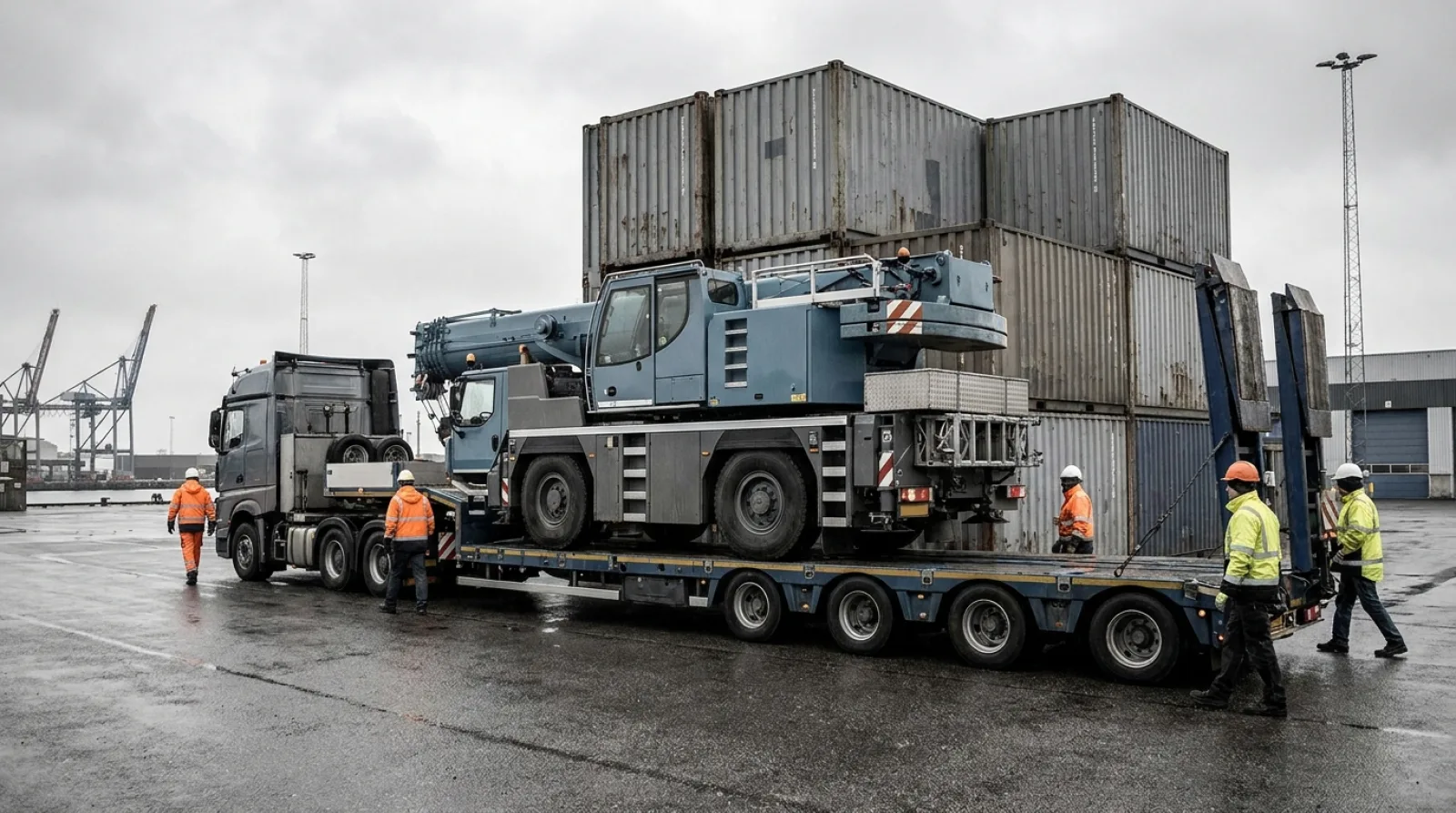
Transporting and importing a mobile crane (German: Mobilkran) from the United Kingdom to the European Union involves customs clearance under CN code 8426 41 and moving machinery typically weighing between 20 and 100 tonnes. Due to weight limits, transport usually requires disassembly, with the largest units travelling divided across several transport sets with counterweights carried on separate vehicles.
How is a mobile crane collected from a UK auction site?
Purchasing heavy machinery at British industrial auctions requires organising collection directly from the auction yard. A mobile crane generally falls into a total weight range of 20 to 100 tonnes. Before moving the chassis, the technical condition of the axles, tyres, and overall dimensions must be checked. Collection schedules and site access conditions depend on the rules specified in the exhibitor manual or the terms and conditions of the auction house.
Moving heavy equipment from the UK to continental Europe requires complete commercial and technical documentation. Machines leaving the UK customs territory must be declared through the UK customs system and cleared upon entry into the European Union. Because of axle load restrictions on public roads, transporting multi-axle crane chassis often requires route permits for abnormal loads, ensuring safe crossing across bridges and road infrastructure.
Why is disassembly necessary when transporting a mobile crane?
Mobile cranes feature a compact wheel chassis, but their full working setup significantly exceeds standard road axle weight limits. Consequently, standard transport procedures require removing auxiliary equipment. The largest units travel divided across several transport sets, with counterweights loaded onto separate trailers. Removing ballast blocks, fly jibs, and hook blocks lowers the base chassis weight to acceptable road levels.
Dividing the machinery across multiple transport vehicles requires precise logistical coordination. Every component, including counterweights and boom sections, must be assigned the correct tariff code and matched to the transport documentation. Reassembly at the destination site must follow manufacturer guidelines, and the time required depends on the specific crane model.
How to organise the import of a mobile crane step by step?
- Verification of auction terms and documentation. Obtain technical specification sheets and check collection deadlines stated in the auctioneer handbook.
- Weight assessment and haulage planning. Determine whether the crane chassis weighing between 20 and 100 tonnes needs counterweights removed for transport.
- Customs declaration preparation. Prepare export and import documentation using CN code 8426 41 for UK departure and EU entry.
- Route planning and permit acquisition. Select low-loader trailers and secure abnormal load permits based on axle loads.
- Collection and loading in the UK. Collect the machine from the auction yard, load counterweights onto separate trailers, and secure the cargo.
- Delivery and customs finalisation. Transport the equipment to the EU destination and finalize the clearance procedures.
Definitions
- CN (Combined Nomenclature): An eight-digit goods classification system used within the European Union for customs and statistical purposes.
- Mobile crane: A wheeled lifting machine mounted on its own truck chassis or special carrier, designed for heavy lifting and assembly work.
- Counterweight: Removable ballast weights mounted on the crane superstructure to provide stability during lifting operations.
- EORI (Economic Operators Registration and Identification): A unique identification number used by businesses when dealing with customs authorities across the EU and UK.
Checklist for mobile crane import and transport
- Obtain purchase invoices and machine technical sheets from the seller.
- Verify total weight and confirm if counterweights must be removed.
- Classify the equipment under CN code 8426 41.
- Ensure active EORI registration for UK and EU customs filing.
- Confirm collection times based on the auction conditions.
- Arrange appropriate low-loader trailers and route permits for transit.
When do these transport and clearance rules not apply?
The rules described here do not apply to equipment moved strictly within the customs territory of the European Union without crossing external borders. Customs requirements depend on the origin of the equipment and its customs status at the time of purchase. These rules also do not apply to crawler cranes classified under different tariff headings, unless specific trade agreements apply.
The OTSL role
OTSL Sp. z o.o., operating from Kielce in Poland with warehouse facilities in Milton Keynes, United Kingdom, manages international machinery haulage. We offer services including machinery transport and customs coordination. For further background on heavy machinery movements, read about farm machinery transport concepts. We support machinery movements from UK auction yards to EU locations. See also: Transport and Import of Plate Compactors and Rammers from the UK and Tower Crane Transport and Import from the United Kingdom. See also: Transport and Import of Mobile Elevating Work Platforms from the UK.